How to Prepare for the NCLEX-PN for Practical Nurses
A complete NCLEX-PN study guide covering exam structure, high-yield clinical topics, question strategy, and the best resources for LPN candidates.
Table of Contents
- How the NCLEX-PN Differs From the NCLEX-RN
- High-Yield Clinical Content for NCLEX-PN
- Pharmacology: The Content You Cannot Skip
- Medical-Surgical Nursing: The Core Clinical Content
- Mental Health Content
- Question Strategy: The Skill That Transfers to Every Item
- Always Identify What the Question Is Really Asking
- Use ABC and Maslow as Decision Frameworks
- Eliminate and Reason, Don't Just Guess
- The Two-Pass Approach for Long Exams
- Building Your NCLEX-PN Study Plan
- Using Spaced Repetition for NCLEX-PN Prep
- What to Do on Exam Day
- The Bottom Line
If you’re approaching the NCLEX-PN, you already know it’s not a typical exam. It’s not about memorizing a thousand facts and regurgitating them on a multiple-choice test. It’s a computerized adaptive exam that adjusts to your performance in real time, and it’s testing something more nuanced than factual recall: clinical judgment.
That distinction matters enormously for how you prepare. Students who treat the NCLEX-PN like a content exam, studying endlessly and hoping that sheer volume of information will get them through, often struggle. Students who understand what the exam is actually testing, and build their preparation around that, tend to do significantly better.
This guide walks you through exactly what you’re up against, how the PN exam differs from the RN board exam, the highest-yield clinical content you need to prioritize, and the question strategies that make the biggest difference on test day.
How the NCLEX-PN Differs From the NCLEX-RN
If you’ve been studying alongside RN students or using RN resources, it’s important to understand that these are genuinely different exams with different scopes of practice.
The NCLEX-RN tests for entry-level registered nursing practice. The NCLEX-PN tests for licensed practical nursing, which has a distinct, more supervised scope. The PN works under the direction of a registered nurse, advanced practice provider, or physician. They don’t initiate care independently in the same way an RN does.
This has direct implications for how questions are written and what answers are correct:
- An RN question might test your independent clinical decision-making. A PN question more often tests your understanding of when to report to or collaborate with a supervising provider.
- Initial assessments and care planning questions are more likely to be answered differently for PN candidates, since these tasks often fall outside the LPN scope.
- Medication administration, basic wound care, and stable patient monitoring are squarely within PN scope, so these show up frequently and in depth.
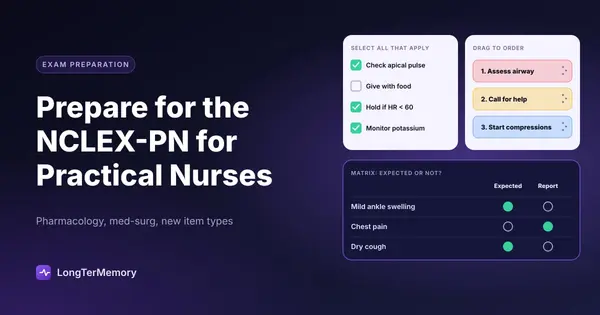
The exam format uses Next Generation NCLEX (NGN) item types, which means you’ll encounter more than just standard multiple-choice. You may see:
| NGN Item Type | What It Tests |
|---|---|
| Multiple response | Selecting all that apply (no partial credit) |
| Drag and drop | Ordering nursing actions or matching items |
| Hot spot | Identifying findings on an image or chart |
| Drop-down | Completing a sentence or table from given options |
| Matrix/Grid | Analyzing multiple data points together |
| Bow-tie items | Recognizing conditions, actions, and outcomes together |
These item types are designed to assess clinical judgment more than factual knowledge. They simulate the kind of thinking you’d actually use in a clinical setting. That’s why practicing with NGN-style questions is not optional, it’s central to how you prepare.
High-Yield Clinical Content for NCLEX-PN
The NCLEX-PN is organized around four major client needs categories. Knowing the approximate weight of each helps you allocate your study time:
| Category | Approximate Weight |
|---|---|
| Safe and Effective Care Environment | 21-33% |
| Health Promotion and Maintenance | 6-12% |
| Psychosocial Integrity | 9-15% |
| Physiological Integrity | 38-62% |
Physiological Integrity is the largest category and the one most candidates spend the most time on. Within it, pharmacology and basic care are particularly important.
Pharmacology: The Content You Cannot Skip
Medication questions appear throughout the exam. You do not need to memorize every drug in a pharmacology textbook, but you need to understand:
- Drug classifications and their general effects (beta-blockers, diuretics, antibiotics, antidepressants, anticoagulants)
- High-alert medications: insulin, heparin, anticoagulants, opioids, digoxin
- Safe medication administration: the five rights, checking allergies, identifying incompatible IV combinations
- Expected vs. adverse effects: what to monitor, when to withhold, when to call the provider
- Client education for common medications: especially for chronic conditions like hypertension, diabetes, and COPD
For pharmacology, flashcards with spaced repetition are among the most efficient tools available. Creating a card per drug class, with the mechanism, common examples, key side effects, and nursing considerations, builds exactly the kind of retrievable knowledge the exam tests.
Medical-Surgical Nursing: The Core Clinical Content
Conditions that commonly appear in NCLEX-PN questions include:
- Cardiovascular: heart failure, hypertension, myocardial infarction, arrhythmias
- Respiratory: COPD, asthma, pneumonia, pulmonary embolism
- Endocrine: diabetes (Type 1 and 2, DKA, hypoglycemia), thyroid disorders
- Neurological: stroke, seizures, increased intracranial pressure
- Genitourinary: urinary tract infections, chronic kidney disease, catheter care
- Musculoskeletal: fractures, compartment syndrome, cast care, traction
- Skin and wounds: pressure injury staging, wound care principles
For each condition, know the key assessment findings, priority nursing interventions, and when to escalate. The exam is not asking you to diagnose. It’s asking you what a practical nurse does with a patient who has this condition.
Mental Health Content
Psychosocial integrity questions often trip up students who haven’t studied mental health systematically. High-yield topics include:
- Therapeutic communication: what to say and, importantly, what not to say
- Safety priorities: suicide assessment, restraint use, fall precautions
- Major mental health conditions: depression, bipolar disorder, schizophrenia, anxiety disorders, personality disorders
- Substance use and withdrawal: alcohol withdrawal (and its life-threatening progression), opioid withdrawal
- Crisis intervention: de-escalation principles, immediate safety actions
Mental health questions often involve selecting the best nursing response from options that all sound reasonable. This is where understanding therapeutic communication principles becomes a differentiator.
Question Strategy: The Skill That Transfers to Every Item
Here’s something many students don’t fully appreciate: how you approach questions is a learnable skill, and it’s almost as important as content knowledge.
Always Identify What the Question Is Really Asking
Before looking at the answer choices, read the question stem carefully and ask: what is this question testing? Is it asking what to do first? What to report? What to teach the client? What the priority nursing action is?
The stem usually contains a clue. Words like “first,” “priority,” “immediately,” and “most important” signal that you’re selecting from a set of actions that might all be correct but one is more urgent.
Use ABC and Maslow as Decision Frameworks
When priority questions stump you, two frameworks do most of the work:
ABCs (Airway, Breathing, Circulation) determine which patient gets seen first and which intervention is done first. Airway concerns almost always take priority over everything else.
Maslow’s Hierarchy helps when you’re comparing physiological needs against psychosocial ones. A patient who says they’re scared is important. A patient whose oxygen saturation is dropping is more urgent.
Eliminate and Reason, Don’t Just Guess
When you’re unsure, eliminate the obviously wrong options first, then reason through what remains. Often you can narrow to two options and reason about which one better fits the scope of PN practice, the clinical condition, or the principle the question is testing.
Don’t overthink “select all that apply” items. These are testing whether you know what’s true, not trying to trick you with complex logic. If something is clinically accurate in the context of the question, include it. If it’s not, don’t.
The Two-Pass Approach for Long Exams
If you’re taking a practice exam, use two passes. Answer confidently first, flag anything uncertain, and keep moving. On the second pass, revisit flagged items with fresh eyes. Don’t second-guess clear answers from the first pass, but do reconsider flagged items more carefully.
On the actual NCLEX-PN, you cannot go back after confirming an answer, so this strategy applies more to your practice exams, where building the habit of moving forward rather than stalling pays dividends in exam confidence.
Building Your NCLEX-PN Study Plan
The structure of your preparation matters as much as the content you cover. Here’s a framework that works for most candidates:
Weeks 1-4: Content foundation Focus on high-yield systems: cardiovascular, respiratory, endocrine, and neurological. Work through pharmacology by class. Use a reputable NCLEX-PN review book to ensure you’re covering the right scope.
Weeks 5-8: Practice questions and gaps Start doing practice questions daily, minimum 75 per day. After each question, review the rationale for every answer, including the ones you got right. Understanding why a correct answer is correct matters as much as knowing which answer is wrong.
Keep a running log of topics where you’re getting questions wrong. Those become your priority content review.
Final 2 weeks: Mixed practice and simulation Take full-length practice exams under timed conditions. Simulate the real experience as closely as possible. After each practice exam, review rationales and add any new gaps to your content review.
The night before the exam: light review only. Your brain needs rest more than it needs one more run through pharmacology. Prioritize sleep.
Using Spaced Repetition for NCLEX-PN Prep
One of the most efficient investments you can make for NCLEX-PN preparation is building a strong flashcard system early, and reviewing it every single day.
LongTerMemory lets you generate Q&A pairs from your study materials, including PDF review guides and textbook chapters, and schedules those flashcards using spaced repetition. Instead of reviewing everything each day (which isn’t sustainable), the system surfaces the cards you’re most likely to forget before you forget them.
For NCLEX-PN prep, this is particularly useful for:
- Pharmacology: drug classifications, effects, and nursing considerations
- Normal vs. abnormal lab values (hemoglobin, potassium, sodium, INR, etc.)
- Standard reference ranges and critical values to report immediately
- NCLEX-specific terminology (delegation, scope of practice, priority frameworks)
The key with spaced repetition for boards prep is to start early enough that your cards have time to consolidate. Building your deck during content review, rather than cramming cards in the final two weeks, means you enter the final stretch with well-consolidated knowledge rather than fresh-but-fragile recall.
What to Do on Exam Day
A few practical notes for the day itself:
Get there early. NCLEX testing centers have strict check-in procedures. Arriving stressed and rushed is a disadvantage you can completely avoid.
Trust your preparation. Second-guessing yourself during the exam is one of the most common ways prepared candidates underperform. If you’ve been studying consistently and doing practice questions, your first instinct on most questions is more reliable than you think.
Breathe between questions. The adaptive nature of the NCLEX-PN means you’ll get harder questions when you answer correctly. A suddenly difficult question doesn’t mean you’re failing, it means the system is adjusting. Maintain your process.
Don’t interpret the length as failure. The NCLEX-PN can end anywhere between 85 and 150 questions for most candidates. A shorter exam doesn’t guarantee a pass, and a longer exam doesn’t guarantee a fail. Both are in the normal range. Focus on answering each question to the best of your ability and don’t try to infer your performance from how many questions you’ve seen.
The Bottom Line
The NCLEX-PN is a genuinely challenging exam, but it’s a fair one. It’s testing the clinical judgment and knowledge that a safe, entry-level practical nurse actually needs. If your preparation builds real understanding of nursing priorities, pharmacology fundamentals, and patient safety, rather than surface-level memorization, you’ll be well positioned.
Study consistently. Do a lot of practice questions. Review every rationale. Use tools like spaced repetition to keep your pharmacology and lab values sharp. And when you sit down at that computer, trust that you’ve built what you need to demonstrate.
You’ve come a long way to get to this point. The NCLEX-PN is one more step.