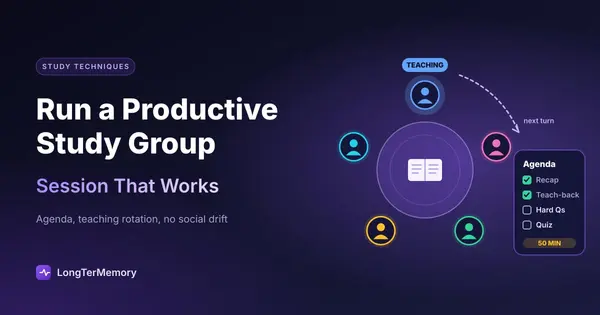
How to Run a Productive Study Group Session
Discover how to set agendas, run peer teaching rotations, and keep your study group focused so every session actually moves the needle.
Table of Contents
- Setting an agenda before every study group session
- The five-minute agenda template that saves fifty minutes
- How to distribute prep work so no one shows up empty-handed
- What to do when the agenda gets blown up by a hard problem
- Peer teaching rotations: who explains what and when
- Rotation formats that actually work
- Handling the "expert" problem in mixed-ability groups
- Keeping the group on task when social drift sets in
- Spotting the drift before it kills the session
- The role of a timekeeper (and why it should rotate)
- When to officially call a break versus push through
- Making the most of your group time
Study groups are one of those ideas that sound perfect in theory and fall apart in practice. You picture a room of motivated students drilling practice problems, correcting each other’s misconceptions, and walking out feeling like geniuses. What you usually get is three people staring at a textbook, one person dominating the conversation, and a thirty-minute detour into a debate about last night’s TV episode. By the end, everyone agrees the session was “helpful,” but nobody can point to exactly what got done.
It does not have to be this way. Productive study groups exist, and they are not the result of luck or unusually disciplined friends. They are the result of a few specific structures that keep the group focused, fair, and actually useful. This post covers the three structures that matter most: setting a clear agenda before every session, running peer teaching rotations so everyone learns deeply, and catching social drift before it wrecks your time.
Setting an agenda before every study group session
A productive study group starts before anyone sits down. The single biggest predictor of whether your session will actually move the needle is whether someone sent an agenda at least a few hours in advance. Not a vague text like “we should review chapter 5,” but a specific, time-bound plan that tells everyone exactly what to prepare and what you will cover.
The five-minute agenda template that saves fifty minutes
You do not need a formal project management tool. A simple shared note or group message works fine. The key elements are:
- Start and end times: Respect people’s schedules by committing to a hard stop.
- Prep work: Each person should know what to review before arriving.
- Topic list: Break the session into specific chunks, not broad subjects.
- Time allocations: Assign realistic time boxes to each chunk.
- One priority outcome: Define what success looks like for this session.
Here is what that looks like in practice for a ninety-minute organic chemistry session:
| Time | Activity | Owner |
|---|---|---|
| 0:00-0:05 | Quick check-in and recap of prep | Everyone |
| 0:05-0:25 | Peer teaching: thermodynamics laws | Alex |
| 0:25-0:45 | Peer teaching: entropy and Gibbs free energy | Jordan |
| 0:45-1:05 | Practice problem set 3B, problems 1-4 | Everyone |
| 1:05-1:15 | Review answers and clarify confusion | Group |
| 1:15-1:20 | Plan next session and assign prep | Everyone |
This agenda took about five minutes to write, but it saves far more than that during the session itself. Without it, groups waste the first ten minutes figuring out what to do, the middle twenty minutes going in circles, and the final ten minutes pretending they are done.
The priority outcome is the most underrated element on that list. It should be one sentence that answers the question: if we only accomplish one thing today, what should it be? Examples include “everyone can explain the three laws of thermodynamics without notes,” or “we finish problem set 3B and agree on the correct answers.” Having this visible prevents the group from feeling productive while actually accomplishing nothing specific.
How to distribute prep work so no one shows up empty-handed
The agenda only works if people actually do the prep. The easiest way to ensure this is to assign specific prep tasks to specific people. Instead of telling everyone to “read chapter 5,” tell Alex to outline the first half, tell Jordan to outline the second half, and tell Sam to bring three practice problems they found confusing.
This distributed prep model does two things. First, it lowers the individual workload. Second, it creates peer teaching opportunities automatically, because the person who prepped a section is naturally positioned to explain it.
A realistic example: in a medical school study group preparing for anatomy, one person might prep the brachial plexus, another the radial nerve pathways, and another the common clinical correlates. Each person spends twenty minutes on their section instead of an hour on everything, and the group covers more ground in less time.
If someone shows up unprepared despite the assignment, do not shame them. Instead, have them take notes while someone else teaches the section they were supposed to prep. This keeps them engaged and gives them a concrete task, rather than letting them sit silently while the group moves on without them.
What to do when the agenda gets blown up by a hard problem
Sometimes you hit a problem so confusing that the group needs to spend forty-five minutes on something allocated fifteen minutes. This is normal. The solution is not to rigidly enforce the agenda at the expense of understanding. The solution is to make a conscious decision to pivot.
If you are falling behind, pause at the twenty-minute mark and ask: “Do we keep going on this, or do we table it and move on?” If the majority needs more time, reallocate time from a later agenda item rather than letting the whole session drift. Conscious tradeoffs are productive. Unconscious drift is not.
One helpful tactic is the parking lot. Keep a running list of questions and topics that deserve attention but do not fit the current agenda. When the group goes down a rabbit hole, ask whether the topic belongs in the parking lot or whether it is critical to today’s priority outcome. If it is not critical, write it down and return to the plan. This single habit can recover twenty to thirty minutes of lost time per session.
Peer teaching rotations: who explains what and when
Peer teaching, also called the protégé effect, is the practice of having students teach material to each other. Research consistently shows that students who teach others retain information longer and understand it more deeply than students who simply review the same material alone. A 2014 study published in Memory & Cognition found that learners who expected to teach a passage performed significantly better on retention tests than those who expected only a test.
This is part of why active recall and retrieval practice are so effective. If you want to understand the full mechanism, our article on how the testing effect improves your active learning breaks down the research in detail.
In a study group context, this means your most valuable activity is not collectively re-reading notes. It is having each member explain a topic to the others, field questions, and defend their understanding.
Rotation formats that actually work
Not every group has the same size or the same dynamic, so the format should match the group. Here are three structures that work consistently:
Format 1: The Round Robin Each person takes a ten-minute turn explaining a pre-assigned topic. The group asks clarifying questions. This works best for groups of three to five people covering discrete topics. The risk is that one confident person might run over time or turn their ten minutes into a lecture.
Format 2: The Panel Two people co-teach a topic while the others take notes and ask questions. This works well for complex material where one person might not feel confident enough to teach alone. The panel format also reduces the social pressure on any single individual.
Format 3: The Reverse Quiz One person presents a topic, then the group quizzes them on it. The quiz questions force the presenter to think about edge cases and applications they might have missed. This format is especially powerful in the week before an exam, because it closely mimics the retrieval demands of the test itself.
| Format | Group Size | Best For | Risk to Watch |
|---|---|---|---|
| Round Robin | 3-5 | Discrete topics, equal prep time | One person dominates the time |
| Panel | 4-6 | Complex or intimidating material | Both presenters defer to each other |
| Reverse Quiz | 3-4 | Deep retention, exam prep | Quizzes can feel adversarial if tone is wrong |
Choose the format in advance and stick to it. Switching formats mid-session creates confusion and gives the group an excuse to socialize instead of engaging. If you are not sure which format fits your group, start with Round Robin. It is the easiest to explain and the hardest to derail.
Handling the “expert” problem in mixed-ability groups
Every study group has someone who knows the material better than everyone else, and someone who is struggling to keep up. This is not a bug. It is an opportunity, but only if you manage it well.
The expert should not monopolize every teaching rotation. Instead, assign them the hardest topics, or pair them with a struggling student in a panel format. The struggling student should be assigned foundational topics, not because they are easy, but because teaching foundational material is often the fastest way to solidify it.
Here is a practical rule: the person who understands the topic least should teach it first. This sounds counterintuitive, but it works. Their explanation will surface gaps and misconceptions that the expert would have glossed over. The expert can then correct and refine the explanation, which deepens their own understanding too. Everyone wins.
If the gap is so large that the struggling student genuinely cannot prepare a ten-minute explanation, shorten the rotation to five minutes and let them lead the first half while the expert finishes. The key is that they are actively engaged in explanation, not just passive note-taking. Research on collaborative learning consistently shows that passive members of a group learn far less than active participants, even when the active participants are not particularly skilled.
Keeping the group on task when social drift sets in
Even with a perfect agenda and well-designed teaching rotations, study groups drift. Someone tells a story about their weekend. Someone else pulls out their phone to look up a vaguely related video. Ten minutes later, nobody remembers what you were talking about. Social drift is the silent killer of productive study groups, and ignoring it does not make it go away.
Spotting the drift before it kills the session
The best time to correct drift is before it fully takes hold. Watch for these early warning signs:
- Topic creep: The conversation shifts from the assigned material to something adjacent but easier to discuss.
- Phone checks: When one person checks their phone, others follow within sixty seconds.
- Joke spirals: One funny comment leads to another, and suddenly everyone is performing instead of studying.
- The “quick question” that is not: Someone asks a tangential question that opens a twenty-minute rabbit hole.
When you notice these patterns, the group needs a gentle reset. Do not shame anyone. Just say something like, “This is fun, but we are running behind on the practice problems. Should we park this conversation for after the session?” Most people will be grateful for the redirect. They were probably drifting too, and your intervention gives them permission to refocus without looking like the rigid one.
The role of a timekeeper (and why it should rotate)
One of the most effective anti-drift tools is a designated timekeeper, but there is a catch. If the same person always plays timekeeper, they become the group’s parent, which breeds resentment and ruins the social dynamic. Instead, rotate the role every session.
The timekeeper’s job is simple: keep the agenda visible, announce transitions between topics, and flag when the group is running over. They are not the boss. They are the referee. A good timekeeper says, “We have two minutes left on thermodynamics, then we move to practice problems,” rather than, “You guys need to focus.”
This small structural intervention prevents the awkward dynamic where everyone knows the group is drifting but nobody wants to be the one to say it. The timekeeper gives the group permission to be disciplined without anyone having to feel like the bad guy.
Some groups find it helpful to add a visible timer on a laptop or phone screen that everyone can see. The physical presence of a countdown creates ambient urgency that reduces the need for verbal corrections. When people can see that twelve minutes remain in the current block, they naturally wrap up their thoughts instead of launching into new ones.
When to officially call a break versus push through
Here is a counterintuitive fact: scheduled breaks reduce social drift, while improvised breaks increase it. When the group knows a break is coming in twenty minutes, they can postpone the urge to check their phone or tell a story. When there is no break scheduled, those impulses leak into the session continuously.
A good structure is the Pomodoro-style block: fifty minutes of focused work followed by a ten-minute break. During the fifty minutes, the group commits to single-tasking. During the ten-minute break, people can talk about whatever they want. The boundary is what matters.
If someone needs a break before the scheduled time, make it an official group break rather than letting them quietly disengage. Say, “Jordan needs a quick reset, so let us all take five and come back at 2:35.” This keeps the group together and prevents the slow fragmentation that happens when people start leaving and returning on individual schedules.
The push-through versus break decision also applies to energy levels. If the entire group is visibly fried, pushing through is usually a mistake. Productivity per minute drops sharply after about fifty minutes of intense focus for most people. A ten-minute break can restore performance to near-baseline levels, while continuing without a break yields diminishing returns and increased error rates.
Making the most of your group time
Study groups are not inherently productive or unproductive. They are a tool, and like any tool, their usefulness depends on how you wield them. The students who get the most value from group study are the ones who treat it with the same intentionality they would bring to a solo session, maybe even more, because group time involves coordination costs that solo time does not.
The agenda gets you aligned. The peer teaching rotations get you learning actively instead of passively reviewing. The anti-drift structures keep the session from dissolving into a hangout. Together, these three systems transform the study group from a social obligation into a genuine force multiplier for your learning.
There is one more piece that can multiply your results even further: what happens between sessions. The best study group in the world will not help you if you forget everything you learned by next week. That is where spaced repetition comes in. Instead of relying on memory alone, you need a system that surfaces the right material for review at the right interval. Our guide on the science of spaced repetition explains exactly why this works and how to build it into your routine.
If you are still building flashcards by hand after every study group, you are spending time on formatting that could go toward actual learning. LongTerMemory takes your study materials, whether they are PDFs, web articles, or uploaded notes, and automatically generates flashcards from them. It then schedules those cards using an optimized spaced repetition algorithm, so you are always reviewing the concepts that are closest to fading from memory.
Students who switch from manual flashcard creation typically save 3 to 5 hours per week on card production and scheduling. Those hours go back into studying, sleeping, or actually having a life outside the library. You can run your LongTerMemory review between study group sessions the same way you would run any other review block, except the system decides what to show you, so you never waste time on material you already know cold.
Study groups give you the social accountability and the deep processing that solo study often lacks. Pair that with a system that locks the material into long-term memory, and you have a combination that is genuinely hard to beat. Build the agenda, run the rotations, guard against drift, and let the software handle the scheduling. That is how you turn a study group from a nice idea into a competitive advantage.