How to Use Reddit and Forums for Certification Exam Tips
Learn which subreddits and forums hold the best certification exam tips, how to ask questions that get real answers, and how to spot bad advice fast.
Table of Contents
- The best subreddits and forums for major professional certifications
- How to ask effective questions in certification communities
- Evaluating exam advice from strangers: red flags and green flags
- Green flags (advice worth acting on)
- Red flags (advice to ignore or verify heavily)
- Turning forum tips into an actual study system
- Conclusion
- FAQ
- Are Reddit certification tips reliable enough to plan around?
- What are the best forums for IT certifications besides Reddit?
- Is it against the rules to discuss exam content on forums?
- How much time should I spend in certification forums while studying?
Every professional certification exam has a hidden study guide, and it isn’t sold by any prep company. It’s the accumulated, brutally honest experience of thousands of people who just sat the same exam you’re about to sit, hanging out in subreddits and certification forums, posting things like “the real exam was nothing like the practice tests” and “here’s exactly what I would skip if I started over.”
I’ve used these communities for every certification I’ve prepared for, and the pattern is always the same: the official study materials tell you what the exam covers, but the forums tell you what the exam feels like, where people actually fail, and which resources are worth the money. That’s information no publisher will ever give you, because they have a product to sell and a stranger on r/CISSP at 11 PM does not.
I already wrote a general guide on using Reddit for exam preparation research, so this post goes narrower and deeper: certification exams specifically, the forums that exist outside Reddit (which most people never find), how to ask questions that actually get answered, and a red flag / green flag framework for deciding whose advice to trust. Let’s get into it.
The best subreddits and forums for major professional certifications
The core answer: every major certification has one or two dominant communities, and the best strategy is to find the exam-specific community first (Reddit or a dedicated forum), then add one broader professional community for context. Lurk for two weeks before you post anything.
Reddit gets most of the attention, but some of the richest certification knowledge lives on old-school dedicated forums that have been running for fifteen or twenty years. These forums tend to have stricter moderation, longer and more detailed posts, and members who have been through multiple recertification cycles. Here’s where I’d start, depending on your certification area:
| Certification area | Reddit communities | Dedicated forums |
|---|---|---|
| IT and security (CISSP, CompTIA, CCNA) | r/cissp, r/CompTIA, r/ccna | TechExams forums, Infosec community boards |
| Cloud (AWS, Azure, GCP) | r/AWSCertifications, r/AZURE | Official AWS and Microsoft Learn community forums |
| Project management (PMP, CAPM) | r/pmp, r/projectmanagement | PMI community forums |
| Nursing (NCLEX, CCRN) | r/NCLEX, r/nursing | allnurses.com |
| Medicine (USMLE, specialty boards) | r/step1, r/Step2, r/medicalschool | Student Doctor Network |
| Finance (CFA, CPA, CMA) | r/CFA, r/CPA | AnalystForum, Another71 |
| Law (bar exam) | r/LawSchool, r/barprep | Top Law Schools forums |
| HR (SHRM, PHR) | r/humanresources, r/AskHR | SHRM Connect community |
A few things worth knowing about this landscape.
Dedicated forums often beat Reddit for depth. Student Doctor Network has threads about USMLE study schedules that run to hundreds of replies over several years, with attendings weighing in. allnurses has NCLEX debriefs from people who took the exam that week, broken down by question type and content area. These threads get indexed by search engines, so a plain Google search like “NCLEX 85 questions passed site:allnurses.com” often beats searching Reddit’s own search bar, which is notoriously mediocre.
Official vendor communities are underrated for logistics. Nobody on the Microsoft Learn forums will tell you their honest feelings about exam difficulty (employees read those threads), but they are the fastest source for factual answers about exam scheduling, retake policies, question format changes, and voucher issues. Use them for facts, use Reddit for feelings.
Niche certifications have tiny but mighty communities. Studying for the CPCU, the LEEP Green Associate, or an actuarial exam? The subreddit might have 800 members, but those 800 people are exactly the ones who’ve taken your obscure exam. A small, focused community of 500 people who all passed the same test is worth more than a general study community of 500,000.
One warning about the dedicated forums: many have a “verified” or long-tenure culture where drive-by questions get ignored. Read the pinned posts and the FAQ wiki first. On r/pmp and r/CFA especially, there are wiki pages with curated study plans that represent thousands of hours of community consensus. Start there.
How to ask effective questions in certification communities
The core answer: specific questions with context get useful answers; vague questions get ignored or mocked. The communities that know the most are also the most impatient with “just passed, any tips?” posts that have been asked four thousand times.
Here’s the formula I’ve seen work across r/CISSP, AnalystForum, Student Doctor Network, and everywhere else. A good forum question has four parts:
- Your situation: where you are in prep, how much experience you have in the field, and your timeline. “Week 6 of a 10-week plan, 3 years of security experience, exam in 4 weeks” gives people everything they need to calibrate advice.
- What you’ve already done: resources you’ve used, scores you’re hitting on practice exams, and what you’ve tried. This prevents fifteen people from recommending the book you already read.
- The specific decision you’re facing: not “how do I study” but “my Boson practice scores are stuck at 68%, should I push my exam date back or add a second question bank?”
- What you’ve searched already: “I read the wiki and searched for ‘Boson vs actual exam’ but most threads are from 2023, has anything changed?” This single sentence transforms how a community treats you, because it signals respect for their time.
Compare these two posts:
- Bad: “Taking CISSP next month, any tips? What should I study?” (Gets: silence, or “read the wiki.”)
- Good: “CISSP in 4 weeks. Scoring 72 to 78% on Boson, weakest in Domain 1 (risk management frameworks). 5 years IT, 2 years security-adjacent. Read the wiki’s study plan. Question: at my score level, is the last month better spent drilling Boson wrong answers or switching to the official practice tests?” (Gets: detailed, calibrated answers from people who just passed.)
A few more tactical tips:
- Search before posting, and say that you did. Most exam-specific subreddits have the same ten questions asked weekly. Searching first isn’t just polite, it often answers your question instantly from threads with 200 replies.
- Ask one question per post. Multi-part questions get partial answers. If you have three questions, post three times over a week.
- Give back after your exam. Write a debrief post. The certification community runs on this reciprocity loop: people share because others shared before them. Your “just passed, here’s what the exam was actually like” post is the content that keeps the whole ecosystem useful. It’s also a great memory consolidation exercise, since explaining what worked forces you to reflect on your own process.
- Don’t ask for exam dumps or “real questions.” Beyond the ethical problem, this violates the NDA you sign for almost every certification exam (ISC2, PMI, and CompTIA all explicitly prohibit it) and can get your certification revoked. Communities that tolerate dump discussions are not communities whose advice you want.
One underused trick: DM the people who wrote great debrief posts. Someone who posted a detailed “passed the CCRN last week” write-up has already demonstrated they like helping. A short, specific message (“Your post mentioned X, I’m in a similar spot, did you do Y or Z?”) gets a surprisingly high response rate, and you’ll get advice tailored to your exact situation instead of crowd-averaged advice.
Evaluating exam advice from strangers: red flags and green flags
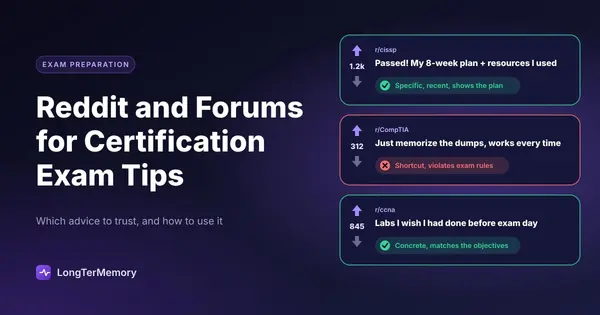
The core answer: trust advice that is specific, recent, caveated, and corroborated; distrust advice that is absolute, dated, product-pushing, or contradicted by the community consensus. Certification forums are full of genuine gold and full of confident nonsense, often from the same accounts.
This matters more for certifications than for academic exams, because the stakes are higher (a failed PMP attempt costs $555 and months of your life) and the incentives are murkier (every certification has an industry of prep providers astroturfing forums). Here’s the framework I run every piece of forum advice through.
Green flags (advice worth acting on)
- Specific numbers and timelines: “I scored 61% on my first Boson exam, 74% average by exam week, passed with a month of prep” beats “Boson is great.” Specificity is expensive to fake and easy to check against other reports.
- Recency: the post is from within the last 6 to 12 months. Exams change. CISSP went adaptive in 2021, PMP overhauled its content outline in 2021, NCLEX launched the Next Generation format in 2023. Advice from before a format change is historical trivia, not guidance.
- Acknowledged trade-offs: “This course worked for me, but the practice questions are easier than the real thing” is what honest experience sounds like. Real people complain about the tools they recommend.
- Corroboration across threads: when fifteen unrelated passers over two years all say “the official practice exam is the single best predictor,” that consensus is more reliable than any individual post, including this blog post.
- Failure posts: counterintuitively, “here’s why I failed and what I’m changing” posts are often the most educational content in a community. Failure is specific and memorable in a way success isn’t, and there’s no product to sell in a failure story.
Red flags (advice to ignore or verify heavily)
- Absolute claims: “You MUST buy X to pass” or “nobody needs more than two weeks.” Real advice scales with the person; absolutes are usually either marketing or survivor bias.
- Brand-new accounts praising one product: click the username. If the account is three days old and has posted about the same prep course in four different threads, you’re reading an ad.
- Outlier success stories presented as a method: “I passed the CFA with 80 hours of total study” is either exceptional, exaggerated, or missing context (like a finance degree and a quant job). Interesting, but do not build your plan around it.
- Dump-adjacent advice: anyone implying you should memorize leaked questions. Besides the NDA risk, exam vendors actively rotate question banks precisely to punish this strategy.
- Fear-based urgency: “The exam is getting 40% harder next month, buy now.” Check the official vendor’s website. It almost never is.
Here’s a compact version you can screenshot:
| Signal | Green flag | Red flag |
|---|---|---|
| Detail level | Scores, dates, timeline, resources listed | ”Trust me, this worked” |
| Age of post | Within 6 to 12 months | Predates the last exam format change |
| Tone | Caveats and trade-offs | Absolutes and urgency |
| Pattern | Matches community consensus | Lone outlier or repeated product praise |
| Source | Tenured account, exam debrief history | New account, single-product post history |
One more layer: run forum advice through your own practice data. If a community swears that practice scores of 75% predict a pass, and you’re at 60%, that’s actionable signal. Tools that surface your weak areas make this concrete; I use the approach from my post on using AI to analyze your study weaknesses to cross-check what the forums say against what my own recall data shows. Forum consensus tells you what typically matters; your own performance data tells you what matters for you.
Turning forum tips into an actual study system
The core answer: collect forum tips in a single pass at the start of your prep, convert the actionable ones into your study plan, and then get out of the forums until your final two weeks. Otherwise community browsing quietly replaces studying.
This is the failure mode I see most often, and I’ve done it myself: reading certification forums feels like studying. You’re thinking about the exam, absorbing strategy, feeling productive. But scrolling r/CFA at midnight is passive consumption, and the research on passive versus active learning is not kind to it. Karpicke and Roediger’s famous 2008 study found retrieval practice produced around 80% retention after a week versus about 33% for repeated studying of the same material, and Dunlosky and colleagues’ 2013 review ranked practice testing and distributed practice as the two highest-utility techniques out of ten common methods. Nobody’s meta-analysis has ever ranked “reading forum threads about studying” in the top ten.
So here’s the workflow I recommend:
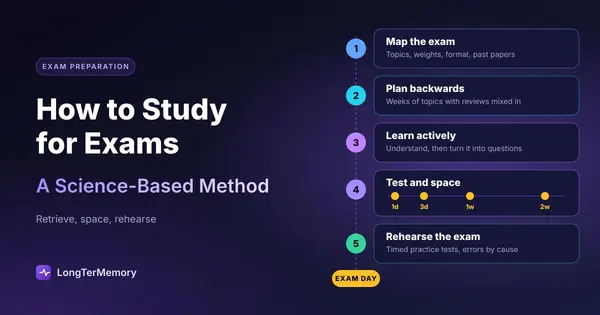
- Week 0 research sprint: spend one focused weekend in your exam’s communities. Read the wiki, the top 20 debrief posts from the last year, and the 10 most common question threads. Take notes in one document.
- Extract decisions, not vibes: from those notes, pull out concrete choices. Which question bank. Which book. What target practice score. What timeline. Which topics people consistently underestimate.
- Build the plan and close the tab: convert those decisions into a schedule, then leave. Set yourself a rule: no certification forums except during your two scheduled check-ins (midpoint and final two weeks).
- Final two weeks: return to the forums with your practice scores in hand. Now your questions are specific (“I’m at X%, here’s my weak domain”) and the community can actually help you fine-tune instead of starting you from zero.
The step where most people lose weeks is step 3, because converting forum advice into flashcards, schedules, and review sessions is pure manual labor. This is honestly where I’ve saved the most time lately: instead of hand-building cards from the “high-yield topics” lists I collected in forums, I drop my PDF study guides and the web pages I saved into LongTerMemory, and it generates Q&A flashcards with automatic spaced repetition scheduling for me. The forum research tells me what to study; the tool handles the how without me spending my evenings formatting cards. If you’re staring at a certification with a 300-page official guide, try it free and see whether it cuts your setup time the way it did mine.
And once you’ve passed, don’t forget the maintenance problem: certifications expire, and the knowledge fades faster than the credential. My post on spaced repetition for certification maintenance covers how to keep the material alive between renewal cycles with about 10 minutes a week.
Conclusion
Reddit and certification forums are the closest thing to a cheat code that certification prep has: thousands of people telling you exactly what the exam was like, what worked, and what they’d skip. But the value only shows up if you use them deliberately. Find the exam-specific community first (Reddit for energy and recency, dedicated forums like TechExams, allnurses, Student Doctor Network, and AnalystForum for depth), ask specific questions with context, filter every piece of advice through the red flag / green flag framework, and then convert what you learn into an active study system instead of an endless browsing habit. Do the two-week lurk, take your notes, build your plan, and go actually study. That’s the part no forum can do for you.
FAQ
Are Reddit certification tips reliable enough to plan around?
Individually, no. Collectively, yes. A single post is anecdote, but when a dozen unrelated recent passers recommend the same resource or warn about the same topic, that consensus is one of the most reliable prep signals available. Use the green flag criteria (specific, recent, caveated, corroborated) to decide what makes it into your plan.
What are the best forums for IT certifications besides Reddit?
TechExams (now part of the Infosec community ecosystem) has deep archives for CISSP, CompTIA, and Cisco exams. Vendor communities like the Microsoft Learn forums and AWS community pages are best for logistics and official policy questions. For cloud certs specifically, the exam-specific subreddits like r/AWSCertifications tend to have the freshest debrief content.
Is it against the rules to discuss exam content on forums?
Discussing your experience, difficulty level, and topic areas is fine. Sharing or requesting actual exam questions (“dumps”) violates the NDA of virtually every certification vendor, including ISC2, PMI, CompTIA, and Cisco, and can result in certification revocation. Stick to communities that enforce this line.
How much time should I spend in certification forums while studying?
Front-load it: one research weekend at the start of prep, then two scheduled check-ins (midpoint and final two weeks). Daily forum browsing feels productive but crowds out the retrieval practice and spaced repetition that actually move your score.