How to Pass the Social Work LCSW Exam
Pass the ASWB Clinical exam for LCSW licensure: content area weights, real pass rate data, vignette strategy, and the best study resources compared.
Table of Contents
- The LCSW exam content areas and their relative weight
- Clinical vignettes in social work: the reasoning approach
- Study resources and practice questions for LCSW candidates
- Conclusion
- FAQ
- How hard is the LCSW exam?
- How many questions are on the ASWB Clinical exam?
- How long should I study for it?
- What is a passing score?
So you’ve finished your MSW, logged your supervised clinical hours, and now there’s exactly one thing standing between you and those four letters after your name: the ASWB Clinical exam. If you’ve been lurking in social work forums, you’ve seen the horror stories. Smart, experienced clinicians failing by a point or two. People on their third attempt.
Here’s the honest picture. The LCSW exam is very passable. The ASWB publishes its own pass rate data, and the 2025 summary shows a 75.7% first-time pass rate for the Clinical exam across 26,439 candidates, according to ASWB’s official exam pass rate page. That means roughly one in four first-timers fails, which is not nothing, but it’s a far cry from the doom narrative. And ASWB’s earlier analysis of 2011 to 2021 data found that about 87.7% of Clinical candidates eventually pass, so persistence works.
The candidates who pass aren’t the ones with the most clinical brilliance. They’re the ones who understood exactly what this exam tests (clinical judgment, not memorized theory), prepped with the question format in mind, and used evidence-based study methods instead of rereading their MSW notes until their eyes bled. This guide covers all three: the exam’s structure and content weights, how to reason through the infamous vignette questions, and an honest comparison of the study resources worth your money.
The LCSW exam content areas and their relative weight
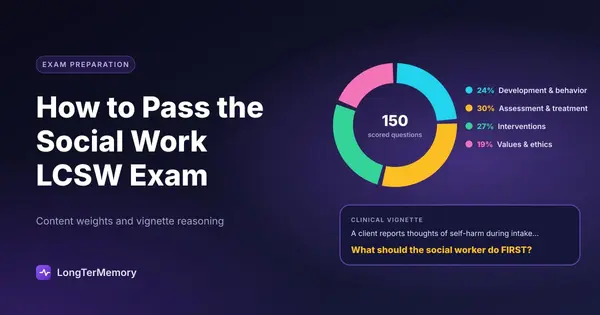
The core answer: the ASWB Clinical exam is a four-hour, computer-based test of 170 multiple-choice questions (150 scored, 20 unscored pretest items) organized into four weighted content areas, with Assessment, Diagnosis, and Treatment Planning carrying the heaviest weight at 30%.
The exam was built on this four-domain blueprint from 2018 through mid-2026, and it’s the structure virtually every prep book and course is organized around:
| Content area | Weight | Scored questions (approx.) |
|---|---|---|
| I. Human Development, Diversity, and Behavior in the Environment | 24% | 36 |
| II. Assessment, Diagnosis, and Treatment Planning | 30% | 45 |
| III. Psychotherapy, Clinical Interventions, and Case Management | 27% | 40 |
| IV. Professional Values and Ethics | 19% | 29 |
A few things to take from this table before you build a study plan:
- Domain II is the single biggest slice. Almost a third of your score lives in assessment, diagnosis (yes, you need to know your DSM criteria and differentials), and treatment planning. If your study time doesn’t reflect that, you’re leaving points on the table.
- Ethics is 19%, not a footnote. Candidates routinely underestimate Domain IV because ethics feels intuitive after years of practice. It isn’t, at least not in ASWB’s framing. The exam tests the NASW Code of Ethics applied with a specific, sometimes rigid logic around confidentiality, informed consent, and mandated reporting.
- Domain I is more than theory trivia. Human development shows up inside vignettes: is this behavior age-appropriate, a sign of pathology, or a culturally normative response? Erikson and attachment theory appear, but usually embedded in a scenario rather than asked directly.
One important update you need to know if you’re scheduling soon: ASWB rolled out a new exam blueprint on August 3, 2026. The updated Clinical exam dropped to 122 questions (110 scored, 12 pretest) and consolidated the four domains into three: Values and Ethics (about 36%), Assessment and Planning (about 32%), and Intervention and Practice (about 32%). The total testing window remains four hours, now with a mandatory break. The content itself didn’t change dramatically; the same competencies were re-bucketed, and ethics became the single highest-weighted area. If you test under the new blueprint, weight your prep accordingly and make sure your practice materials are updated for it.
As for what “passing” means: ASWB uses scaled scoring, and the raw number of correct answers needed to pass varies by form and jurisdiction, generally landing somewhere around 93 to 107 correct out of 150 on the classic blueprint. Don’t fixate on the exact cut score. Fixate on consistently scoring 75% or better on full-length practice exams.
Clinical vignettes in social work: the reasoning approach
The core answer: most ASWB Clinical questions are short clinical vignettes ending in FIRST, NEXT, MOST, or BEST, and the winning strategy is a fixed reasoning order, not more content knowledge. Ask: is anyone unsafe? Then: do I have enough information to act? Then: what is the least intrusive, most client-centered step?
Here’s the frustrating thing about this exam that nobody warns you about: the wrong answers are rarely ridiculous. On a good chunk of questions, you’ll look at the four options and think three of them are things a competent social worker might genuinely do. The exam isn’t testing whether you know what to do. It’s testing whether you know what to do in the order ASWB wants it done.
The reasoning hierarchy that resolves most vignettes:
- Safety first, always. If there’s any indication of danger to self, danger to others, abuse, or neglect, the answer almost always involves addressing that before anything therapeutic. A client mentioning suicidal ideation beats exploring feelings about their divorce, every single time.
- Assess before you intervene. This is the trap ASWB sets most often. An option describing a perfectly valid intervention (referral, confrontation, treatment modality) is wrong because the vignette hasn’t established enough information yet. When in doubt between “do something” and “gather more information,” gather more information, unless safety is at stake.
- Start where the client is. Answers that impose the clinician’s agenda, dismiss the client’s stated goals, or jump past the client’s current readiness are usually wrong. ASWB’s ideal social worker follows the client’s lead within ethical bounds.
- Least intrusive, most direct option. Between a heavy-handed option (hospitalizing, reporting, confronting) and a milder one that still addresses the issue, the milder one wins unless the situation clearly demands escalation.
- The client is the person in front of you. Vignettes love to bait you into treating a family member, colleague, or referring professional as your client. Whoever is sitting in your office (or defined as the client system) is whose interests govern the answer.
Now, how do you actually train this reasoning so it’s automatic on exam day? This is where most candidates go wrong. They read about these rules, nod along, and then freeze when a vignette offers two plausible FIRST steps. The fix is retrieval practice on real question formats, not more reading.
The research here is about as settled as education research gets. Karpicke and Roediger’s landmark 2008 study found that students who practiced retrieval retained around 80% of material a week later versus about 33% for students who reread. Dunlosky and colleagues, in their 2013 review of learning techniques, ranked practice testing and distributed practice as the two highest-utility methods studied. In plain terms: doing practice questions and drilling weak facts on a schedule beats rereading your notes by a wide margin. I’ve written about the mechanics in my posts on active recall techniques and the science of spaced repetition, and the same principles apply perfectly to the LCSW.
Here’s the loop I recommend for vignette training:
- Do timed blocks of 25 to 50 questions from a reputable bank, at exam pace (roughly 90 seconds per question).
- Review every single question, including ones you got right by guessing. For each miss, write down which rule in the hierarchy above you violated. Safety vs. assessment errors are the most common and the most fixable.
- Turn every missed fact into a flashcard the same day: a DSM criterion you confused, an ethics standard you forgot, a development milestone you blanked on. One card, one fact.
- Review those cards with spaced repetition so they resurface right as you’re about to forget them. The Ebbinghaus forgetting curve means a fact you learn today is mostly gone in two weeks without review; spaced repetition flattens that curve into something manageable.
- Narrate vignettes out loud once a week. Explain to an empty room why each wrong option is wrong. If you can’t articulate the reasoning, you don’t own it yet.
That last point about error analysis is what separates repeat test-takers from one-and-doners. “I got it wrong” is not feedback. “I jumped to intervention before assessing” is. If you want to sharpen your overall test-taking instincts beyond content, my post on becoming a better test taker covers pacing, distractor analysis, and answer-changing myths in detail.
Study resources and practice questions for LCSW candidates
The core answer: you need (1) the official ASWB practice exam because it’s the only one built from retired real items, (2) one structured course or question bank that matches your budget and learning style, and (3) a spaced repetition system for the facts the questions expose. Everything else is optional.
The LCSW prep market is crowded and the marketing is aggressive, so here’s a transparent comparison of the options candidates actually use and recommend:
| Resource | Format | Approx. cost | Best for |
|---|---|---|---|
| ASWB Official Practice Exam | One full-length online exam | ~$85 | Non-negotiable baseline; real retired questions |
| Therapist Development Center (TDC) | Audio course + mocks + coaching | ~$275+ per exam | Candidates who learn by listening; strong on reasoning strategy |
| Social Work Test Prep (SWTP) | Online practice exams + rationales | ~$40 to $60 per exam | Affordable volume of realistic questions |
| Pocket Prep | Mobile app question bank | ~$50 to $80 (subscription) | Question reps in spare moments; commute-friendly |
| Agents of Change | Video course + study groups + mocks | ~$200 to $350 | Structured program with community accountability |
| Springer / LEAP print materials | Books and printed practice tests | ~$60 to $150 | Candidates who prefer physical review materials |
A few honest observations from what test-takers consistently report (the r/socialwork community’s exam prep threads are a goldmine of this, and I dug into what Reddit’s data says about prep in that post):
- The ASWB practice exam is the closest thing to the real test because it uses actual retired exam questions. Take it two to three weeks before your exam date, under timed conditions. Your score on it is the best single predictor of exam day.
- No third-party question bank perfectly matches ASWB’s style. Third-party questions tend to be either harder or more fact-heavy than the real thing. That’s fine for training, as long as you don’t panic when a bank scores you lower than the official practice exam does.
- More resources does not mean more passing. The failure pattern I see most often is someone owning four courses, finishing none of them, and doing fewer than 500 practice questions total. Pick one course and one question source, finish them, and spend the saved time on flashcard review of your weak spots.
That last piece deserves emphasis. Notice what’s missing from every row in that table: none of these resources solve the retention problem. A video course tells you the DSM criteria once. A question bank shows you a defense mechanism definition once. Two weeks later, the forgetting curve has eaten half of it. The candidates who consolidate what they learn are the ones running a personal flashcard system alongside their course, reviewing a bit every day.
Building that system by hand is genuinely painful though. A typical LCSW prep generates 800 to 1,500 flashcard-worthy facts (DSM criteria, theoretical orientations, psychopharm basics, ethics standards, development stages), and writing those cards manually eats ten to twenty hours you could spend on questions. This is exactly the bottleneck LongTerMemory was built for: you drop in your PDF study guides, DSM notes, or web resources, and it generates Q&A flashcards with automatic spaced repetition scheduling for you. No card formatting, no scheduling math, just daily reviews that show up when you’re about to forget. If card admin is what’s keeping you from actually starting your prep, try LongTerMemory free and put those twenty hours back into practice questions where they belong.
A realistic timeline, for what it’s worth: most working candidates do well with 8 to 12 weeks of prep at 6 to 10 hours per week. Front-load your weakest domain (usually Domain II content or DSM differentials), take the official practice exam at the two-to-three-week mark, and spend the final stretch on mixed timed blocks plus flashcard maintenance. Don’t cram new material in the last 72 hours; consolidate what you have.
Conclusion
Passing the LCSW exam comes down to three things done consistently. First, know the terrain: four content areas with assessment and diagnosis at the top (or three domains with ethics at the top, if you’re testing under the August 2026 blueprint), 170 questions, four hours. Second, master the vignette reasoning order: safety, then assessment, then the least intrusive client-centered step, and train it with hundreds of timed practice questions plus honest error analysis. Third, protect what you learn from the forgetting curve with daily spaced repetition review instead of rereading. The 75.7% first-time pass rate isn’t luck; it’s what happens when preparation matches the exam’s actual demands. Build the plan, trust the process, and go get your license.
FAQ
How hard is the LCSW exam?
It’s genuinely challenging but very passable with structured prep. ASWB reports a 75.7% first-time pass rate for the Clinical exam in 2025, and roughly 87.7% of candidates eventually pass across attempts. The difficulty is less about obscure content and more about choosing the best answer among several reasonable clinical options.
How many questions are on the ASWB Clinical exam?
Under the blueprint used through mid-2026, the exam has 170 multiple-choice questions (150 scored, 20 unscored pretest items) over four hours. Starting August 3, 2026, the updated exam has 122 questions (110 scored, 12 pretest) in the same four-hour window with a mandatory break.
How long should I study for it?
Most candidates need 8 to 12 weeks at 6 to 10 focused hours per week. If you’re working full-time, err toward the longer end. The strongest predictor of passing isn’t total hours but consistency: daily spaced repetition review plus regular timed question blocks beats weekend cramming.
What is a passing score?
ASWB uses scaled scoring, so the raw number varies by exam form and jurisdiction. On the 170-question blueprint, passing generally required around 93 to 107 correct out of the 150 scored items. Aim for consistent scores of 75% or higher on full-length practice exams rather than targeting the minimum.