How to Study Internal Medicine: A Systems Approach
A practical guide to organizing internal medicine study by organ system, mastering high-yield presentations for USMLE and ABIM, and using question banks...
Table of Contents
- Organizing internal medicine study by organ system vs. by disease
- Why disease-based studying falls short
- How the organ system approach builds clinical reasoning
- A realistic systems-based study schedule
- High-yield internal medicine presentations for USMLE and ABIM
- The presentations that dominate the exams
- USMLE vs. ABIM, what changes
- Building comparison tables for pattern recognition
- Using question banks as the primary study tool for internal medicine
- Why question banks beat passive reading
- The right way to use UWorld for internal medicine
- Common question bank mistakes to avoid
- Supplementing with NBMEs and ABIM-style questions
- Automating your review with LongTerMemory
- Putting the systems approach into practice
Internal medicine is enormous. If you have ever opened a standard textbook like Harrison’s or Cecil’s and felt a small wave of despair at the sheer page count, you are not alone. The field spans every organ system, connects basic pathophysiology to complex multisystem management, and demands that you hold thousands of discrete facts in working memory while simultaneously recognizing broad patterns. It is no surprise that students and residents often feel like they are drowning in content.
The good news is that there is a study framework that actually tames this beast. It is called the systems approach, and it is the way most practicing internists actually think. Instead of memorizing diseases as isolated entities, you organize knowledge around organ systems, physiological mechanisms, and the presentations that cross multiple conditions. This post walks through exactly how to implement that framework, which high-yield presentations deserve your full attention for USMLE and ABIM, and why your question bank should be treated as your primary textbook, not just a side activity.
Organizing internal medicine study by organ system vs. by disease
The core idea here is simple: studying by organ system wins because it mirrors how patients actually show up and how clinicians reason through uncertainty. When a patient presents with shortness of breath, the differential spans cardiology, pulmonology, hematology, and renal medicine. If you have only studied diseases in isolation, you will struggle to connect the dots across systems. If you have studied by system, you are already trained to ask which organ is failing and why.
Why disease-based studying falls short
Disease-based studying, where you tackle one condition at a time, feels satisfying in the short term. You read about pneumonia, you feel like you know pneumonia, and you move on. The problem is that real clinical medicine is not a series of isolated encounters. A patient rarely walks in and announces, “I have lupus nephritis.” They walk in with fatigue, edema, and hypertension, and your job is to figure out which of a dozen renal, cardiac, or endocrine conditions explains the pattern.
When you study by disease, you create mental silos. Pneumonia lives in the infectious disease box, pulmonary embolism lives in the cardiopulmonary box, and heart failure lives in the cardiology box. On exam day, when a vignette asks you to distinguish between these three causes of dyspnea, you end up frantically searching across disconnected mental files. It is inefficient and stressful.
How the organ system approach builds clinical reasoning
Studying by organ system means you learn the physiology, pathology, pharmacology, and classic presentations of a single system before moving to the next. A cardiology block, for example, covers coronary artery disease, heart failure, arrhythmias, valvular disease, and hypertension. You see how these conditions interact, how they share symptoms like dyspnea or chest pain, and how the physical exam and diagnostics differentiate them.
This structure builds what cognitive psychologists call elaborative encoding. When you learn heart failure and COPD side by side, you naturally compare them. You notice that both cause dyspnea, but one produces orthopnea and JVD while the other produces a prolonged expiratory phase and barrel chest. Those comparisons create richer, more retrievable memories than studying each condition in a vacuum.
Here is a practical comparison of the two approaches:
| Feature | Disease-Based Study | Organ System Study |
|---|---|---|
| Mental organization | Siloed by diagnosis | Integrated by physiology |
| Differential skill | Weak, requires cross-referencing | Strong, built into the structure |
| Exam readiness | Struggles with mixed presentations | Handles cross-system vignettes naturally |
| Retention | High short-term recall, rapid decay | Slower initial pace, better long-term retention |
| Efficiency for boards | Poor for USMLE Step 2 and ABIM | Excellent for pattern recognition exams |
A realistic systems-based study schedule
If you are preparing for USMLE Step 2 CK or ABIM, a typical twelve-week systems schedule might look like this:
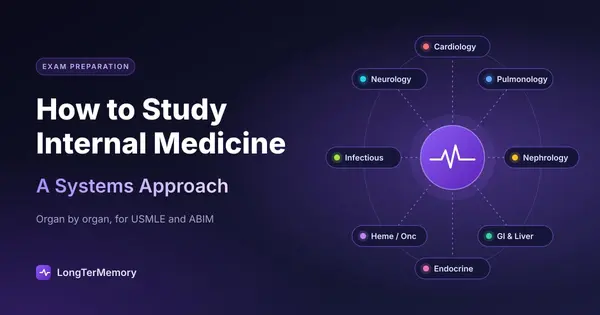
- Weeks 1 to 2: Cardiology
- Weeks 3 to 4: Pulmonology and critical care
- Weeks 5 to 6: Gastroenterology and hepatology
- Weeks 7 to 8: Nephrology and acid-base disorders
- Weeks 9 to 10: Endocrinology and metabolism
- Weeks 11 to 12: Hematology, oncology, and infectious disease
Within each block, you are not just reading a textbook cover to cover. You are actively building comparison tables, drawing mechanism diagrams, and doing system-specific question blocks. The goal is depth within the system, not superficial breadth across the entire field.
This is also where spaced repetition becomes essential. As we discuss in our post on the science of spaced repetition, reviewing material at expanding intervals locks it into long-term memory far better than cramming. When you finish the cardiology block, you need a system that brings those facts back at the right moments so they do not evaporate before you reach hematology.
High-yield internal medicine presentations for USMLE and ABIM
If you only have limited study hours, the highest-return activity is mastering the presentations that show up again and again. Both USMLE Step 2 CK and the ABIM exam draw from a surprisingly predictable set of clinical scenarios. Knowing these cold, and knowing the subtle findings that distinguish one diagnosis from another, is worth more than memorizing rare zebras.
The presentations that dominate the exams
Internal medicine questions cluster heavily around a few core complaints. Based on exam content outlines and question bank analytics, these are the presentations that eat up the most real estate:
- Chest pain and dyspnea: ACS, heart failure, PE, pneumonia, COPD exacerbation, pericarditis, and aortic dissection
- Altered mental status: Delirium, dementia, hepatic encephalopathy, hyponatremia, hypercalcemia, hypoglycemia, and intoxication
- GI bleeding: Upper vs. lower, variceal vs. peptic ulcer, and the diagnostic workup sequence
- Anemia: Microcytic, normocytic, and macrocytic differentials, with iron deficiency, B12/folate deficiency, and hemolytic anemia
- Electrolyte abnormalities: Hyponatremia, hyperkalemia, hypokalemia, and acid-base disorders
- Fever and infection: Sepsis, endocarditis, pneumonia, UTI/pyelonephritis, and intra-abdominal infection
- Abdominal pain: Appendicitis, pancreatitis, biliary disease, bowel obstruction, and ischemic bowel
- Rash with systemic symptoms: Drug reactions, autoimmune conditions, and infectious exanthems
These eight categories probably account for over half of all internal medicine questions on Step 2 CK and a similarly large share of ABIM content. That is not an exact statistic, but if you look at major question banks, the distribution is remarkably consistent. Master these, and you have built a foundation that makes the rest of your studying far more efficient.
USMLE vs. ABIM, what changes
While the presentations overlap, the exams test them differently. USMLE Step 2 CK tends to focus on initial diagnosis and first-line management. The question is usually, “What is the most likely diagnosis?” or “What is the next best step?” ABIM, by contrast, often tests longitudinal management, screening intervals, complications of chronic disease, and when to refer.
For example, a USMLE question about diabetes might ask you to recognize diabetic ketoacidosis and start insulin and fluids. An ABIM question might ask you how often to screen for nephropathy, when to add an ACE inhibitor, or how to manage a patient with both diabetes and coronary artery disease over a five-year horizon.
Because of this difference, your study emphasis should shift slightly:
| Exam Focus | USMLE Step 2 CK | ABIM |
|---|---|---|
| Typical question | Diagnosis and initial management | Long-term management and screening |
| Depth per disease | Moderate, broad across systems | Deep, especially chronic conditions |
| Urgency emphasis | Acute presentations | Chronic disease complications |
| Biostatistics | Moderate | Higher emphasis on guidelines and evidence |
If you are studying for both, start with the acute presentation framework that USMLE demands, then layer on the long-term management details ABIM requires. The systems approach handles this naturally because you build the acute framework first, then add the chronic management layer as you review.
Building comparison tables for pattern recognition
Just like in our guide to emergency medicine for USMLE, the key to internal medicine is comparative thinking. The exam rewards your ability to distinguish similar presentations, not your ability to recite isolated facts. For every major presentation, build a table that forces direct comparison.
Here is an example for dyspnea:
| Condition | Key Distinguishing Feature | Diagnostic Gold Standard | First-Line Treatment |
|---|---|---|---|
| Acute coronary syndrome | Crushing substernal pain, diaphoresis, radiation to jaw or arm | ECG and troponins | Aspirin, anticoagulation, cath lab if STEMI |
| Pulmonary embolism | Pleuritic pain, tachycardia out of proportion, risk factors | CT pulmonary angiography | Anticoagulation |
| Heart failure exacerbation | Orthopnea, JVD, peripheral edema, BNP elevation | Echocardiogram | Diuretics, afterload reduction |
| COPD exacerbation | Prolonged expiration, wheezing, smoking history | Clinical plus spirometry | Bronchodilators, corticosteroids, oxygen |
| Pneumonia | Fever, productive cough, focal lung findings | Chest X-ray | Antibiotics tailored to setting |
The act of building this table is itself a powerful learning exercise. You are not passively reading; you are actively deciding what separates one condition from another. That decision process is exactly what the exam is testing.
Using question banks as the primary study tool for internal medicine
Here is a truth that a lot of students resist until they are deep into prep: for internal medicine, your question bank is not a supplement to your textbook. It is your actual curriculum. The explanations in UWorld, NBME, or ABIM-style question banks contain more high-yield, clinically relevant information per hour than almost any other resource. If you are spending three hours reading a textbook and thirty minutes doing questions, you probably have the ratio backwards.
Why question banks beat passive reading
Internal medicine is a field of patterns, and patterns are learned through exposure, not description. A textbook can tell you that mitral stenosis causes dyspnea, orthopnea, and hemoptysis, but a question bank forces you to recognize that pattern in a clinical vignette, choose the right diagnostic test, and pick the appropriate management. That three-step process, recognition, diagnosis, and management, is what the exam requires, and it is what question banks train.
Research on medical education consistently shows that test-enhanced learning, also called the testing effect, produces better long-term retention than restudying the same material. A 2023 review in Academic Medicine found that students who completed at least 80% of their primary question bank scored an average of 15 to 20 points higher on Step 2 CK than those who completed less than 50%, even when controlling for baseline knowledge. The correlation is not perfect, but the trend is robust. Doing questions works.
The right way to use UWorld for internal medicine
Most students know they should do UWorld. Fewer students know how to use it in a way that actually builds expertise. Here is a framework that works:
- Start in tutor mode, then move to timed. Early in a systems block, tutor mode lets you read explanations immediately and learn as you go. Once you are two-thirds through a system, switch to timed blocks to build pacing.
- Do system-specific blocks first, then random. During your cardiology block, filter UWorld to cardiology only. This reinforces the comparisons you are building. In the final four weeks before your exam, switch to random mixed blocks to simulate test day.
- Read every explanation, even for correct answers. The explanation for the correct answer teaches you the reasoning. The explanations for wrong answers teach you the traps. Both are valuable.
- Flag questions where you guessed. A correct guess is still a knowledge gap. Review those questions as if you got them wrong.
- Keep a running list of “lesson learned” notes. For every question you miss, write one sentence summarizing the teaching point. Review this list weekly.
Common question bank mistakes to avoid
There are a few traps that waste enormous amounts of time:
- Rushing through explanations to hit a completion percentage. This feels productive but leaves shallow knowledge. It is better to do 60% of the bank with deep review than 100% with skimmed explanations.
- Doing questions without a systems foundation. If you have never studied nephrology and you jump into a random nephrology block, you will learn fragments without context. Do a first pass through a system before heavy question drilling.
- Ignoring biostatistics and ethics questions. Internal medicine exams include more of these than students expect. UWorld has excellent biostatistics explanations. Do not skip them.
- Failing to review incorrect answers repeatedly. A question you miss once is a question you are likely to miss again unless you actively revisit the concept. This is where a tool like LongTerMemory shines, which we will get to shortly.
Supplementing with NBMEs and ABIM-style questions
For USMLE Step 2 CK, the NBME self-assessments are invaluable for gauging readiness and getting used to the exact question style. Take one at the halfway point of your study schedule to identify weak systems, and take one in the final week to confirm you are in passing range.
For ABIM, the American College of Physicians question bank and the Mayo Clinic board review questions are well-regarded. ABIM questions tend to be longer and more detailed than USMLE questions, so practicing with actual ABIM-style vignettes is important for pacing.
Automating your review with LongTerMemory
By this point, you have a systems schedule, high-yield presentation tables, and a mountain of question bank explanations. The final piece is making sure all of that knowledge stays accessible on exam day, not just the afternoon you wrote it down.
This is where most study plans fall apart. Students build beautiful notes and comparison tables, then never look at them again until a panicked cram session the week before the exam. The human brain forgets roughly 50% of newly learned material within 24 hours if it is not reviewed, and that decay continues unless you interrupt it with spaced repetition.
LongTerMemory solves this by automating the flashcard creation and scheduling process. Instead of manually copying every fact from your question bank explanations into Anki, you can upload your study materials, PDFs, web articles, or lecture notes directly to longtermemory.com. The system extracts key concepts and converts them into active recall flashcards, then schedules them using an optimized spaced repetition algorithm.
What this means in practice is significant. Manually creating a high-quality flashcard deck for internal medicine can easily take 40 to 60 hours. LongTerMemory reduces that to the time it takes to upload your files. More importantly, it ensures your review schedule is automatic. You do not have to decide which card to review today; the system surfaces the material you are about to forget, exactly when you need to see it.
For internal medicine specifically, this is a game changer because the volume of material is so large. Between cardiology drugs, renal electrolyte thresholds, and infectious disease antibiotic spectra, there are thousands of discrete facts that benefit from repeated exposure. LongTerMemory handles the scheduling, so you can focus on the higher-order clinical reasoning that question banks train.
If you are serious about retaining what you study for USMLE or ABIM, automating your spaced repetition is one of the highest-ROI upgrades you can make to your workflow.
Putting the systems approach into practice
Internal medicine does not have to feel like an impossible mountain of facts. The systems approach gives you a map. By organizing your study around organ systems rather than isolated diseases, you build the comparative thinking skills that exams reward. By focusing on high-yield presentations, you ensure your limited hours go toward the content that actually appears. And by making question banks your primary study tool, you train the pattern recognition and clinical reasoning that separate passing from excelling.
Start with one system. Build your comparison tables. Do questions deeply, not quickly. And use spaced repetition to keep the foundation solid as you add each new system on top. With this framework, internal medicine becomes less about memorizing everything and more about understanding how the pieces fit together, which is exactly what your future patients need you to do.