How to Create a Study Plan When You Don't Know Where to Start
Feeling overwhelmed? Learn a step-by-step system to build a study plan from scratch, prioritize what matters, and schedule your prep one week at a time.
Table of Contents
- Starting With a Diagnostic: What Do You Actually Need to Know?
- Building a Topic List and Prioritizing by Exam Weight
- Scheduling Your Study Plan One Week at a Time
- Phase One: Coverage (Weeks One to Six)
- Phase Two: Consolidation (Weeks Seven to Ten)
- Phase Three: Simulation (Weeks Eleven to Twelve)
- Building Flexibility Into Your Weekly Schedule
- Choosing the Right Resources Without Overwhelm
- Maintaining Momentum When Motivation Fades
- Leveraging Technology to Reduce Planning Friction
- Reviewing and Adjusting Your Plan Weekly
- The First Step Is the Only Step That Matters
Staring at a syllabus, a textbook, or a certification outline with no idea where to begin is one of the most paralyzing feelings in education. The material feels infinite. The exam feels close. And every minute you spend worrying about where to start is a minute you are not actually learning anything.
The good news is that creating a study plan from scratch is a learnable process. It does not require special talent or prior experience. It requires a simple diagnostic sequence: figure out what you need to know, figure out what you actually know, and build a bridge between the two. This article will walk you through that sequence step by step.
Starting With a Diagnostic: What Do You Actually Need to Know?
Before you open a book or schedule a session, you need data. Guessing at your weak areas wastes time. Studying topics you already understand feels productive but delivers zero improvement. The first step in any effective study plan is an honest diagnostic.
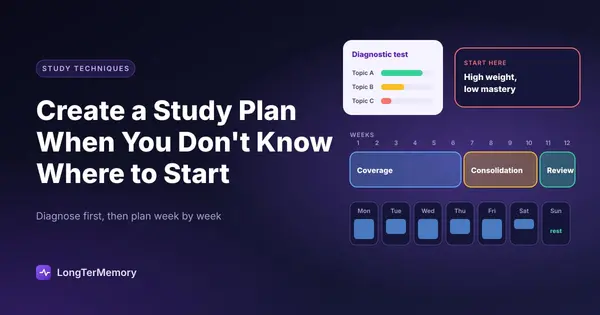
If you are preparing for a standardized exam, take a full-length practice test under realistic conditions. Do not study for it first. The point is to measure your starting point, not to score well. A diagnostic test reveals three things: your overall readiness, your strongest and weakest content areas, and whether your struggles are rooted in knowledge gaps, reasoning errors, or time pressure.
For course-based exams without practice tests, use the syllabus as a diagnostic tool. Go through each topic and rate yourself on a simple scale: green for comfortable, yellow for shaky, and red for clueless. Be brutally honest. This color-coded map becomes the foundation of your entire plan.
If you are learning a subject without a formal exam, create your own diagnostic. Write down the ten most important concepts in the field from memory. The gaps you discover are your starting curriculum. This technique, sometimes called a blank-page diagnostic, takes fifteen minutes and provides more actionable information than hours of passive reading.
Building a Topic List and Prioritizing by Exam Weight
Once you have diagnostic data, build a master topic list. For certification exams, the exam outline or content specification document tells you exactly what is tested and in what proportion. For university courses, the syllabus learning objectives serve the same purpose.
Your topic list should be granular enough to study in single sessions. “Cardiology” is too broad. “Heart failure pathophysiology” is about right. A typical certification exam might break down into fifty to eighty specific topics. A semester course might have thirty to fifty.
Next, assign two scores to each topic: exam weight and your current mastery. Exam weight comes from the official outline. Mastery comes from your diagnostic. Multiply these scores or rank them together to produce a priority list. High-weight topics where you scored poorly are your top priority. Low-weight topics where you are already strong are your lowest priority.
Here is a simple priority matrix you can use.
| Priority | Exam Weight | Your Mastery | Action |
|---|---|---|---|
| 1 | High | Low | Start here. Allocate the most time. |
| 2 | High | Medium | Second priority. Solidify with practice. |
| 3 | Low | Low | Third priority. Cover quickly for completeness. |
| 4 | Low | Medium | Fourth priority. Brief review only. |
| 5 | Any | High | Maintenance review only. Do not over-invest. |
This matrix prevents the two most common planning errors: spending too much time on easy material because it feels good, and neglecting high-weight hard material because it feels bad. Your plan should be weighted toward discomfort. That is where the learning happens.
Scheduling Your Study Plan One Week at a Time
Long-term plans are necessary for orientation, but they are terrible for execution. A twelve-week plan written on day one will be wrong by week three. Life intervenes. You learn faster or slower than expected. Topics turn out to be harder or easier than you assumed.
The solution is rolling weekly planning. Maintain a high-level timeline that maps phases, but plan the specific work only one week in advance. Here is how to structure it.
Phase One: Coverage (Weeks One to Six)
In the coverage phase, your goal is to expose yourself to every topic on your list at least once. Do not aim for mastery yet. Aim for familiarity. For each topic, complete one focused learning session: read the material, watch the lecture, or review the chapter. Then do a small set of practice questions to confirm basic understanding.
Schedule coverage blocks using your priority matrix. High-priority topics get multiple sessions. Low-priority topics get one. Aim for ninety-minute blocks with ten-minute breaks. Research on ultradian rhythms suggests that most people cannot sustain deep focus much longer than ninety minutes without diminishing returns.
Phase Two: Consolidation (Weeks Seven to Ten)
Once you have covered every topic, shift to consolidation. Your goal is to strengthen weak areas and build connections between topics. This phase relies heavily on active recall and spaced repetition. Review your summary notes using retrieval practice rather than re-reading. Work through larger practice question sets. Identify the topics where your accuracy is still below 70 percent and schedule targeted remediation.
Consolidation is also the phase where you should begin mixed practice. Instead of studying cardiology on Monday and pulmonology on Tuesday, mix questions from both. Interleaving improves your ability to distinguish between similar concepts, which is exactly what exams test.
Phase Three: Simulation (Weeks Eleven to Twelve)
In the final phase, your goal is exam readiness. Take full-length practice tests under timed conditions. Review every incorrect answer in detail. Update your summary notes or flashcards based on mistakes. Taper your study intensity in the last forty-eight hours before the exam. Cramming produces familiarity, not memory, and increases anxiety without improving performance.
Building Flexibility Into Your Weekly Schedule
No plan survives contact with reality. You will miss sessions. You will underestimate how long a topic takes. You will have days when focus is impossible. A rigid plan breaks under these conditions. A resilient plan bends.
Build buffer time into every week. If you plan to study twenty hours, schedule only sixteen. Reserve four hours for catch-up, unexpected difficulty, or life events. If nothing goes wrong, use the buffer for extra practice or rest. If something does go wrong, you have margin.
Use a two-tier daily target system. Your primary target is the minimum viable work for the day: one flashcard review session, one practice question set, or one topic review. Your secondary target is the ideal: full coverage of the planned material. On bad days, hit the primary target and stop. On good days, push for the secondary. This prevents the all-or-nothing collapse that destroys so many study plans.
Track your actual hours versus planned hours. A simple spreadsheet or habit tracker is enough. The data reveals patterns. Are you consistently overestimating what you can do on weekdays? Are weekends more productive than you assumed? Use this information to calibrate future weeks. A plan that ignores reality is a fantasy.
Choosing the Right Resources Without Overwhelm
Resource overload is a real problem. For major exams, there are dozens of textbooks, question banks, video courses, and flashcard decks. Students often try to use them all, which fragments attention and prevents depth.
The rule is simple. Choose one primary resource per function: one source for content, one for practice questions, and one for review scheduling. Your content source might be a textbook or video series. Your practice source should be a high-quality question bank with explanations. Your review source should be a spaced repetition system or summary note set.
Here is a comparison of common resource combinations for different learning styles.
| Learning Style | Content Source | Practice Source | Review Source |
|---|---|---|---|
| Visual learner | Video lecture series | Question bank with diagrams | Image-based flashcards |
| Reading learner | Comprehensive textbook | Text-based question bank | Written summary notes |
| Interactive learner | Hands-on lab or simulation | Case-based questions | Spaced repetition with cloze cards |
| Auditory learner | Podcast or lecture audio | Discussion-based practice | Recorded self-explanations |
Once you have chosen your resources, stop shopping. The marginal benefit of finding a slightly better textbook is almost always lower than the benefit of actually studying the one you have. Resource optimization is a form of procrastination dressed up as productivity.
Maintaining Momentum When Motivation Fades
Every study plan looks great on day one. By week four, the novelty is gone, the material is hard, and the exam still feels far away. This is where most plans die.
The antidote is systems over motivation. Do not rely on feeling inspired to study. Rely on environmental cues, social commitments, and scheduled routines that make studying the default rather than the choice.
Set a fixed study location. Your brain associates places with behaviors. If you study at the same desk every day, sitting down triggers study mode automatically. If you study in bed one day and a coffee shop the next, you lose that contextual support.
Use implementation intentions: specific if-then plans that remove decision-making. Instead of saying “I will study tomorrow,” say “When I finish breakfast tomorrow, I will sit at my desk and review flashcards for thirty minutes before checking my phone.” Research by Peter Gollwitzer shows that implementation intentions increase follow-through by 200 to 300 percent compared to vague goals.
If you struggle with self-direction, consider an accountability structure. A study partner, a tutor, or a public commitment to a friend can provide external motivation when internal motivation fails. For more on this, see our guide on how to build accountability into your study schedule.
Leveraging Technology to Reduce Planning Friction
Technology should reduce the mental load of studying, not increase it. The right tools handle scheduling, tracking, and formatting so you can focus on learning.
For spaced repetition, use an app that schedules reviews automatically based on your performance. Manual scheduling is cognitively expensive and error-prone. For practice questions, use a platform that tracks your accuracy by topic and surfaces weak areas. For content review, use a tool that generates active recall material from your notes rather than forcing you to convert everything by hand.
LongTerMemory was designed specifically to remove these friction points. Upload your study materials, and the system generates exam-style flashcards, schedules them optimally, and tracks your performance by topic. Instead of spending hours building decks and managing calendars, you spend your time on the work that actually builds knowledge. If you are starting from zero and need a system that works immediately, it is worth trying.
Once your plan is in place, our science-based guide to building a study schedule explains how to space sessions, size study blocks, and match tasks to your energy.
Reviewing and Adjusting Your Plan Weekly
A study plan is not a monument. It is a hypothesis about how to learn, and like any hypothesis, it should be tested and revised.
Every Sunday, spend twenty minutes reviewing the past week. Ask three questions. First, did I complete the planned work? If not, why? Second, which topics took longer or shorter than expected? Third, what is my accuracy trend on practice questions?
Use the answers to adjust the next week. If pathology is consistently taking twice as long as planned, break it into smaller subtopics or allocate more time. If your pharmacology accuracy jumped from 60 to 85 percent, reduce the review frequency and shift time to a weaker area. This iterative adjustment prevents the drift that turns a good plan into a failed one.
The First Step Is the Only Step That Matters
You do not need a perfect plan. You need a plan you can start today. The best study schedule in the world is worthless if you spend three weeks designing it and never actually study.
Start with the diagnostic. Build the topic list. Prioritize by weight and weakness. Schedule this week only. Choose one resource per function. Set a primary daily target. Begin.
Everything else is optimization. Optimization comes later. For now, focus on motion. The plan will improve as you use it. The knowledge will accumulate as you work. And the exam will feel less overwhelming with every session you complete.