How to Use Power Naps to Boost Memory Consolidation
The best nap length for memory (10, 20, or 90 minutes), when to nap after studying, and how to wake up sharp instead of groggy. Backed by sleep research.
Table of Contents
- How Naps Help Memory Consolidation
- The Optimal Nap Length: 10, 20, or 90 Minutes?
- Nap length comparison
- What the research says about short naps
- So which should you choose?
- Timing Naps to Maximize Learning From Morning Study Sessions
- Why early afternoon works
- The learn, nap, review sequence
- Pair naps with spaced repetition
- How to Nap Effectively Without Waking Groggy
- 1. Set an alarm, always
- 2. Try the "coffee nap"
- 3. Make the environment nap-friendly
- 4. Don't stress if you don't fully fall asleep
- 5. Wake up properly
- Who should be careful with naps?
- Power Naps and Exam Preparation
- Frequently Asked Questions
- How long should a power nap be for studying?
- Does napping after studying improve memory?
- When is the best time to take a nap for learning?
- Why do I feel worse after a nap?
- Can a nap replace a full night's sleep before an exam?
- The Bottom Line
A nap can genuinely help you remember what you studied: a 10 to 20 minute power nap boosts alertness with little grogginess, while a 60 to 90 minute nap that includes deep and REM sleep gives the biggest memory consolidation benefit. For most students, the sweet spot is a 20-minute nap in the early afternoon, shortly after a morning study session.
There’s a strange guilt that comes with napping when you’re supposed to be studying. Your exam is in four days, you’ve got a pile of chapters left, and lying down for 20 minutes feels like quitting. It isn’t: sleep is one of the steps in any plan to memorize quickly and not forget.
But here’s the twist: that nap might be one of the most productive things you do all day. Sleep isn’t downtime for your brain. It’s when your brain files away what you learned, strengthens the important connections, and clears space for more. And you don’t have to wait until nighttime to get some of those benefits.
Let’s talk about how to nap strategically, so it actually helps your memory instead of leaving you foggy and behind schedule.
How Naps Help Memory Consolidation
During sleep, your brain replays and stabilizes newly learned information, moving it from fragile short-term storage toward more durable long-term memory. Naps can trigger a smaller version of this same process.
When you learn something new, the memory starts out fragile and heavily dependent on the hippocampus, a brain region that acts like a temporary inbox. During sleep, especially slow-wave (deep) sleep, the hippocampus replays recent experiences and helps transfer them to the cortex for long-term storage. Sleep spindles, bursts of brain activity during light stage 2 sleep, are also strongly linked to consolidating facts and skills.
Research has shown naps can tap into this:
- Mednick and colleagues (2003) found that a 60 to 90 minute nap containing both slow-wave and REM sleep improved performance on a perceptual learning task about as much as a full night of sleep.
- Lahl and colleagues (2008) found that even an ultra-short nap of about 6 minutes improved word list recall compared with staying awake, with a longer nap helping more.
- A study from the Walker lab at UC Berkeley found that a 90-minute early afternoon nap restored the brain’s capacity to learn new facts later in the day, while people who stayed awake got worse at learning as the day went on.
- Cousins and colleagues (2019), working with students in Singapore, found that a one-hour midday nap helped students retain factual material as well as spending that hour cramming, and better than taking a break without sleep.
That last one is worth repeating: napping performed as well as an extra hour of studying, while also leaving students more alert. For more background, see our guide to sleep and memory consolidation.
The Optimal Nap Length: 10, 20, or 90 Minutes?
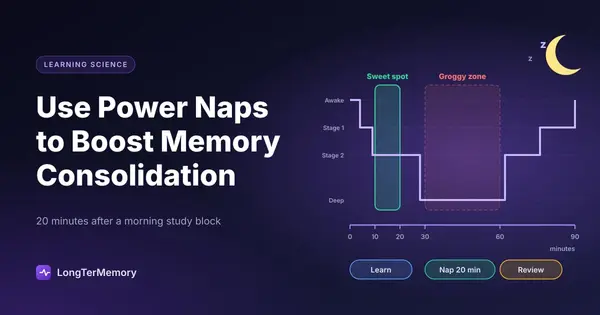
Choose your nap length based on your goal: 10 to 20 minutes for alertness and a mild memory boost, 60 to 90 minutes for maximum consolidation if you have time and won’t need to perform right away. Avoid 30 to 45 minute naps when you need to be sharp immediately afterward.
The reason length matters so much is sleep stages. In the first 10 to 20 minutes, you’re mostly in light sleep (stages 1 and 2). After around 30 minutes, you start sliding into deep slow-wave sleep. Waking up from deep sleep causes sleep inertia, that heavy, confused grogginess. A full cycle of about 90 minutes ends in lighter sleep, so waking up feels easier again.
Nap length comparison
| Nap length | Sleep stages reached | Main benefit | Grogginess risk | Best for |
|---|---|---|---|---|
| 6 to 10 min | Stage 1 to 2 | Quick alertness boost | Very low | A fast reset between study blocks |
| 10 to 20 min | Stage 2 (spindles) | Alertness, focus, some memory benefit | Low | Most study days |
| 30 to 45 min | Entering deep sleep | Some consolidation | High | Usually best avoided |
| 60 min | Deep sleep | Strong consolidation of facts | Moderate to high | Fact-heavy learning, when you have recovery time |
| 90 min | Full cycle with REM | Strongest overall consolidation, creativity | Low to moderate | Weekend or free afternoon after big study session |
What the research says about short naps
A frequently cited 2006 study by Brooks and Lack compared naps of 5, 10, 20, and 30 minutes. The 10-minute nap produced immediate improvements in alertness and performance that lasted about two and a half hours, with almost no grogginess. The 20 and 30 minute naps also helped, but people felt groggy for a while first. The 5-minute nap did very little.
NASA research from the 1990s found similar practical benefits: pilots given a planned nap opportunity (averaging about 26 minutes of sleep) showed a 34% improvement in performance and a 54% improvement in alertness.
So which should you choose?
- Regular study day, need to keep going after: 10 to 20 minutes.
- Just finished a big learning session, have a free afternoon: 90 minutes.
- Only have 30 to 40 minutes: Set an alarm for 20 instead. You’ll wake up clearer.
Timing Naps to Maximize Learning From Morning Study Sessions
The best time to nap for learning is early afternoon, roughly 1 to 3 p.m., ideally soon after a focused morning study session. This matches your body’s natural post-lunch dip and lets your brain consolidate what you just studied.
Why early afternoon works
Your circadian rhythm includes a natural dip in alertness in the early afternoon. That’s why so many cultures have a siesta tradition. Napping during this dip is easier (you fall asleep faster) and less likely to mess with your nighttime sleep.
Napping too late, after about 4 p.m., can make it harder to fall asleep at night. And since nighttime sleep is still your most important memory consolidation tool, you don’t want to sacrifice it.
The learn, nap, review sequence
Here’s a simple daily structure that uses napping strategically:
| Time | Activity |
|---|---|
| 9:00 to 12:00 | Focused study: new material plus active recall |
| 12:00 to 12:45 | Lunch, short walk |
| 12:45 to 1:15 | Quick flashcard review of the morning’s material |
| 1:15 to 1:40 | 20-minute power nap |
| 1:45 to 4:30 | Second study block: practice problems or new topic |
| Evening | Light spaced review, then a full night of sleep |
Why review right before the nap? There’s some evidence that information you’ve recently engaged with, and that you expect to need later, gets prioritized for consolidation during sleep. A quick review before lying down helps “tag” it as important.
Pair naps with spaced repetition
Naps strengthen what you learned today. Spaced repetition makes sure you keep it for weeks and months. They work beautifully together: study and retrieve in the morning, nap to consolidate, then revisit the same material at increasing intervals over the following days. If you’re new to spacing, read the science of spaced repetition.
How to Nap Effectively Without Waking Groggy
To avoid grogginess, keep naps under 20 minutes (or a full 90), nap in the early afternoon, set an alarm, and get light and movement right after you wake up. A small dose of caffeine just before a short nap can also help.
1. Set an alarm, always
Give yourself about 5 extra minutes to fall asleep. So for a 20-minute nap, set the alarm for 25. Without an alarm, short naps easily become 60-minute naps, and you’ll wake up from deep sleep feeling awful.
2. Try the “coffee nap”
This sounds strange, but it’s backed by research. Drink a cup of coffee (or about 100 to 200 mg of caffeine) right before a 15 to 20 minute nap. Caffeine takes around 20 minutes to kick in, so it starts working just as you wake up. A study by Hayashi and colleagues in 2003 found that combining caffeine with a short nap reduced afternoon sleepiness more than either a nap alone or other approaches. Skip this if caffeine late in the day disrupts your night sleep.
3. Make the environment nap-friendly
- Dark: use an eye mask or close the blinds.
- Quiet: earplugs or white noise.
- Cool: a slightly cool room helps you fall asleep faster.
- Comfortable but not too comfortable: a couch or reclining chair can be better than your bed for short naps, because it’s less tempting to sleep for hours.
4. Don’t stress if you don’t fully fall asleep
Even lying down quietly with your eyes closed has restorative effects. Light stage 1 sleep often feels like you were “just resting,” but your brain may still be benefiting.
5. Wake up properly
After the alarm:
- Get bright light (open the curtains or step outside).
- Move: stretch, walk around, splash water on your face.
- Start with something easy: a quick flashcard review is perfect for warming back up before harder work.
Who should be careful with naps?
| Situation | Advice |
|---|---|
| You have insomnia | Avoid naps or keep them very short and early |
| You’re sleep-deprived | Naps help, but they don’t replace a full night |
| You get groggy easily | Stick to 10 minutes |
| Nap makes night sleep worse | Move it earlier or shorten it |
Napping is a supplement to good nighttime sleep, not a replacement. If you’re regularly sleeping less than 7 hours, fixing that will do far more for your memory than any nap. Our post on building a sleep-friendly study strategy can help.
Power Naps and Exam Preparation
Naps are especially useful during intense exam prep, when you’re learning large amounts of new material each day. A strategic nap can help you consolidate the morning’s work and stay sharp for the afternoon.
A few exam-specific tips:
- During heavy study weeks, schedule a daily 20-minute nap after lunch.
- The day before an exam, a short nap can help you feel refreshed, but don’t let it ruin your night sleep.
- On exam day, avoid napping right before a test unless you have time to fully wake up (at least 15 to 30 minutes).
- After a long exam, a 90-minute nap is a great way to recover.
And of course, naps work best when what you’re consolidating was learned well in the first place. That means active recall and spaced review, not just rereading. If you need help building that routine, LongTerMemory turns your PDFs, notes, and slides into question and answer cards automatically, then schedules them with spaced repetition. Do your morning reviews, take your nap, and let your brain do the rest.
For more on how your daily rhythm affects learning, see our guide to study habits and your chronotype.
Frequently Asked Questions
How long should a power nap be for studying?
For most students, 10 to 20 minutes is ideal. It improves alertness and focus with minimal grogginess. A 90-minute nap gives the strongest memory benefit if you have the time.
Does napping after studying improve memory?
Yes. Several studies show naps after learning improve retention of facts and skills compared with staying awake, likely because sleep helps consolidate new memories.
When is the best time to take a nap for learning?
Early afternoon, around 1 to 3 p.m., ideally after a morning study session. Avoid napping after about 4 p.m. if it interferes with your night sleep.
Why do I feel worse after a nap?
You probably woke up from deep sleep, which causes sleep inertia. Keep naps under 20 minutes or extend them to a full 90-minute cycle.
Can a nap replace a full night’s sleep before an exam?
No. Naps help, but they can’t fully replace the memory consolidation and restoration of a full night of sleep, which is still the priority.
The Bottom Line
A well-timed nap is a legitimate study tool: 10 to 20 minutes for alertness, 90 minutes for maximum consolidation, ideally in the early afternoon after a morning study session. Set an alarm, get light and movement when you wake, and pair naps with spaced review so the learning lasts.
Tomorrow, try it: study in the morning, review your flashcards after lunch, and set an alarm for a 20-minute nap. Notice how your afternoon session feels. You might be surprised how much more you get done.