How to Read Faster and Remember More
Learn what research says about speed reading limits and discover the active engagement strategies that actually help you read faster and remember more.
Table of Contents
- The trade-off between reading speed and comprehension
- Skimming strategies that maintain retention
- Preview with a purpose (the survey step)
- Read the "connective tissue" at full speed
- Skim to triage, then decide
- How active engagement while reading replaces speed tricks
- Turn headings into questions before you read
- Pause and retrieve at every natural break
- Annotate by compressing, not highlighting
- Convert key facts into flashcards as you go
- Putting it all together (and saving yourself hours)
- The bottom line
- FAQ
- Is speed reading a complete scam?
- What is a good reading speed for studying?
- Does re-reading help at all?
- How do I remember what I read without taking tons of notes?
You have a 400-page textbook, a stack of research papers, and an exam in three weeks. At some point, usually around midnight with chapter two still unfinished, everyone has the same thought: there has to be a way to read faster. And the internet is happy to sell you one. Speed reading courses promise 1,000, 2,000, even 25,000 words per minute with “full comprehension.” Just move your eyes differently, stop subvocalizing, use your peripheral vision. Easy, right?
Here’s the honest answer upfront: you can read meaningfully faster, but the ceiling is much lower than the marketing claims, and speed alone is the wrong goal anyway. The students who genuinely get through material quickly and remember it aren’t reading differently. They’re engaging differently. In this post I’ll walk you through what the research actually says about reading speed and comprehension, which skimming strategies hold up, and why active engagement plus retrieval practice beats every speed trick on the market. For what to do after reading, see how to memorize fast without forgetting.
The trade-off between reading speed and comprehension
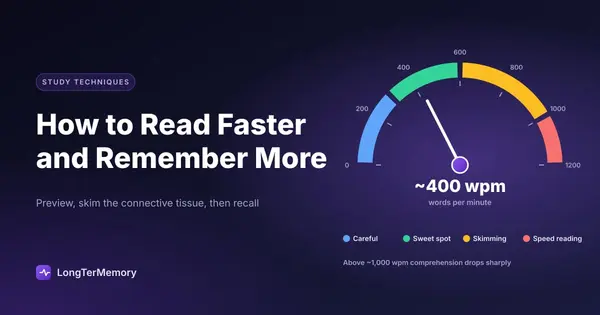
The core answer: reading speed and comprehension trade off against each other, and the realistic ceiling for most adults with good comprehension is around 200 to 400 words per minute. Push much past that and you are not reading faster, you are understanding less.
This isn’t my opinion. It’s one of the most thoroughly studied questions in cognitive psychology. The definitive review is a 2016 paper by Keith Rayner and colleagues, titled “So Much to Read, So Little Time,” published in Psychological Science in the Public Interest (Rayner et al., 2016). Rayner spent his career studying eye movements during reading, and the review’s conclusion is blunt: there is no magic technique that lets you read dramatically faster without sacrificing comprehension.
Here’s why the physics of reading won’t bend:
- Your eyes don’t glide, they jump. Reading happens through rapid movements called saccades, separated by fixations where your eyes actually stop and take in information. A typical fixation lasts about 200 to 250 milliseconds. You can only extract visual information during the fixation, not during the jump.
- You can only see clearly in a tiny window. Your foveal vision, the sharp part, covers roughly 7 to 8 characters around your fixation point. Claims about “taking in whole lines with peripheral vision” collide with basic retinal anatomy.
- Normal reading already includes backups. About 10 to 15% of saccades are regressions, little backward jumps to re-check something. These aren’t wasted motion. They’re how comprehension repairs itself in real time.
- Subvocalization is a feature, not a bug. Speed reading courses tell you to silence the inner voice. But that inner speech supports working memory and comprehension, especially for difficult text. Remove it and the words blur past without sticking.
So what do those 1,000+ wpm “speed readers” actually do? They skim. And research consistently shows that skimming at very high speeds produces comprehension roughly on par with guessing the gist from headings. Fine for deciding whether a document is worth reading, disastrous for studying exam material. When Woody Allen joked, “I took a speed reading course and read War and Peace in twenty minutes. It involves Russia,” he was describing the actual outcome of the technique.
Now, does that mean your reading speed is fixed? Not at all. Most people can genuinely improve from, say, 200 wpm toward 300 or 350 wpm with comprehension intact. But the way you get there is boring: read more, build vocabulary, and build background knowledge in the subject. Familiarity with a topic is the single biggest legitimate speed booster, because comprehension, not eye movement, is the real bottleneck. A biology major reads a biology textbook faster than a philosophy major does, not because her eyes move better, but because she already has the mental scaffolding the text hangs on.
Skimming strategies that maintain retention
The core answer: skimming works when you use it as a preview-and-triage tool instead of a reading replacement. Strategic skimming before and around careful reading can save you 30 to 50% of your reading time with almost no retention cost. Skimming instead of reading saves 100% of your time and most of your knowledge too.
The trick is knowing what skimming is for. It’s for answering two questions: “What is this text about?” and “Which parts deserve my slow attention?” Here are the strategies that actually hold up:
Preview with a purpose (the survey step)
Before reading a chapter properly, spend two to five minutes surveying it. Read the title, introduction, headings, first sentences of paragraphs, and the summary. Look at figures and their captions. This is the “S” in the classic SQ3R method (Survey, Question, Read, Recite, Review), which dates back to Francis Robinson’s 1946 work with military students.
Why does this help? Because your brain encodes new information far better when it has a structure to attach it to. A quick preview builds a mental outline, so when you read properly, details slot into place instead of floating loose. You end up reading the chapter faster and remembering more, which is the actual goal behind the “read faster and remember more” search that probably brought you here.
Read the “connective tissue” at full speed
Not all sentences carry equal weight. The first and last paragraphs of a section, topic sentences, and anything after signal phrases like “the key point is,” “in contrast,” or “therefore” carry disproportionate meaning. Read those slowly. The examples, anecdotes, and transitional padding in between can be read at a brisk pace without losing the argument. This is sometimes called selective reading, and unlike speed reading, it speeds you up by allocating attention rather than by moving your eyes faster.
Skim to triage, then decide
For dense material like research papers, use a three-pass approach: skim title, abstract, and headings first; read intro and conclusion second; only then commit to the full text if it earned it. I break this workflow down for journal articles specifically in my post on active reading strategies for comprehension, and the same triage logic applies to textbooks and reports.
A quick comparison of what each approach actually buys you:
| Approach | Typical speed | Retention after a week | Best use |
|---|---|---|---|
| Careful reading | 200 to 300 wpm | Moderate (decays fast without review) | Core material you must know cold |
| Strategic skimming + selective reading | 300 to 450 wpm | Moderate to good for key ideas | Previewing, familiar topics, triage |
| ”Speed reading” techniques | 700+ wpm claimed | Poor, little better than guessing | Deciding if something is worth reading |
| Reading + active recall review | 200 to 300 wpm | High (up to 80% with testing) | Anything you need to remember long-term |
Look at that last row, because it’s the whole point of this article. The biggest retention gains don’t come from how you read. They come from what you do after and during reading.
How active engagement while reading replaces speed tricks
The core answer: if you want to read faster and remember more, stop optimizing your eyes and start optimizing your engagement. Asking questions while you read, pausing to retrieve, and testing yourself afterward produce dramatically better retention than any eye-movement technique, and they effectively speed up your overall studying because you stop re-reading.
Think about the total time cost, not the page speed. Passive reading feels fast, but Ebbinghaus’s classic forgetting curve research shows we lose the majority of newly encountered information within days when nothing reinforces it. So you re-read the chapter before the exam. Then re-read it again. Three passes at 300 wpm is slower than one engaged pass at 250 wpm plus short review sessions. Active readers aren’t faster per page. They’re faster per learned fact, which is the only metric that matters.
Here’s the engagement toolkit, in order of how much each piece buys you:
Turn headings into questions before you read
This is the “Q” in SQ3R, and it takes ten seconds per section. A heading like “Causes of the French Revolution” becomes “What caused the French Revolution?” Now you’re reading to answer something, which transforms your attention completely. Your brain starts hunting for the answer instead of passively absorbing sentences. This is active recall embedded inside the reading itself, and it costs you zero extra time.
Pause and retrieve at every natural break
At the end of each section, close the book (or cover the screen) and say or write what you just learned in your own words. Two or three sentences. This feels slow, and it’s the highest-value minute in your entire reading session. Karpicke and Roediger’s famous 2008 study in Science (Karpicke & Roediger, 2008) found that students who practiced retrieval after studying remembered about 80% of the material a week later, versus roughly 33% for students who re-studied the same content. Same total study time. The re-reading group even predicted they’d do better, and they were wrong. If you want the full rundown of why testing yourself beats reviewing, read my deep dive on active recall techniques.
Annotate by compressing, not highlighting
Highlighting feels like engagement but requires almost no thought. Instead, write a five-to-ten-word summary in the margin for each page or section, in your own words. The compression forces you to decide what matters, and the decision is where the memory forms. Dunlosky and colleagues ranked self-testing and distributed practice as the two highest-utility study techniques in their comprehensive 2013 review, while highlighting and re-reading landed at the bottom (Dunlosky et al., 2013). Summarizing scored moderately, but only when done in your own words, which is exactly the margin-note version.
Convert key facts into flashcards as you go
Anything you’d want to recall cold on exam day (definitions, formulas, dates, mechanisms, thresholds) becomes a question-and-answer flashcard. This is where the retention curve gets flat in the best way, because once a fact is in a spaced repetition system, it gets re-tested at expanding intervals right before you’d forget it. If you’re new to how that scheduling works, my post on the science of spaced repetition covers the mechanics.
Here’s what an engaged reading session actually looks like, start to finish:
- Survey the chapter for three minutes: headings, intro, summary, figures.
- Question: turn each heading into a question you expect the text to answer.
- Read selectively at your natural pace, slow on key sentences, brisk through filler.
- Retrieve after each section: cover the text, write or say the main points from memory.
- Card it: convert must-know facts into Q&A flashcards for spaced review.
- Review tomorrow and at expanding intervals, letting the algorithm handle the timing.
Total extra time versus passive reading: maybe 20 to 30%. Retention difference: often double or more. That is the real version of “read faster and remember more.” It’s not a reading technique at all. It’s a learning technique with reading inside it.
Putting it all together (and saving yourself hours)
The core answer: read at a natural pace, skim strategically to triage, engage actively while reading, and offload retention to retrieval practice with spaced repetition. Do that and you’ll outperform any “speed reader” on the only test that counts, which is what you can recall two weeks later.
The one honest friction point in this system is step five. Turning a dense chapter into good flashcards by hand takes real time, sometimes as long as the reading itself, and card admin is where most people’s consistency goes to die. This is exactly the bottleneck that made me start using LongTerMemory for my own reading-heavy study: you drop in the PDF of your textbook chapter or a link to web content, and it automatically generates Q&A flashcards from the material, then schedules them with spaced repetition so the right cards resurface at the right intervals. Your time goes into the high-value work (reading, questioning, retrieving) instead of typing cards. If that’s the piece holding your system back, grab the free trial and run one chapter through it. The gap between “I read this once” and “I can recall this cold” is where exams are won and lost.
The bottom line
Speed reading as advertised doesn’t exist. Reading is constrained by your eyes, your retina, and your working memory, and the 200 to 400 wpm range with solid comprehension is close to the honest ceiling. But the goal was never really speed. The goal is getting knowledge into long-term memory with the least total time spent.
Skim to preview and triage, not to replace reading. Engage while you read: questions, retrieval pauses, compressed margin notes. And then let retrieval practice and spaced repetition do the heavy lifting that no eye trick ever could. Read at a human pace, remember at a superhuman one.
FAQ
Is speed reading a complete scam?
Not entirely, but close for study purposes. You can legitimately improve from slow to average speeds by reading more and building vocabulary and background knowledge. What doesn’t work are the dramatic claims: techniques promising 1,000+ wpm with full comprehension consistently fail under testing. At those speeds you’re skimming, and comprehension drops accordingly.
What is a good reading speed for studying?
Around 200 to 300 wpm for dense study material is normal and healthy. Trying to push study reading much past 350 wpm usually costs more in lost comprehension than it saves in time. Optimize for retention per hour instead of words per minute.
Does re-reading help at all?
A second read through, spaced by a few days, has modest value. But re-reading consistently underperforms retrieval practice for long-term retention, and it creates a fluency illusion: the text feels familiar, so you mistake recognition for knowledge. One engaged read plus self-testing beats three passive re-reads.
How do I remember what I read without taking tons of notes?
Use the retrieve-and-card loop: pause at each section break to recall the main points from memory, and convert only the must-know facts into flashcards for spaced review. Ten flashcards per chapter, reviewed on a schedule, will outperform pages of notes you never look at again.