How to Use Spaced Repetition for Legal Bar Exam Prep
Learn how to build MBE rule-statement flashcard decks and pair SRS review with essay practice for a complete bar exam preparation system.
Table of Contents
- Which bar exam content is flashcard-appropriate vs. requires application practice
- What Belongs in Your SRS Deck
- What Needs Live Practice Instead
- How to Think About the Split
- Building MBE rule statement flashcard decks by subject
- The Anatomy of a Legal Flashcard
- Subject-by-Subject Deck Strategy
- How Many Cards You Actually Need
- Pairing SRS review with essay practice for a complete bar prep system
- The Daily Split: Morning Cards, Afternoon Essays
- Using Flashcards to Bridge MBE and MEE
- Tracking Weaknesses Across Both Formats
- The Bar Prep Efficiency Advantage
- Making It Stick: Habits for Bar Exam SRS Success
- Final Thoughts
Most bar exam takers study harder than they need to and remember less than they should. It is not because they are lazy. It is because they are using study techniques that fight their own brain chemistry. The bar exam requires you to hold thousands of black-letter rules in working memory, ready to deploy under time pressure, and most people try to do that with passive review, re-reading outlines, and highlighting. That approach creates familiarity, not retrieval strength, and the difference between those two things is the difference between passing and failing.
Spaced repetition is the fix. It is a system for reviewing material at gradually increasing intervals, forcing your brain to pull information out of memory just before it would otherwise fade. For bar prep, this means converting the mountain of rules, elements, exceptions, and definitions into a review schedule that keeps every subject fresh without requiring you to re-read your outlines every weekend. When you pair that systematic memory work with deliberate essay and multiple-choice practice, you get a preparation system that is both more efficient and more reliable than the traditional bar review grind.
This post shows you exactly how to build that system. We will cover which bar exam content belongs in flashcards and which does not, how to construct MBE rule-statement decks that actually help on exam day, and how to integrate spaced repetition with essay practice so that your knowledge and your application skills improve together. If you are looking for a full overview of the exam structure and timeline, see our complete guide on how to prepare for the Uniform Bar Exam.
Which bar exam content is flashcard-appropriate vs. requires application practice
The short answer is that discrete factual content goes in your spaced repetition system, while skills must be practiced live. Flashcards are unbeatable for memorizing the rule against perpetuities, the elements of negligence, or the hearsay exceptions. They are useless for learning how to spot issues in a convoluted fact pattern, how to organize an IRAC paragraph under time pressure, or how to pace yourself through 200 multiple-choice questions. Both categories are essential for passing, but they require different training methods.
What Belongs in Your SRS Deck
Bar exam content that is pure memorization is perfectly suited to flashcards. This includes the vocabulary of law, the structural rules, and the specific exceptions that examiners love to test. If you can reduce it to a question with a definite answer, it belongs in your deck.
Here is what should be flashcard-driven:
- Black-letter rule statements: The precise formulation of each rule, including all elements and sub-elements. For example, the elements of adverse possession (actual, open and notorious, exclusive, continuous, hostile) or the requirements for a valid contract (offer, acceptance, consideration).
- Definitions: Legal terms of art that appear in both MBE questions and essay prompts. Think of concepts like “promissory estoppel,” “res ipsa loquitur,” or “attainder.”
- Exceptions and counter-exceptions: The bar exam tests the exceptions more than the rules. Hearsay exceptions, contract defenses, and criminal law affirmative defenses are all high-yield flashcard material.
- Numeric thresholds and time periods: Statutes of limitations, the Rule 23 requirements for class actions, the time limits for filing notice of appeal. These are easy to mix up under pressure and benefit enormously from repeated retrieval.
- Multi-part tests: The Lemon Test, the balancing tests for Fourth Amendment searches, the Mathews v. Eldridge test for due process. These have a specific structure that you need to reproduce accurately.
Research on spaced repetition for law students shows that learners who use active recall for rule statements can retrieve those rules roughly 40 to 60 percent faster than learners who rely on passive review. For a deeper look at why this technique works at the neurological level, read our breakdown of the science of spaced repetition. On a timed exam where you have 30 minutes per essay and under 1.8 minutes per MBE question, that retrieval speed translates directly into better answers and less panic.
What Needs Live Practice Instead
Flashcards will give you the bricks, but you still need to learn how to build the house. The following skills cannot be developed by reviewing cards and must be practiced with real or simulated exam material:
- Issue spotting: Reading a fact pattern and identifying which legal issues are present, which is the core skill tested by the MEE and the MPT. No flashcard can replicate the ambiguity of a real exam question.
- Rule application: Taking a rule you know and applying it to messy, incomplete, or contradictory facts. This is what the MBE tests with its fact-pattern multiple-choice questions, and it requires judgment that flashcards do not build.
- Organization and time management: Structuring an IRAC paragraph, deciding how much space to give each issue, and writing under strict time limits. These are motor and executive skills that only improve through repetition.
- Pattern recognition: The MBE is a pattern recognition exam. After you have done enough questions, you start to see how the examiners frame particular issues, where they hide the trick, and which distractors they favor. That only comes from volume.
How to Think About the Split
A useful way to think about your bar prep is the knowledge-application ratio. For most takers, roughly 40 percent of preparation should be memory work (flashcards, outlining, rule review) and 60 percent should be active practice (MBE questions, essays, MPTs). But within that 40 percent, spaced repetition is the most efficient method available. It compresses what would be hours of passive re-reading into focused, 20 to 30 minute daily sessions that actually strengthen memory.
The key is to avoid the trap of thinking that because you recognize a rule on a flashcard, you can apply it. Recognition and application are different neural pathways. Your SRS deck makes sure the rule is available. Your practice sessions make sure you know when to use it.
Building MBE rule statement flashcard decks by subject
A good legal flashcard is not a condensed outline. It is a precise, testable question that forces you to produce the rule from memory. The most common mistake bar takers make is writing cards that are too long, too vague, or that test multiple things at once. When you sit down to build your MBE decks, think like an examiner. What would you need to write in an essay to earn the rule statement points? That exact language is what your card should demand.
The Anatomy of a Legal Flashcard
Every card in your bar prep deck should follow a few rigid principles:
- One card, one rule or one element. A card that asks for all seven elements of a negligence claim is too big. Your brain will remember some elements and forget others, and you will not know which is which. Break it into seven cards, or use a cloze deletion format where each element is tested separately.
- Use the same language you will use on the exam. If your bar prep course teaches the contracts rule as “offer, acceptance, and consideration with no valid defenses,” your card should ask for exactly that phrasing. Do not paraphrase into casual language. The bar exam rewards precision, and your flashcards should train precision.
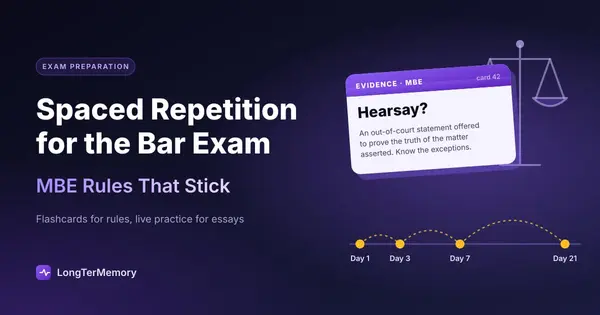
- Include the exception on the same card when possible. If the rule is “hearsay is an out-of-court statement offered to prove the truth of the matter asserted,” the card should also ask for the definition of hearsay and, on the reverse or in a follow-up card, the most common exceptions. This creates associative links that help you remember the rule as a network rather than an isolated fact.
- Make it active, not passive. Bad card: “The statute of limitations for a written contract is six years.” Good card: “What is the statute of limitations for breach of a written contract under the common law?” The second version forces retrieval. The first version just creates recognition.
Here is an example of how to transform a typical outline excerpt into flashcards:
| Outline Excerpt | Flashcard Front | Flashcard Back |
|---|---|---|
| Adverse possession requires actual, open and notorious, exclusive, continuous, and hostile possession for the statutory period. | What are the five elements of adverse possession? | 1. Actual 2. Open and notorious 3. Exclusive 4. Continuous 5. Hostile |
| The mailbox rule states that acceptance is effective upon dispatch when the offeree uses an authorized medium. | Under the mailbox rule, when is an acceptance effective? | Upon dispatch, if sent by an authorized medium. |
| Hearsay is an out-of-court statement offered to prove the truth of the matter asserted. | Define hearsay. | An out-of-court statement offered to prove the truth of the matter asserted. |
Subject-by-Subject Deck Strategy
The MBE tests seven subjects, and each one has a different density of memorizable rules versus application-heavy concepts. Your deck composition should reflect that.
Civil Procedure is highly rule-driven and perfect for flashcards. Jurisdiction rules, venue transfer standards, the Erie doctrine, and discovery timelines all have precise formulations. This subject should be one of your largest decks, probably 150 to 250 cards for a thorough coverage.
Constitutional Law is also excellent for cards, particularly the tests and standards: rational basis, intermediate scrutiny, strict scrutiny, the Lemon Test, the Central Hudson test. The tricky part is remembering which test applies to which scenario, so consider cards that pair the standard with the context.
Contracts divides cleanly. The formation rules, defenses, and remedies are flashcard gold. The UCC Article 2 rules for merchants, warranties, and risk of loss are also highly memorizable. Keep your contract cards focused on the black-letter rules; save the tricky application issues for MBE practice.
Criminal Law and Procedure has a lot of definitional material that cards handle well: the elements of larceny, burglary, conspiracy, and the various levels of mens rea. Criminal procedure, especially Fourth, Fifth, and Sixth Amendment law, is packed with tests and exceptions that reward spaced repetition.
Evidence is arguably the most flashcard-friendly subject on the bar. The Federal Rules of Evidence are a codified system of definitions, exceptions, and qualifications. Hearsay alone can generate 50 to 100 high-quality cards. Privileges, character evidence, and impeachment also map cleanly to question-and-answer cards.
Real Property is dense but predictable. The rules for present and future interests, conveyances, recording acts, and landlord-tenant law are all memorization-heavy. Many students find property to be their weakest MBE subject, which makes it an ideal candidate for aggressive SRS review.
Torts is the least flashcard-dependent of the MBE subjects because negligence analysis is so fact-sensitive. Still, the intentional torts, strict liability categories, and damages rules are worth carding. A lean deck of 80 to 120 cards for torts is usually sufficient.
How Many Cards You Actually Need
Most successful bar takers end up with between 800 and 1,500 flashcards across all MBE subjects. That sounds like a lot, but consider that each card takes roughly 10 to 20 seconds to review once it is mature. A daily review of 100 cards, which is typical after the first few weeks, takes about 15 to 25 minutes. The upfront investment of creating the cards pays off in daily efficiency for the rest of your prep.
If you are using a commercial bar course, you can generate cards directly from your outline by turning every bolded rule statement into a question. If that manual process feels like a second job, that is because it is. Many students spend 2 to 3 hours per subject just transcribing rules into cards. This is where automation becomes valuable. LongTerMemory can ingest your PDF outlines, lecture notes, or even pasted text and generate rule-statement flashcards automatically, preserving the precise legal language while saving you hours of manual typing. You get the same active recall benefit without the busywork.
Pairing SRS review with essay practice for a complete bar prep system
Flashcards and essays are not separate study activities. They are two halves of the same skill. The cards ensure that your memory contains the rules. The essays ensure that you can deploy those rules in a structured, time-bound analysis. If you only do cards, you will know the law but choke on exam day when you have to apply it. If you only do essays, you will fumble for rule statements and waste precious minutes trying to remember the elements of a claim. The students who pass are the ones who integrate both into a single daily workflow.
The Daily Split: Morning Cards, Afternoon Essays
One practical way to structure your study day is to front-load memory work and back-load application work. The reason is neurological. Retrieval practice is most effective when your brain is fresh, and the effort of generating rule statements from memory primes your mind for the analytical work that follows.
A sample daily structure might look like this:
- Morning, 60 to 90 minutes: Spaced repetition review of due cards across all subjects. This is non-negotiable daily maintenance. If you skip a day, cards pile up and the schedule breaks.
- Midday, 2 to 3 hours: MBE practice questions, 50 to 100 per day during the intensive phase. Focus on one or two subjects per day, and review every explanation thoroughly.
- Afternoon, 60 to 90 minutes: Essay practice. Write at least one full MEE under timed conditions, or outline and partially write two. Alternate subjects to ensure breadth.
- Evening, 30 to 60 minutes: Light review of missed MBE questions, rule refinement, or adding new cards based on errors.
This rhythm keeps your memory fresh while building stamina. The morning card session also serves as a warm-up. By the time you sit down to write an essay, you have already activated the relevant legal vocabulary.
Using Flashcards to Bridge MBE and MEE
The MEE tests many of the same subjects as the MBE, plus additional topics like Business Organizations, Trusts and Estates, Secured Transactions, and Family Law. The non-MBE subjects are where flashcards are especially valuable because you get far less multiple-choice practice repetition for them. A single essay on trusts might test the rule against perpetuities, but if you do not have that rule locked in memory, you cannot spot the issue or analyze it.
Build separate decks or tags for the MEE-only subjects and review them on the same schedule as your MBE cards. Because these subjects appear less frequently, it is easy to let them slide. Resist that temptation. A well-timed 20-minute review of Secured Transactions priority rules can be the difference between a passing and a failing essay when that subject appears.
You can also use your flashcards to pre-write rule statements. Before you start an essay, do a quick 5-minute card review of the subject you are about to write. Then, during the essay, force yourself to write the rules from memory without looking at your outline. This simulates exam conditions and trains you to trust your memory. If you consistently miss an element or phrase, that signals a card that needs revision or additional repetition.
Tracking Weaknesses Across Both Formats
The most sophisticated bar takers use their error logs to drive both their SRS decks and their practice priorities. When you miss an MBE question, log not just the subject but the specific rule. When an essay grader tells you that your rule statement was incomplete, note exactly what was missing. Then turn those gaps into cards.
This creates a feedback loop:
- You practice an essay or MBE set.
- You identify a weak rule or application area.
- You add or modify flashcards to strengthen that rule.
- The spaced repetition algorithm ensures you review that card at optimal intervals.
- The next time you encounter that issue, your memory is stronger.
Over 8 to 10 weeks, this loop compounds. By the final weeks of prep, your deck should be a personalized reflection of your weakest areas, not just a generic outline. The cards you see most frequently should be the ones you have missed most often in practice. That targeted review is far more efficient than re-reading an entire subject outline because one rule gave you trouble.
The Bar Prep Efficiency Advantage
Time is the scarcest resource in bar preparation. Most takers have 8 to 10 weeks of full-time study, and every hour spent on low-value activity is an hour not spent on practice or rest. Traditional passive review, like re-watching lectures or re-reading outlines, consumes huge blocks of time while producing minimal memory improvement. Spaced repetition inverts that ratio. It gives you high-intensity memory training in short, predictable daily doses.
Consider the numbers. A typical bar outline for one MBE subject might take 4 to 6 hours to read passively. If you re-read it three times over your prep, that is 12 to 18 hours per subject, or roughly 100 hours total. In contrast, building a flashcard deck for that subject takes 2 to 3 hours upfront, and daily review thereafter takes 15 to 20 minutes. Over 10 weeks, your total time investment per subject might be 8 to 12 hours, and the retention will be significantly higher because the review was active and spaced rather than passive and massed.
That time savings is not trivial. Those extra hours can be redirected into essay writing, MPT practice, or sleep, all of which have direct, measurable impacts on your score.
This efficiency argument is why AI-powered study tools are becoming standard for serious bar takers. If you are still copying rules by hand into Anki or physical flashcards, you are spending premium study hours on clerical work. LongTerMemory automates that step. You upload your bar prep PDFs, paste your lecture notes, or drop in a web article, and the system generates question-and-answer flashcards with automatic spaced repetition scheduling. Instead of spending an evening making cards, you spend 10 minutes reviewing them, and the algorithm handles the rest. For a 10-week bar prep cycle, that can easily save 20 to 30 hours of manual labor, hours that are better spent writing practice essays or recovering from the mental load of intensive study.
Making It Stick: Habits for Bar Exam SRS Success
A spaced repetition system is only as good as your consistency. The algorithm depends on regular review to flatten the forgetting curve. Here are the habits that separate bar takers who get real value from SRS from those who abandon it after week two.
Review every single day, including weekends. The bar exam does not care that it is Sunday. Missing two days of review creates a backlog that can take a week to clear, and during that week your memory of the oldest cards decays. A 20-minute daily session is infinitely better than a two-hour catch-up session on Monday.
Add new cards gradually. The classic beginner mistake is to dump 500 cards into the deck on day one. Those cards will all come back for review within the first week and bury you. A sustainable pace is 15 to 25 new cards per day. This keeps your daily review queue manageable and gives each card enough early repetition to stabilize.
Grade yourself ruthlessly. If you forgot an element, mark the card as failed. Do not give yourself partial credit because you “kind of knew it.” The algorithm only works if it knows which cards are actually weak. Cards you mark as easy will come back less often, and if you were wrong about knowing them, you will have a nasty surprise on exam day.
Keep cards short and precise. If a card takes you more than 30 seconds to answer, it is too long. Break it down. The goal is rapid, accurate retrieval, not mini-essays. The faster you can fire off a rule statement, the more mental bandwidth you have left for the actual analysis on exam day.
Use your cards as a pre-exam warm-up. In the final week before the bar, many students panic and try to re-read everything. That is counterproductive. Instead, do a quick 30-minute review of your most difficult cards each morning. It activates the knowledge without creating the overwhelm of trying to cram entire subjects.
Final Thoughts
The bar exam is a test of memory and application under pressure. You cannot apply what you cannot remember, and you cannot remember efficiently without a system that respects how your brain actually works. Spaced repetition is that system. It transforms the impossible task of memorizing thousands of legal rules into a manageable daily habit. When you combine that habit with deliberate essay and MBE practice, you are not just studying harder. You are studying smarter.
Build your decks with precision. Review them with discipline. Pair that memory work with real practice. And let the spacing algorithm do what it does best: make sure that on exam day, the rules are there when you need them, crisp, complete, and ready to deploy.
Start today. Pick one MBE subject, open your outline, and turn the first ten rule statements into flashcards. Do your first review tomorrow morning. In ten weeks, you will be amazed at how much you actually know, and how calmly you can prove it.