How to Use Anki Effectively from Day One
A beginner-friendly guide to setting up Anki, writing effective cards, and building daily habits for long-term retention.
Table of Contents
- Installing Anki and Setting Up Your First Deck
- The Right Way to Write Anki Cards
- Card Types That Work Best for Beginners
- Daily Anki Habits That Produce Results
- The Most Common Beginner Mistakes
- When to Review and When to Stop
- Using Anki for Different Subjects
- When Anki Becomes a Burden
- Building a Long-Term Anki Habit
- The Bottom Line
Anki is one of the most powerful study tools ever built. It is also one of the easiest to misuse. New users open the app, create a few cards, review them once or twice, and then abandon the program because it feels clunky or because the cards do not seem to stick.
The problem is rarely Anki itself. The problem is that Anki does not teach you how to use it. The interface is sparse, the settings are confusing, and the community advice can feel overwhelming. Without a clear starting routine, most people never experience the real benefit of spaced repetition.
This guide is designed to fix that. It shows you how to use Anki effectively from day one, with a simple setup, good card-writing habits, and a daily review routine that actually works.
Installing Anki and Setting Up Your First Deck
The first step is straightforward. Download Anki from the official website and install it on your computer. The desktop version is free and fully featured. If you use Android, AnkiDroid is also free. The iOS app costs money, but it supports Anki’s continued development.
Once installed, create your first deck. A deck is just a collection of cards organized by topic. Resist the urge to create dozens of decks right away. Start with one or two broad decks. For example, if you are studying medicine, a single “Medicine” deck is fine at first. If you are learning a language, one deck for vocabulary and one for grammar is enough.
Too many decks create decision fatigue. Every study session becomes a debate about which deck to open. One or two decks let you focus on reviewing instead of organizing.
The Right Way to Write Anki Cards
Card quality is the single most important factor in whether Anki works for you. A badly written card is worse than no card at all because it wastes your time and creates false confidence.
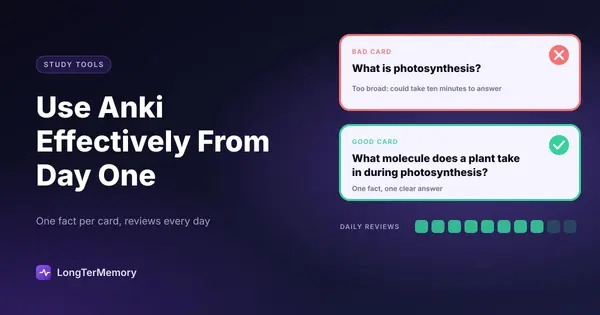
The golden rule is to make each card test one specific fact. If a card asks for too much, you will never know which part you actually remembered. If a card is too vague, you will fool yourself into thinking you know it.
Here are examples of bad and good cards.
| Bad card | Why it fails | Good card | Why it works |
|---|---|---|---|
| What is photosynthesis? | Too broad; could take ten minutes to answer | What molecule does a plant take in during photosynthesis? | Tests one specific fact |
| Explain World War II | Impossible to evaluate consistently | What event marked the beginning of World War II in Europe? | Clear, specific answer |
| List the cranial nerves | Overloads working memory | Name the cranial nerve responsible for smell. | Tests one item |
| What does mitosis do? | Vague wording | During mitosis, one parent cell produces how many daughter cells? | Precise and scorable |
Another important rule is to put the question on the front and the answer on the back. This sounds obvious, but many beginners write cards that are basically re-reading. A card that says “Mitosis produces two identical daughter cells” on the front and nothing on the back is not a flashcard. It is a note.
Card Types That Work Best for Beginners
Anki offers several card types, but beginners should start with the two simplest: basic cards and cloze deletions.
Basic cards have a question on the front and an answer on the back. They are ideal for definitions, facts, and discrete pieces of information. “What is the capital of France?” on the front and “Paris” on the back is a classic basic card.
Cloze deletion cards show a sentence with a missing word or phrase. Your job is to recall what belongs in the blank. For example: “The {{c1::mitochondria}} are the powerhouse of the cell.” Cloze cards are excellent for learning from notes because you can turn a paragraph into several cards quickly.
Avoid complex card types like typed answers, image occlusion, and reverse cards until you are comfortable with the basics. These features are powerful, but they add friction when you are still learning the workflow.
Daily Anki Habits That Produce Results
Anki works because of consistency, not intensity. Ten minutes every day beats two hours once a week. The algorithm is designed around frequent, distributed review. If you skip days, cards pile up and the system starts to feel overwhelming.
The simplest effective habit is this: open Anki every day, review all due cards, and add a small number of new cards. How many new cards depends on your capacity. For most beginners, ten to twenty new cards per day is sustainable. Advanced users might add fifty or more, but only after they know their review load is manageable.
When reviewing, grade yourself honestly. Anki gives you buttons like Again, Hard, Good, and Easy. Use them based on how well you actually knew the answer, not on how well you want to know it. If you got the answer mostly right but struggled, choose Hard. If you had no idea, choose Again. The algorithm depends on accurate feedback to schedule cards optimally.
The Most Common Beginner Mistakes
Three mistakes destroy most new Anki habits.
The first is creating too many cards too fast. It feels productive to add fifty cards in one sitting, but those cards will come back to review over the next few days and swamp you. Start small. Add ten to fifteen cards per day and let your review load stabilize before adding more.
The second mistake is using Anki as a highlighter. If you copy sentences from your textbook onto cards without changing them into questions, you are not doing active recall. You are just reading familiar text in a different format. Every card should require you to generate an answer from memory.
The third mistake is giving up during the first week. Anki feels hard at first because the algorithm is still learning your memory, and because you have not yet built the habit. The first two weeks are the hardest. After that, the routine becomes automatic and the results become visible.
When to Review and When to Stop
Anki tells you how many cards are due each day. Your job is to clear that number. Do not add new cards if your review queue is already too large. The priority is always reviews first, new cards second.
A good session length is whatever you can sustain daily. For many people, that is fifteen to thirty minutes. If you need to stop before finishing all reviews, that is better than skipping entirely, but try to avoid it. Incomplete reviews disrupt the spacing schedule.
If you find yourself pressing Easy on every card just to finish faster, slow down. The goal is learning, not inbox zero. It is okay to take longer on hard cards. That struggle is where the memory strengthening happens.
Using Anki for Different Subjects
Anki works for almost any subject, but the card design changes.
For language learning, cards should include context. A card that asks for a translation in both directions is better than a card with an isolated word. Include example sentences, audio when possible, and notes about collocation.
For medicine and law, focus on relationships, not just facts. Instead of asking “What is drug X?” ask “Which condition does drug X treat, and what is its main side effect?” Clinical and legal exams test application, not memorization in isolation.
For math and science, Anki is best for definitions, theorems, and problem-solving triggers. Do not try to replace problem practice with flashcards. Use Anki to remember the tools, then solve problems separately to build skill.
| Subject | Best card style | What to avoid |
|---|---|---|
| Languages | Translation with context | Isolated words without sentences |
| Medicine | Disease, mechanism, treatment | Rote lists without clinical reasoning |
| Law | Rule and application | Long case summaries |
| Math | Theorems and definitions | Step-by-step solutions |
| History | Cause, event, consequence | Vague essay prompts |
When Anki Becomes a Burden
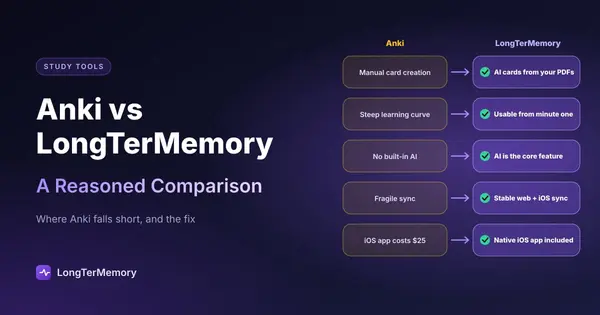
Anki is powerful, but it is not perfect. Creating cards manually takes time. The interface is dated. Syncing can be finicky. And if your study material is mostly in PDFs, lecture slides, or notes, converting everything into cards can feel like a second job.
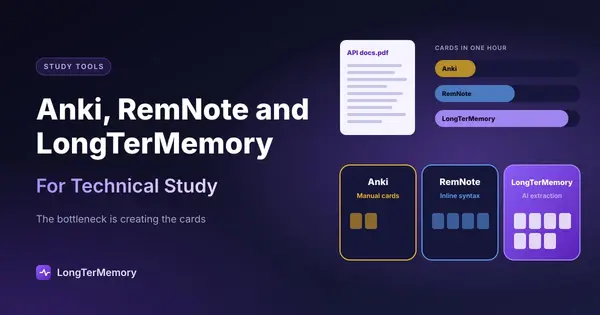
If you find yourself spending more time making cards than actually learning, consider using a tool that automates card creation. LongTerMemory can generate Anki-style question-and-answer cards directly from your PDFs, PowerPoint files, photos of notes, or pasted text. You still review with spaced repetition, but you skip the hours of manual card entry.
The principle matters more than the tool. Whether you use Anki, LongTerMemory, or paper flashcards, the core idea is the same: test yourself repeatedly over time, and let the spacing algorithm do the scheduling.
If you want to understand how does spaced repetition work before tuning your Anki settings, our college guide covers the science and the scheduling.
Building a Long-Term Anki Habit
The people who get the most value from Anki are the ones who turn it into a daily habit they barely have to think about. They review at the same time each day, often linked to an existing routine like breakfast, a commute, or the start of a study session.
Habit stacking helps. Tell yourself, “After I pour my morning coffee, I will open Anki.” The existing habit becomes the trigger for the new one. Over a few weeks, the sequence becomes automatic.
Track your streak if it motivates you, but do not let a missed day become a reason to quit. One missed review is a data point, not a failure. The next day, open the app and continue. Long-term retention comes from cumulative consistency, not perfect attendance.
The Bottom Line
Anki is not magic. It is a system for doing something simple at the right intervals: retrieving information from memory. When you use it correctly, it dramatically improves how much you remember. When you use it poorly, it becomes another forgotten app on your desktop.
Start with one or two decks. Write specific, single-fact cards. Review daily. Grade yourself honestly. Add new cards slowly. And remember that the goal is not to finish cards. The goal is to know the material.
If the manual card creation slows you down, LongTerMemory offers an alternative path that keeps the power of spaced repetition while removing the busywork. Either way, the habit is what matters. Start small, stay consistent, and let the spacing do the rest.