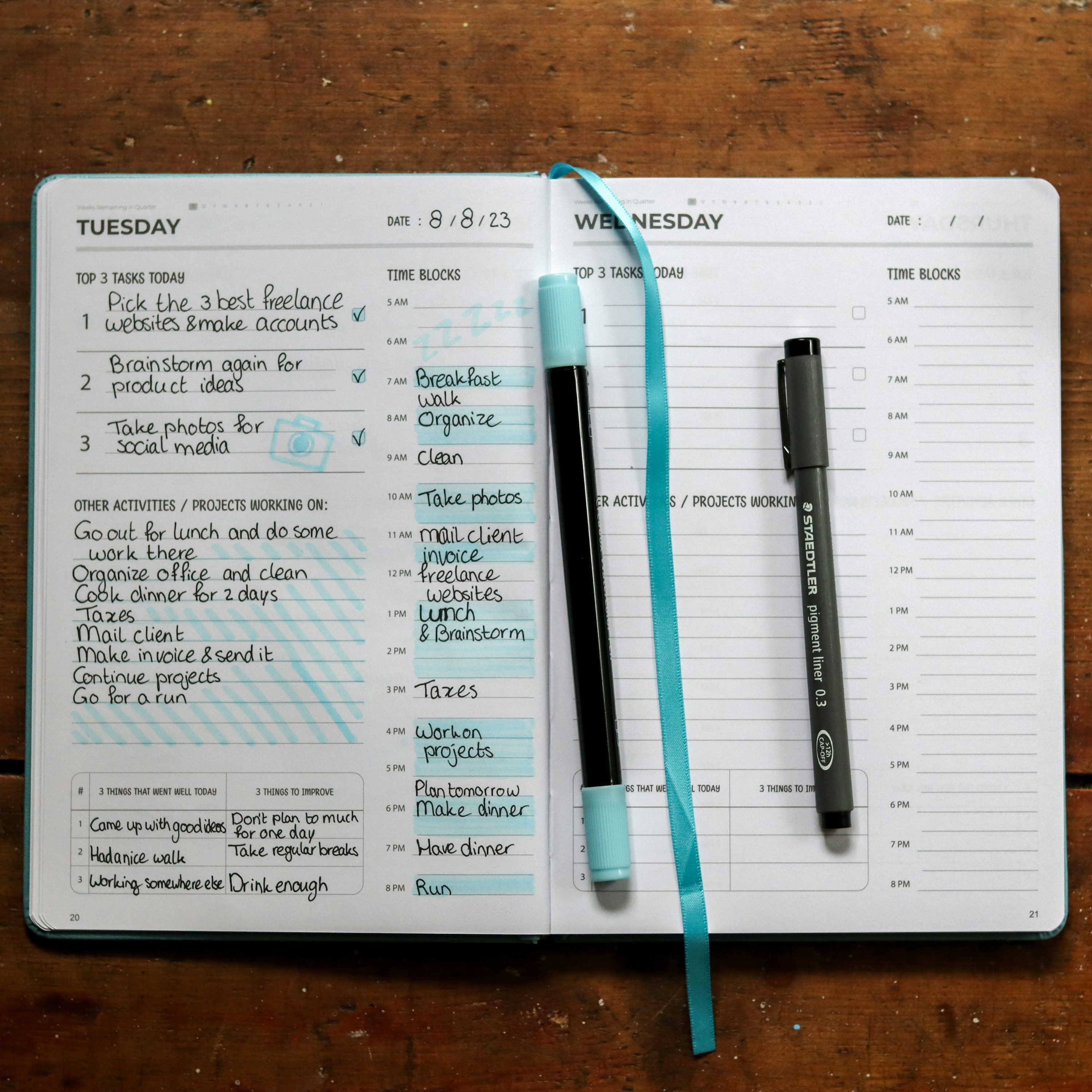

You’ve probably built a study schedule before. A nice color-coded one, maybe, blocking out every hour from 6am to 10pm across seven days. And you probably abandoned it by Wednesday, because real life doesn’t respect color-coded blocks.
This is one of the most common patterns in students who struggle with consistency: not a lack of discipline, but a scheduling approach that was never designed to survive contact with an actual week. If you’ve cycled through this same failure a few times, the problem isn’t you, it’s the structure you’re using.
Why Rigid Daily Schedules Collapse
A daily schedule treats every day as identical: same wake time, same study blocks, same subjects in the same order. The problem is that no two days in a real week are actually identical. Monday might have a three-hour class block. Wednesday might have a work shift. Friday evening is, realistically, never going to be your most productive study time no matter what the plan says.
When a rigid daily plan meets an actual disruption, whether that’s a friend’s emergency, an unexpectedly long meeting, or just running low on energy, the entire structure breaks. And here’s the part that really kills momentum: once you’ve missed the Tuesday block, the whole system feels broken, and it’s tempting to abandon the schedule entirely rather than just adjusting.
A weekly rhythm solves this differently. Instead of asking “what happens at 4pm on Tuesday,” it asks “what needs to happen sometime this week, and which days are actually good candidates for it.” That flexibility is not a compromise, it’s what makes the system durable.
Designing Your Weekly Rhythm
Start by mapping your week’s fixed obligations, classes, work shifts, commitments you can’t move, before you place a single minute of study time. This sounds obvious, but most people do it backwards: they design an ideal study schedule first, then get frustrated when real commitments don’t fit around it.
Once your fixed obligations are mapped, look for your natural pockets of availability. These usually fall into a few recognizable categories:
| Pocket Type | Example | Best Use |
|---|---|---|
| Long open block | Free afternoon, no classes | Deep work, new material, hardest topics |
| Short gap | 30-45 min between classes | Flashcard review, active recall drills |
| Commute/transit time | Bus, train, walk | Audio review, light recall practice |
| Wind-down block | 30 min before bed | Light review, never new hard material |
The mistake most people make is treating all study time as interchangeable. It’s not. Learning brand-new, cognitively demanding material during a 20-minute gap between classes is a losing proposition, you’ll barely get oriented before you have to stop. That same 20-minute gap is, however, perfect for a focused flashcard review session. Match the task to the pocket, not the other way around.
Balancing New Material, Review, and Practice Across the Week
A study routine that only ever introduces new content will feel productive in the moment and produce weak results over time, because nothing gets reinforced. A routine that’s all review and no new material stalls your progress. The balance that tends to work best across a week looks roughly like this:
- 40% new material: first exposure to concepts you haven’t covered yet
- 35% active review: retrieval practice on material from the past 1-3 weeks
- 25% practice application: problem sets, practice questions, applying concepts in new contexts
This ratio isn’t a rigid law, adjust it based on where you are in a course or how close an exam is, but it’s a useful default. Notice that review isn’t an afterthought squeezed in when you have spare time, it’s over a third of your weekly study time by design. This is what actually prevents the “I studied this three weeks ago and now it’s completely gone” experience that derails so many otherwise hardworking students.
A Sample Weekly Structure
Here’s what this can look like in practice for someone with a fairly typical student schedule:
- Monday: Long block after class, new material for the hardest subject
- Tuesday: Short gaps for review, one focused practice-problem session in the evening
- Wednesday: Work shift day, review only, using commute time and a short evening block
- Thursday: Long open block, new material for a second subject plus practice application
- Friday: Light day, quick review session only, protect the evening for rest
- Saturday: Medium block for catching up on anything behind schedule, plus a full review pass
- Sunday: Planning for the week ahead, light review, no new material
Notice this isn’t uniform. Some days carry more weight than others, and that’s intentional. A weekly rhythm should mirror your actual energy and obligation patterns, not fight against them.
How to Adapt the Routine When Life Interrupts
This is the part most study-schedule advice skips entirely, and it’s the actual reason most schedules fail. Life interrupts. Something will come up almost every week: illness, a family obligation, an unexpectedly demanding work week. A routine that has no answer for disruption isn’t a routine, it’s a fragile plan waiting to break.
Build in slack deliberately, rather than discovering it’s missing when you need it. A few principles that make routines resilient:
- Leave one buffer block per week with nothing scheduled. When nothing goes wrong, use it for extra review. When something does go wrong, this is where the missed work goes, without cascading into every other day.
- Protect review time before new-material time when you’re behind. If a disrupted week means you can’t do everything, skipping a new-material session costs you less than skipping review, since review is what prevents past learning from evaporating.
- Never try to “make up” a full missed week in one day. Cramming five days of planned study into one session doesn’t work, it just produces exhaustion and poor retention. Instead, redistribute the lost time gradually across the following week.
- Reassess weekly, not just when things go wrong. Spend ten minutes every Sunday looking at what actually happened the previous week versus what you planned. Adjust the pockets and ratios based on reality, not on how you wish the week had gone.
The Role of Spaced Review in a Weekly System
The “review” portion of your weekly rhythm works best when it isn’t random. Reviewing whatever feels stale, or whatever you happen to remember needing to revisit, is much less effective than a system that tracks what you learned and resurfaces it at the right intervals automatically.
This is where spaced repetition earns its place inside a weekly routine rather than as a separate technique you use occasionally. If Monday’s new material gets flagged for review three days later, then again the following week, then again two weeks after that, the review portion of your schedule essentially runs itself, you just show up and do what the system tells you needs attention today.
A tool like LongTerMemory is built around exactly this problem: you upload your study materials once, and it automatically generates spaced-repetition flashcards and schedules your review sessions so the “35% review” slice of your week doesn’t require you to remember what needs revisiting. You open the app during your short-gap pockets, and there’s already a prioritized queue waiting, no planning required in the moment.
Matching Your Routine to Your Actual Energy Patterns
Most weekly schedules are built around available time slots and completely ignore energy, which is a mistake, because the same hour of the day is not equally productive for everyone. Some people do their sharpest thinking early in the morning; others don’t hit real focus until late afternoon or evening. Building your routine around the schedule you have while ignoring when you actually think clearly is a common reason otherwise well-structured plans underperform.
Spend one week simply noticing, without trying to change anything, when you feel genuinely focused versus when you’re just going through the motions. Then, where possible, shift your hardest, highest-value tasks (new material, difficult problem sets) into those genuine focus windows, and push lower-demand tasks (light review, organizing notes, flashcard drills) into the times when your energy is naturally lower. You don’t need to fight your own biology to be productive, you just need to stop scheduling your hardest work for your worst hours.
Protecting the Routine From Its Biggest Threat: All-or-Nothing Thinking
The single most common reason a reasonable weekly routine collapses isn’t a bad design, it’s a psychological trap: missing one session and treating that as proof the whole system has failed. A missed Tuesday block doesn’t erase Monday’s progress, and it doesn’t doom Wednesday either, unless you decide it does by abandoning the rest of the week in response.
Reframe missed sessions as data, not failure. Ask what specifically caused the miss, was the block scheduled at an unrealistic time, did an obligation genuinely conflict, was it simple avoidance, and adjust accordingly rather than scrapping the entire structure. A routine that bends slightly under pressure and keeps going will always outperform a rigid one that shatters at the first disruption and has to be rebuilt from scratch every few weeks. Durability, not perfection, is the actual design goal.
The Real Measure of a Good Routine
A weekly study routine isn’t successful because it looks impressive on paper. It’s successful if you’re still following a recognizable version of it eight weeks from now. That’s the actual test, not whether week one goes perfectly, but whether the structure survives a bad week without collapsing entirely.
Build in flexibility from the start, balance new learning with genuine review, and treat disruptions as something the system should absorb rather than something that breaks it. A routine designed this way doesn’t need willpower to sustain, it needs occasional ten-minute check-ins to keep it honest. That’s a dramatically easier thing to maintain than a rigid schedule you’re constantly failing to follow.