How to Pass AWS Certified Solutions Architect Exam
Pass the AWS Solutions Architect Associate (SAA-C03): the 30 services to know, scenario question strategies, and practice tests that match the real exam.
Table of Contents
- The SAA-C03 Exam at a Glance
- The 30 Most Important AWS Services to Know for the Exam
- Compute
- Storage
- Databases
- Networking and content delivery
- Security and identity
- Integration and monitoring
- Learn the confusable pairs as pairs
- Scenario-Based Question Strategies for the SAA-C03
- Step 1: Read the last sentence first
- Step 2: Find the keyword that decides it
- Step 3: Eliminate, then choose
- Step 4: Manage your time
- Practice Tests and Question Banks That Actually Match the Real Exam
- Practice resources compared
- How to use practice tests well
- An 8-Week SAA-C03 Study Plan
- Hands-on matters
- Common SAA-C03 Mistakes
- Remember the Details Without Writing 500 Flashcards
- Frequently Asked Questions
- How hard is the AWS Solutions Architect Associate exam?
- How long should I study for the SAA-C03?
- What is the passing score for the SAA-C03?
- Do I need the Cloud Practitioner certification first?
- Which AWS services are most important for the exam?
- The Bottom Line
To pass the AWS Certified Solutions Architect Associate (SAA-C03), learn about 30 core services well enough to choose between them, practice reading scenario questions for their key requirement (cost, availability, performance, or security), and take full-length practice exams until you consistently score 80% or more. Most candidates with some cloud exposure need 6 to 10 weeks at 1 to 2 hours a day.
I’ve coached a lot of people through this exam, and the ones who struggle almost never fail because of missing facts. They fail because they know what S3 and EFS are, but can’t decide which one a scenario needs in 90 seconds. That’s what this exam really tests: architectural judgment under time pressure.
This guide covers the exam format, the 30 services that matter most, how to break down scenario questions, and which practice tests are worth your time.
The SAA-C03 Exam at a Glance
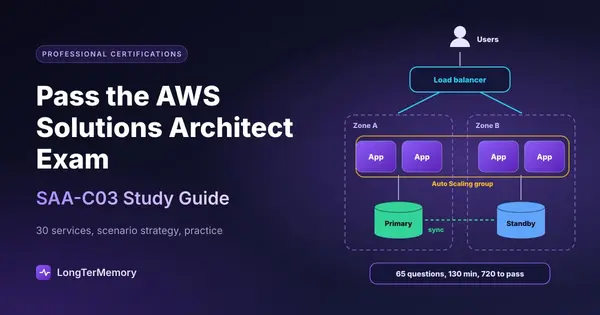
The SAA-C03 is a 130-minute exam with 65 multiple choice and multiple response questions, scored from 100 to 1,000, with 720 needed to pass. 15 of the 65 questions are unscored, but you can’t tell which ones.
| Detail | SAA-C03 |
|---|---|
| Questions | 65 (50 scored, 15 unscored) |
| Time | 130 minutes |
| Format | Multiple choice and multiple response |
| Passing score | 720 out of 1,000 (scaled) |
| Cost | 150 USD |
| Validity | 3 years |
| Delivery | Test center or online proctored |
The exam is organized into four domains, according to the official AWS exam guide:
| Domain | Weight |
|---|---|
| Design Secure Architectures | 30% |
| Design Resilient Architectures | 26% |
| Design High-Performing Architectures | 24% |
| Design Cost-Optimized Architectures | 20% |
Security is the biggest slice, so IAM, encryption and network isolation deserve real time. AWS updates its exam guides from time to time, so check the current version on the AWS certification site before you book.
The 30 Most Important AWS Services to Know for the Exam
You don’t need to know all 200+ AWS services; you need to know about 30 deeply enough to pick the right one for a requirement. The rest appear rarely and usually as wrong answers.
Here’s the list I give everyone, grouped by category, with the one thing the exam loves to test about each.
Compute
| Service | What the exam tests |
|---|---|
| EC2 | Instance types, purchasing options (On-Demand, Reserved, Spot, Savings Plans) |
| Auto Scaling | Scaling policies, scaling across AZs |
| Lambda | Serverless, event-driven, 15-minute max runtime |
| ECS / Fargate | Containers without managing servers |
| Elastic Beanstalk | Quick deployment with managed infrastructure |
Storage
| Service | What the exam tests |
|---|---|
| S3 | Storage classes, lifecycle rules, versioning, replication |
| S3 Glacier | Archive tiers and retrieval times |
| EBS | Volume types (gp3, io2), snapshots, single-AZ |
| EFS | Shared file system for many Linux instances |
| FSx | Windows file shares and Lustre for high performance |
| Storage Gateway | Hybrid storage with on-premises |
Databases
| Service | What the exam tests |
|---|---|
| RDS | Multi-AZ (availability) vs read replicas (performance) |
| Aurora | Higher performance, Aurora Serverless, Global Database |
| DynamoDB | Key-value, single-digit millisecond latency, DAX caching |
| ElastiCache | Redis or Memcached caching for read-heavy loads |
| Redshift | Data warehouse for analytics |
Networking and content delivery
| Service | What the exam tests |
|---|---|
| VPC | Subnets, route tables, NAT gateway, security groups vs NACLs |
| Route 53 | Routing policies (failover, latency, weighted, geolocation) |
| CloudFront | Caching at the edge, signed URLs |
| Elastic Load Balancing | ALB (HTTP, paths) vs NLB (TCP, extreme performance) |
| Direct Connect / Site-to-Site VPN | Hybrid connectivity options |
| Global Accelerator | Static IPs and global performance for non-HTTP apps |
Security and identity
| Service | What the exam tests |
|---|---|
| IAM | Roles vs users, policies, least privilege |
| KMS | Encryption key management |
| Cognito | User sign-in for web and mobile apps |
| WAF / Shield | Web attack and DDoS protection |
| Secrets Manager | Rotating database credentials |
Integration and monitoring
| Service | What the exam tests |
|---|---|
| SQS | Decoupling, standard vs FIFO queues |
| SNS | Pub/sub notifications, fan-out |
| CloudWatch / CloudTrail | Metrics and alarms vs API activity logs |
That’s 30. If you can explain the “why this one and not that one” for each pair (EBS vs EFS, SQS vs SNS, Multi-AZ vs read replicas), you’re in great shape.
Learn the confusable pairs as pairs
The exam loves near-miss answers. Study these side by side:
| Pair | Quick rule |
|---|---|
| Multi-AZ vs read replica | Availability vs read scaling |
| Security group vs NACL | Stateful instance level vs stateless subnet level |
| SQS vs SNS | Queue (pull, one consumer) vs topic (push, many subscribers) |
| ALB vs NLB | Layer 7 routing vs Layer 4 speed and static IP |
| EBS vs EFS vs S3 | Block for one instance vs shared file vs object storage |
| CloudWatch vs CloudTrail | Performance metrics vs who did what |
Scenario-Based Question Strategies for the SAA-C03
Every SAA-C03 scenario has one deciding requirement; find it first, then eliminate answers that don’t meet it. Most questions give you two answers that work technically, and only one that fits the requirement best.
Step 1: Read the last sentence first
The final line tells you what’s being asked: “Which solution meets these requirements with the LEAST operational overhead?” That phrase changes the correct answer completely.
Step 2: Find the keyword that decides it
Common decider phrases and what they usually point to:
| Phrase in the question | Usually points toward |
|---|---|
| ”Most cost-effective” | Spot, S3 lifecycle to cheaper tiers, serverless, right-sizing |
| ”Least operational overhead” | Managed or serverless services (Lambda, Fargate, Aurora Serverless) |
| “Highly available” | Multi-AZ, Auto Scaling across AZs, load balancer |
| ”Decouple” | SQS, SNS, EventBridge |
| ”Millisecond latency at any scale” | DynamoDB |
| ”Shared storage for many instances” | EFS (Linux) or FSx (Windows) |
| “Unpredictable traffic” | Auto Scaling, serverless, on-demand capacity |
| ”Encrypt at rest with managed keys” | KMS |
Step 3: Eliminate, then choose
Cross out answers that:
- Add manual work when “least overhead” is asked
- Use a single AZ when “high availability” is asked
- Overprovision when “cost-effective” is asked
- Use services that don’t exist or don’t do what’s described
Usually that leaves two. Pick the one that meets the requirement most directly with the fewest moving parts.
Step 4: Manage your time
130 minutes for 65 questions is 2 minutes per question. Use the flag feature: answer everything on the first pass, flag anything uncertain, and come back. Never leave a question blank, because there’s no penalty for guessing.
Practice Tests and Question Banks That Actually Match the Real Exam
Use practice exams that mirror the SAA-C03 style (long scenarios with several plausible answers) and treat every wrong answer as a study item. Practice tests are your best predictor of readiness.
Practice resources compared
| Resource | Cost | Strength |
|---|---|---|
| AWS Skill Builder official practice question set | Free | Real exam style, small set |
| AWS Skill Builder official practice exam | Subscription | Closest to real scoring and difficulty |
| Popular third-party practice exam sets (e.g. Tutorials Dojo) | About 15 to 20 USD | Large question banks with detailed explanations |
| Video course question banks | Included with course | Good for checking each section |
| AWS whitepapers (Well-Architected Framework) | Free | The logic behind “best” answers |
How to use practice tests well
- Take one early (after about two weeks) to find weak domains
- Review every question, including those you got right by guessing
- Write down why each wrong answer is wrong, that’s where the learning is
- Turn every mistake into a flashcard (“When do you use NLB over ALB?”)
- Aim for 80%+ consistently on new tests before booking
For a structured way to work through mistakes, see how to learn from practice test mistakes.
An 8-Week SAA-C03 Study Plan
Spend the first five weeks learning services by domain with hands-on labs, then three weeks on practice exams and targeted review. Adjust if you have less cloud experience.
| Week | Focus |
|---|---|
| 1 | IAM, VPC basics, EC2, AWS global infrastructure |
| 2 | Storage: S3, EBS, EFS, FSx, Glacier |
| 3 | Databases: RDS, Aurora, DynamoDB, ElastiCache |
| 4 | Networking: Route 53, CloudFront, ELB, hybrid connectivity |
| 5 | Decoupling, serverless, monitoring, security services |
| 6 | First full practice exams, fix weakest domain |
| 7 | More practice exams, review flashcards daily |
| 8 | Final practice exams, light review, book the exam |
Daily, keep a 15 to 20 minute flashcard review running from week 1. AWS has a lot of small facts (instance limits, storage class retrieval times, Lambda limits), and spaced review stops them from slipping while you learn the next domain.
Hands-on matters
Use the AWS Free Tier to build a few things: a VPC with public and private subnets, an Auto Scaling group behind an ALB, an S3 static site with CloudFront. Building them once makes scenario questions much easier to picture. Just set a billing alarm first.
If you’re planning the next step after this one, the AWS DevOps Engineer Professional guide covers the professional level.
Common SAA-C03 Mistakes
The most common mistakes are memorizing service descriptions instead of trade-offs, skipping hands-on practice, and booking the exam before scoring 80% on practice tests. Also:
- Ignoring the cost domain. It’s 20% of the exam and many technical people undervalue it.
- Over-studying rare services. Focus on the core 30.
- Not reading the last sentence. “Least overhead” vs “most cost-effective” changes everything.
- Cramming the week before. AWS details fade fast without spaced review.
Remember the Details Without Writing 500 Flashcards
The SAA-C03 has hundreds of small, testable details, and writing flashcards for all of them takes many hours. That’s the part worth automating.
With LongTerMemory, you can upload AWS whitepapers, your course notes, or the exam guide as PDFs, and it generates question and answer cards automatically. Then spaced repetition schedules every review, so storage class details from week 2 are still there in week 8. It saves you the hours of card writing so you can spend them in the AWS console instead. The free trial is a good way to cover your first few study weeks.
Frequently Asked Questions
How hard is the AWS Solutions Architect Associate exam?
It’s moderately hard. The questions are long scenarios with several plausible answers, so it tests judgment more than memorization. With 6 to 10 weeks of focused preparation, most candidates pass.
How long should I study for the SAA-C03?
Most people need 6 to 10 weeks at 1 to 2 hours a day. With strong AWS work experience, 3 to 4 weeks can be enough; complete beginners may need 12 weeks.
What is the passing score for the SAA-C03?
720 out of 1,000 on a scaled score. Aim for 80% or higher on quality practice exams before booking.
Do I need the Cloud Practitioner certification first?
No, it’s not required. It can help beginners, but many candidates go straight to the Solutions Architect Associate.
Which AWS services are most important for the exam?
Focus on EC2, S3, VPC, IAM, RDS, Aurora, DynamoDB, ELB, Auto Scaling, Route 53, CloudFront, Lambda, SQS, SNS and KMS, and know the trade-offs between similar services.
The Bottom Line
Passing the SAA-C03 comes down to knowing about 30 services well enough to compare them, reading every scenario for its deciding requirement, and practicing with realistic exams until 80% feels routine. Build a few things hands-on, keep a daily spaced review going, and treat every practice mistake as a study item.
Start today: download the official exam guide, list the 30 services above, and rate yourself on each one. Your weakest five are week 1.