How to Pass the CFA Level 1 Exam: A Realistic Study Plan
A realistic 300-hour CFA Level 1 study plan: topic weights, why Ethics, FRA and Quant matter most, and when to switch from end-of-chapter questions to mocks.
Table of Contents
- CFA Level 1 Exam at a Glance
- Topic weights
- Building a 300-Hour CFA Level 1 Study Plan That Fits Real Life
- The three phases
- What 12 to 15 hours a week looks like
- Topic order that actually works
- Build in a buffer
- Don't forget what you studied in month one
- Ethics, FRA, and Quant: The Three Pillars of CFA Level 1 Success
- Ethics: the highest-weight topic (15 to 20%)
- FRA: the technical backbone (11 to 14%)
- Quant: small weight, big influence (6 to 9%)
- End-of-Chapter Questions vs. Mock Exams: Timing Your Practice Right
- Why not start mocks earlier?
- How many mocks?
- Review takes longer than the mock
- Pacing on exam day
- A Sample 20-Week CFA Level 1 Plan
- Common Mistakes That Sink CFA Level 1 Candidates
- Frequently Asked Questions
- How many hours do I need to study for CFA Level 1?
- How long should a CFA Level 1 study plan be?
- What is the hardest topic in CFA Level 1?
- What is the CFA Level 1 pass rate?
- When should I start taking CFA mock exams?
- Keep 300 Hours of Material in Your Head
- The Bottom Line
To pass CFA Level 1, plan for about 300 hours over 4 to 6 months (roughly 12 to 15 hours a week), finish the full curriculum at least 6 weeks before your exam, and spend those final weeks on timed mock exams and spaced review of your mistakes. Prioritize Ethics and Financial Statement Analysis (the two heaviest topics), build solid Quant foundations early because later topics depend on them, and use end-of-chapter questions while learning but full mocks for the final phase.
CFA Level 1 has a reputation, and it’s earned. Recent pass rates have hovered around 40%, which means most candidates who sit the exam don’t pass it. But here’s what the statistics don’t show: a large share of those failing candidates ran out of time in their prep, not out of ability. They planned for 300 hours and managed 180. They left Ethics for the last week. They took their first mock exam ten days before test day.
This is a plan built for real life, with a job, a commute, and the occasional week when nothing goes right.
CFA Level 1 Exam at a Glance
CFA Level 1 is a 4.5-hour computer-based exam of 180 multiple-choice questions, split into two sessions of 2 hours and 15 minutes with an optional break. Each question has three answer options, there’s no penalty for wrong answers, and the minimum passing score isn’t published (candidates commonly estimate it around 65 to 70%).
Topic weights
| Topic | Exam weight |
|---|---|
| Ethical and Professional Standards | 15 to 20% |
| Financial Statement Analysis (FRA) | 11 to 14% |
| Equity Investments | 11 to 14% |
| Fixed Income | 11 to 14% |
| Portfolio Management | 8 to 12% |
| Alternative Investments | 7 to 10% |
| Quantitative Methods | 6 to 9% |
| Economics | 6 to 9% |
| Corporate Issuers | 6 to 9% |
| Derivatives | 5 to 8% |
Check the CFA Institute website for the current weights and your exam window (Level 1 is offered several times a year), since both are updated periodically. You also need to complete the Practical Skills Modules before receiving your result; they aren’t graded, but don’t leave them for the last week.
Building a 300-Hour CFA Level 1 Study Plan That Fits Real Life
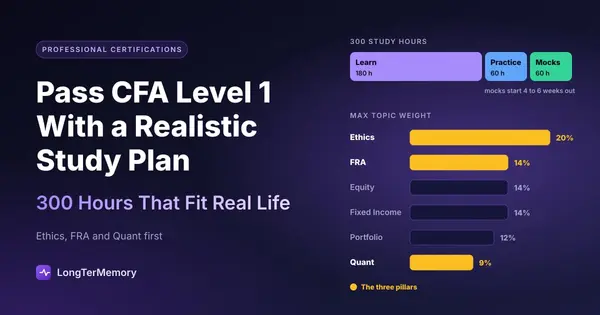
Divide your preparation into three phases: learning (about 60% of your hours), practice (about 20%), and mock exams plus final review (about 20%). The most common mistake is giving the learning phase 90% of the time and treating the mock exam phase as an afterthought.
CFA Institute surveys of candidates have consistently found that successful candidates report studying around 300 hours on average. Some need less (finance graduates), some need more (career changers from non-quantitative fields). Use 300 as your planning number and adjust after the first month.
The three phases
| Phase | Hours | Weeks (at 12 to 15 h/week) | Goal |
|---|---|---|---|
| 1. Learn | About 180 | Weeks 1 to 14 | Read every topic, do end-of-chapter questions |
| 2. Practice | About 60 | Weeks 15 to 18 | Topic tests, weak areas, question banks |
| 3. Mock and review | About 60 | Final 4 to 6 weeks | At least 3 to 4 full timed mocks, review errors |
What 12 to 15 hours a week looks like
For a working professional, a sustainable week looks something like this:
| Day | Session | Time |
|---|---|---|
| Monday to Thursday | 1 reading or video + 20 questions | 1.5 h per day |
| Friday | Light: flashcards and formula review | 45 min |
| Saturday | Long session: new material + topic test | 4 h |
| Sunday | Review the week + error log | 2 to 3 h |
| Total | About 14 h |
Topic order that actually works
Study in an order that builds foundations first:
- Quantitative Methods (time value of money, statistics) because Fixed Income, Equity, Derivatives, and Portfolio Management all use it.
- Economics and Corporate Issuers.
- Financial Statement Analysis (the biggest technical topic, give it 4 to 5 weeks).
- Equity and Fixed Income.
- Derivatives, Alternatives, Portfolio Management.
- Ethics in the middle of your plan, and then reviewed continuously until the exam.
Build in a buffer
Life will steal 2 to 3 weeks from your plan: a project deadline, a sick week, a holiday. Schedule them in advance as buffer weeks, so that falling behind doesn’t mean losing the mock exam phase.
Don’t forget what you studied in month one
By month four, the time value of money calculations from month one will be fuzzy, unless you keep reviewing them. Spaced repetition solves that: short daily reviews of formulas, definitions, and past mistakes, spread over the whole plan. Our guide on why you forget what you study explains the forgetting curve behind this.
Ethics, FRA, and Quant: The Three Pillars of CFA Level 1 Success
Ethics and FRA together make up roughly a third of the exam, and Quant is the foundation for most other topics, so these three pillars deserve a disproportionate share of your attention. Weakness in any of them tends to spread to the rest of your score.
Ethics: the highest-weight topic (15 to 20%)
Ethics feels easy when you read it and hard when you answer questions. The questions are full of nuance: whether something is a violation depends on small details in the scenario.
How to study it:
- Learn the Standards of Professional Conduct (I to VII) and their sub-sections cold.
- Work through the examples in the Standards of Practice Handbook, where most question patterns come from.
- Study it twice: once in the middle of your plan, once in the final month.
- Do Ethics questions every week, not just during the Ethics weeks.
There’s also a well-known “ethics adjustment”: CFA Institute has said that for candidates very close to the passing score, Ethics performance can decide the result. Another reason not to treat it as an afterthought.
FRA: the technical backbone (11 to 14%)
Financial Statement Analysis is the most technical part of Level 1, and it’s also one of the most useful for Levels 2 and 3. Focus on:
- How the three financial statements connect
- Inventory methods (FIFO vs. weighted average) and their effects
- Long-lived assets, depreciation, and impairment
- Income taxes (deferred tax assets and liabilities)
- Leases, from the lessee’s perspective
- Ratio analysis and DuPont decomposition
- Differences between IFRS and US GAAP
A practical tip: make a “statement effects” table for each accounting choice (effect on income, assets, cash flow, ratios). It turns a huge pile of rules into a pattern you can recall under pressure.
Quant: small weight, big influence (6 to 9%)
Quant’s direct weight is modest, but it powers other topics. Time value of money, for example, shows up in Fixed Income, Equity valuation, and Corporate Issuers. Make sure you’re fluent in:
- Time value of money on your calculator (the BA II Plus or HP 12C are the approved models)
- Rates and returns (holding period, money-weighted vs. time-weighted)
- Statistical measures, probability, and hypothesis testing basics
- Simple linear regression
Master your calculator early. Every question where you fumble the calculator steals time from the next one.
End-of-Chapter Questions vs. Mock Exams: Timing Your Practice Right
Use end-of-chapter questions while you’re learning a topic, topic tests once a topic is finished, and full timed mock exams only in the last 4 to 6 weeks. Each type of practice does a different job, and using them in the wrong phase wastes their value.
| Practice type | When | What it measures | How to use it |
|---|---|---|---|
| End-of-chapter (EOC) questions | During the learning phase | Did I understand this reading? | Right after each reading, untimed |
| Topic tests / question bank | After finishing a topic | Can I answer mixed questions on this topic? | Timed, about 90 seconds per question |
| Full mock exams | Final 4 to 6 weeks | Am I exam-ready across all topics? | Full 4.5 hours, real conditions |
Why not start mocks earlier?
A mock taken before you’ve covered all the topics mostly measures what you haven’t studied yet. It’s discouraging and tells you little. A mock taken in the final phase shows exactly which topics need your remaining hours.
How many mocks?
Plan for at least 3 to 4 full mock exams, including the ones available in the CFA Institute Learning Ecosystem. A common rule of thumb among candidates: consistently scoring 70% or higher on official mocks is a good sign of readiness.
Review takes longer than the mock
A 4.5-hour mock needs about 4 to 6 hours of review. For every wrong answer (and every lucky guess):
- Write down why you got it wrong: knowledge gap, misread, calculation error, or time pressure.
- Write the correct principle in one line.
- Add it to your error log or flashcards, then review it on a spaced schedule.
Our guide on learning from practice test mistakes goes deeper into building an error log that actually changes your score.
Pacing on exam day
180 questions in 270 minutes gives you 90 seconds per question. Set checkpoints: in each 135-minute session, aim to be at question 30 by about 22 minutes, question 60 by about 45 minutes, and so on. If a question is eating time, guess, flag, and come back. There’s no penalty for wrong answers, so never leave a question blank.
A Sample 20-Week CFA Level 1 Plan
Twenty weeks at 14 to 15 hours a week covers about 300 hours, with time for buffers and a full mock exam phase.
| Weeks | Focus |
|---|---|
| 1 to 2 | Quantitative Methods + calculator fluency |
| 3 | Economics |
| 4 | Corporate Issuers |
| 5 to 8 | Financial Statement Analysis |
| 9 | Ethics (first pass) |
| 10 to 11 | Equity Investments |
| 12 to 13 | Fixed Income |
| 14 | Derivatives + Alternative Investments |
| 15 | Portfolio Management + buffer |
| 16 | Topic tests on weakest topics |
| 17 to 19 | Mock exams (one or two per week) + error review + Ethics second pass |
| 20 | Light review, formulas, rest before exam day |
If you have less time, shorten the learning weeks, not the mock phase.
Common Mistakes That Sink CFA Level 1 Candidates
The biggest killers are underestimating total hours, leaving Ethics to the end, and not doing enough timed practice. Others to avoid:
- Reading without doing questions (“I’ll do practice at the end”)
- Spending too long on low-weight topics you enjoy
- Not reviewing early topics, then relearning them in the final month
- Taking the first mock in the final week
- Skipping the Practical Skills Modules until it’s urgent
- Ignoring calculator practice
If you’re thinking ahead, Level 2 is a very different exam built around item sets. Our CFA Level II preparation guide explains the jump.
Frequently Asked Questions
How many hours do I need to study for CFA Level 1?
Plan for about 300 hours. CFA Institute candidate surveys show successful candidates typically report around that amount. Finance graduates may need less, career changers often need more.
How long should a CFA Level 1 study plan be?
Most working candidates need 4 to 6 months at 12 to 15 hours a week. A 20-week plan with buffer weeks and a 4 to 6 week mock exam phase is a realistic structure.
What is the hardest topic in CFA Level 1?
Most candidates find Financial Statement Analysis the hardest because of its volume and technical detail. Ethics is often underestimated because it reads easily but its questions are nuanced.
What is the CFA Level 1 pass rate?
Recent Level 1 pass rates have been around 40%, varying by exam window. Check CFA Institute’s published results for the latest figures.
When should I start taking CFA mock exams?
In the final 4 to 6 weeks, after covering all topics. Take at least 3 to 4 full timed mocks under exam conditions, and spend as much time reviewing them as taking them.
Keep 300 Hours of Material in Your Head
The hardest part of CFA Level 1 isn’t any single topic. It’s keeping 10 topics fresh at the same time, so that what you learned in week 3 is still there in week 20.
LongTerMemory is built for that. Upload your curriculum readings, notes, or formula sheets as PDFs, and it generates question and answer cards automatically, then schedules them with spaced repetition so every formula and Ethics standard comes back right before you’d forget it. You skip hours of manual card writing and spend them on question banks and mocks instead. The free trial is a good way to cover your first study topics and see the difference.
The Bottom Line
A realistic CFA Level 1 study plan is about 300 hours, three phases, and protected time for mocks. Build Quant foundations first, give FRA the weeks it needs, study Ethics twice and practice it weekly, and use EOC questions, topic tests, and full mocks each at the right moment.
Plan for buffers, review continuously, and walk in having already sat the exam three or four times at your desk. That’s how you end up in the 40% who pass.