How to Create a Monthly Study Calendar for a Big Exam
Turn a huge syllabus into monthly milestones, with built-in review cycles and practice tests that tell you when to change the plan. Includes a 6-month example.
Table of Contents
- What a Monthly Plan Does (and Doesn't Do)
- Step 1: Work Out Your Real Capacity
- Dividing the Exam Curriculum Into Monthly Milestones
- Weigh Your Topics Before You Allocate Them
- Write Milestones You Can Measure
- Leave the Last Stretch Free of New Material
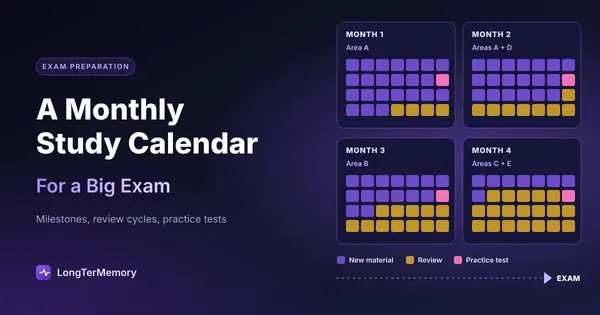
- A Sample 6-Month Calendar
- Building Monthly Review Cycles to Keep Early Material Alive
- How Long Should Review Gaps Be?
- The Budget: How Much Time Goes to Review?
- Three Types of Review to Schedule
- Adjusting the Monthly Plan Based on Practice Test Results
- A Simple Decision Table
- Look at Why You Lost the Points
- Make the Trade-Offs Explicit
- Keeping the Calendar Alive
- Automate the Part That Doesn't Need Your Judgment
- FAQ
- How far in advance should I start a monthly calendar?
- How many hours a month should I study?
- What if I miss a whole week?
- Should I study topics in the order of the textbook?
- When should I take my first full-length practice test?
- The Bottom Line
Six months until the exam can feel like plenty of time, right up until you notice it’s now eight weeks and you’re still on chapter four.
That’s what a monthly study calendar prevents. It breaks a huge exam into a few checkpoints, so you always know whether you’re on pace, while there’s still time to do something about it. A daily to-do list can’t show you that. A vague plan to “finish everything by May” can’t either.
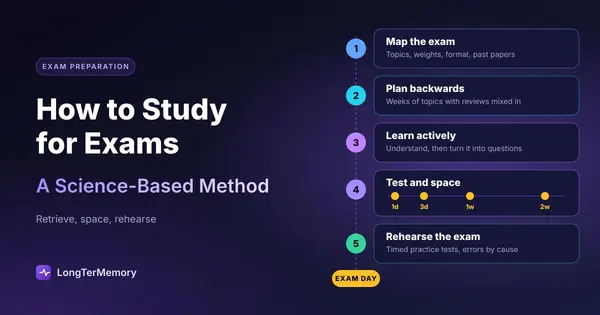
Here’s how to build one that holds up: split the syllabus into monthly milestones, keep earlier material alive with built-in review cycles, and use practice tests to change course when the plan and reality disagree. If your exam is weeks rather than months away, the shorter plan in our guide on how to prepare for an exam fits better.
What a Monthly Plan Does (and Doesn’t Do)
A monthly plan sets your direction and your checkpoints, while your weekly and daily schedules handle the details. Think of it as the top layer of three.
| Layer | Question it answers | Example |
|---|---|---|
| Monthly | What must be true by the end of this month? | ”Cardiology and renal finished, practice test at 60%“ |
| Weekly | Which topics will I cover this week? | ”Heart failure, arrhythmias, 150 practice questions” |
| Daily | What do I do in today’s session? | “45 minutes on arrhythmias, then 20 minutes of reviews” |
The most common mistake is planning all six months in day-by-day detail. By the third week, one sick day has wrecked the schedule and you’ve abandoned it. Keep distant months broad and detail only the next week or two.
Step 1: Work Out Your Real Capacity
Before you divide anything, count the hours you actually have. Most study calendars fail here, because they’re built on the hours you wish you had.
A simple estimate looks like this:
- Count the weeks until the exam, and remove holidays, busy periods at work and any trips.
- Estimate your weekly hours based on a typical week, not your best one.
- Multiply them to get your total.
- Take off about 20% for the illness, overtime and family surprises you can’t predict.
Here’s an example: 24 weeks minus 2 for holidays gives 22 weeks. At 12 hours a week, that’s 264 hours. After the 20% buffer, you’re planning with about 210.
That buffer isn’t pessimism. In a classic study of the planning fallacy, Roger Buehler and colleagues asked students to predict how long their thesis would take. On average, they predicted about 34 days. It took about 56. You’re not immune, and neither am I.
Now compare your total to what the exam usually demands. If your exam’s guidance or candidates’ reports point to 300 hours and you’ve got 210, you’ve learned something crucial while you can still act: start earlier, cut lower-value material, or move the exam date. It’s far better to find this out now than in the final month.
Dividing the Exam Curriculum Into Monthly Milestones
Good milestones divide the syllabus by exam weight and difficulty, not by page count, and each one describes a result you can check. Follow these steps to build yours.
Weigh Your Topics Before You Allocate Them
List every syllabus area and give it three scores: its share of the exam, how difficult it is for you, and how well you already know it. Most large exams publish a blueprint with weights, so start there.
| Topic | Exam weight | Difficulty for you | Current knowledge | Priority |
|---|---|---|---|---|
| Area A | 30% | High | Low | Top, and start early |
| Area B | 25% | Medium | Medium | High |
| Area C | 20% | Low | High | Short review only |
| Area D | 15% | High | Low | Medium, start early |
| Area E | 10% | Low | Low | Low, cover efficiently |
A small area you find hard shouldn’t swallow a month, however much it bothers you. And a big area you already know well still needs a check, even if it doesn’t need weeks of work.
Write Milestones You Can Measure
“Study pharmacology” isn’t a milestone, because you can never tell whether you’ve done it. Try this instead:
- Weak: Work on financial reporting.
- Strong: Finish the financial reporting readings, create flashcards for them, and score at least 70% on a 50-question topic set.
Each milestone should cover three things: the material you’ll complete, the output you’ll create, and the score that shows it worked.
Leave the Last Stretch Free of New Material
Plan to finish new content with about 20 to 25% of your time left, which means the last 4 to 6 weeks of a six-month plan. Those weeks are for mixed practice, weak spots and full-length tests. If you plan new content right up to the exam, delays will consume your review time, and that’s the time that raises scores most.
A Sample 6-Month Calendar
Here’s how this could look for a professional exam at about 10 to 12 hours a week. Adjust it to fit your blueprint.
| Month | New content | Review focus | Checkpoint |
|---|---|---|---|
| 1 | Area A, first half, plus foundations | Daily cards only | Baseline test in week 1, topic quiz at the end |
| 2 | Area A, second half, plus Area D | Month 1 topics, once a week | Half-length test |
| 3 | Area B | Months 1 and 2, weekly mixed set | Half-length test |
| 4 | Areas C and E | Months 1 to 3, weekly mixed set | First full-length test |
| 5 | No new content, weak spots only | Mixed practice across everything | Full-length test every 2 weeks |
| 6 | No new content, fine-tuning | Light, targeted review | Final full-length test about a week out |
Notice that a baseline test comes first. It feels pointless to take a test before you’ve studied, but it shows you the exam’s style and your starting point. Trying to answer before you know the material can also help you learn from what comes next.
Shorter plans keep the same shape. For a 3-month exam, use about 8 weeks for content and 4 for review. For 12 months, go slower and add more review rounds, not more new content at the end.
If you’ve got an exam date and you’re starting to place your milestones, our guide to planning backward from your exam date goes deeper on that step. For a full plan from scratch, see how to create a study plan as a beginner.
Building Monthly Review Cycles to Keep Early Material Alive
Add review to the calendar as scheduled work from month two onward, or month one’s material will quietly fade while you’re busy with month four. New topics always feel more urgent, so without a fixed slot, review is the first thing to go.
The research makes this hard to ignore. When Jaap Murre and Joeri Dros replicated Ebbinghaus’s forgetting experiment in 2015, memory savings for nonsense syllables had fallen to about 4% after 31 days. Real exam material sticks better, because it’s meaningful and connected, but the direction is the same. Material you studied and never revisited can’t be expected to survive six months.
How Long Should Review Gaps Be?
The longer you need to remember something, the further apart your reviews can sit. A large study led by Nicholas Cepeda in 2008 found that the best gap depends on how far away the test is: around 20 to 40% of the retention interval for a one-week horizon, falling to about 5 to 10% for a horizon of one year.
Translating that into something you can actually use:
| Time until the exam | Reasonable review gap |
|---|---|
| 6 months or more | Every 2 to 4 weeks |
| 2 to 3 months | Every 1 to 2 weeks |
| 1 month | Every few days |
| Final week | Light daily review of weak items |
These ranges are approximations based on that research, not exact rules. Flashcard software handles the detailed scheduling for you, so you don’t have to calculate anything card by card.
The Budget: How Much Time Goes to Review?
A useful rule is that review should take up a growing share of your time as the months go by:
| Stage | New material | Review and practice |
|---|---|---|
| Months 1 and 2 | 80% | 20% |
| Months 3 and 4 | 60% | 40% |
| Months 5 and 6 | 0 to 10% | 90 to 100% |
Three Types of Review to Schedule
- Daily spaced repetition (10 to 20 minutes). This handles individual facts and is the foundation of spaced repetition. Even on your busiest day, try to keep this going.
- A weekly mixed set (45 to 60 minutes). Do questions drawn from all the topics you’ve covered so far. Mixing feels harder than doing one topic at a time, because you also have to work out what kind of problem you’re facing. That’s the skill the real exam tests.
- A monthly “lookback” session (2 to 3 hours). At the end of each month, try writing out the main ideas of earlier topics from memory, then take a test and find out what’s slipping.
The review needs to be active recall, not re-reading. Rereading old chapters feels reassuring, but it mostly tells you the text looks familiar.
Adjusting the Monthly Plan Based on Practice Test Results
Use a practice test around the middle of each month to decide whether to carry on, reallocate time or change your overall strategy. A plan that never changes means you’re not paying attention to the results.
A Simple Decision Table
Compare your score with the target you’ve set for that point in the plan.
| Result on your mid-month test | What it probably means | What to do |
|---|---|---|
| At or above target | The plan is working | Keep going, and don’t add hours for the sake of it |
| Up to 5 points below | Normal variation or a small gap | Spend extra time on the weakest topic |
| 5 to 15 points below | You’re behind | Move 20 to 30% of next month’s time to weak areas |
| More than 15 points below | The plan or the method is wrong | Stop and rethink: cut scope, add hours, or move the date |
| Flat for two tests in a row | The method has stopped working | Change how you study, not just how long |
The points above are rules of thumb, so adjust them to your exam. Single scores can bounce around, so look for trends across tests and don’t overreact to one result. Do look for patterns though: if one area keeps dragging you down, deal with it.
Look at Why You Lost the Points
The total score tells you much less than the reasons behind your wrong answers. Sort every mistake into a category:
- Didn’t know it. Needs content review and flashcards.
- Knew it but forgot. Needs more frequent retrieval.
- Misread the question. Needs a slower reading method.
- Ran out of time. Needs timed practice.
Each cause has a different fix. Spending more time on content won’t help if you’re running out of time on the test. Here’s more on how to learn from your practice test mistakes.
Make the Trade-Offs Explicit
When you fall behind, time has to come from somewhere, and you should decide where instead of leaving it to chance. In order, try these:
- Use your buffer. That’s what it’s there for.
- Cut low-weight, high-effort topics to the bare essentials.
- Move some time away from strong areas.
- Add hours, within reason. Check against the signs of burnout before you pile them on.
- Reschedule the exam if you can and the gap is too large.
What you shouldn’t do is delete your review time so you can keep pushing through new content. That’s the trade most likely to backfire. If you tend to fill every available slot, read up on how to avoid over-scheduling your study time.
Keeping the Calendar Alive
A calendar only works if you look at it. Set aside 30 minutes at the end of each month for a short review, and ask yourself these four questions:
- Did I hit this month’s milestones?
- What did my practice test say?
- What got in the way, and will it happen again?
- What needs to change for next month?
Then rewrite the next month in light of your answers. A plan that’s been revised five times is usually a healthier plan than one that has never changed.
As for tools, use whatever you’ll open daily. A paper wall calendar has one great advantage, which is that you can see it from your desk. A digital calendar is better for moving things around, and a spreadsheet works well for scores. These study planning templates give you a ready-made starting point.
Automate the Part That Doesn’t Need Your Judgment
Your calendar decides which topics to work on and when. But working out which individual facts you need to review today shouldn’t be another job on your list. LongTerMemory takes care of that: upload your textbook PDFs or notes, and it generates questions and answers, then schedules every review automatically with spaced repetition. You save hours of card writing, month one’s material keeps coming back when you need it, and your attention stays on the big decisions. You can try it free with one chapter from your syllabus.
FAQ
How far in advance should I start a monthly calendar?
It depends on the exam, but start as soon as you have a date and a syllabus. Exams that take many months of preparation, such as professional certifications or admission tests, benefit most. For anything under about four weeks, a weekly plan works better.
How many hours a month should I study?
Start with your exam’s total recommended hours and divide them by the months you have. Add 20% as a buffer. If the result is more than you can realistically sustain, you need a longer runway, not a more optimistic schedule.
What if I miss a whole week?
Use your buffer first, and don’t try to double up the following week. Then look at the rest of the month and decide what’s lowest priority. Keep your daily reviews going as soon as you can, because they protect what you’ve already learned.
Should I study topics in the order of the textbook?
Not necessarily. Follow the book’s order when topics build on one another, but otherwise start with high-weight areas and your weakest subjects. Early months give hard topics more time and more rounds of review.
When should I take my first full-length practice test?
Take a short diagnostic in the first week, then your first full-length test around the two-thirds mark of your plan. After that, take them regularly until about a week before the exam, and leave enough time to review each one properly.
The Bottom Line
A big exam gets a lot less scary when you stop looking at it as one huge mountain. Count your real hours, turn the syllabus into measurable monthly milestones, reserve time for review from the second month, and let your practice tests tell you when to change course. You won’t follow the plan perfectly. You don’t have to. You only need to notice early when you’ve drifted, and that’s what a monthly calendar is for.