
How to Combine Note-Taking Methods for Better Retention
Compare Cornell, outline, and mapping notes, learn when to use each, and combine them into one system that turns notes into retrieval practice.
Table of Contents
- Overview of Major Note-Taking Formats (Cornell, Outline, Mapping)
- The Cornell Method
- The Outline Method
- The Mapping Method
- What Does the Research Say?
- When to Use Each Method Based on Subject and Learning Goal
- Match Method to Goal
- Match Method to Context
- A Hybrid System: Capture, Process, Retrieve
- Step 1: Capture (During Class or Reading)
- Step 2: Process (Within 24 Hours)
- Step 3: Retrieve (Scheduled Review)
- A Sample Page Layout
- Converting Notes Into Review-Ready Retrieval Practice Material
- Quick Conversion Rules
- Write Better Questions
- Automate the Boring Part
- Digital vs Paper: Does It Matter?
- Common Mistakes When Combining Methods
- Putting It Together: A One-Week Trial
- Frequently Asked Questions
- Which note-taking method is best for retention?
- Is the Cornell method better than outlining?
- Are mind maps good for studying?
- Should I handwrite or type my notes?
- How soon should I review my notes?
- The Bottom Line
The best note-taking system is usually not a single method but a combination: capture with the format that fits the material, then process the notes into questions you can use for retrieval practice. No format wins on its own. What matters is what you do with the notes after the lecture ends.
Every semester, students ask me, “Which is better, Cornell notes or outlines?” My honest answer is always the same: it depends on the subject, the speaker, and, most importantly, your review habits. In this guide I will compare the major formats, show you when each one shines, and walk you through a hybrid system that works for almost any course.
Overview of Major Note-Taking Formats (Cornell, Outline, Mapping)
Each major format organizes information differently: Cornell adds a review structure, outlining shows hierarchy, and mapping shows relationships. Here is a quick comparison before we dig into each.
| Method | Structure | Best for | Weakness |
|---|---|---|---|
| Cornell | Page split into cues, notes, and summary | Lectures and textbooks you will review later | Takes setup and discipline |
| Outline | Indented hierarchy of topics and subtopics | Well-organized lectures and readings | Poor at showing links between ideas |
| Mapping (mind maps) | Visual web of connected ideas | Conceptual, interconnected subjects | Hard to use at lecture speed |
| Charting | Table with categories as columns | Comparisons, facts across items | Only suits tabular content |
| Sentence method | One line per new idea | Fast, disorganized lectures | Little structure, needs cleanup |
| Flow notes | Own words and arrows, non-linear | Understanding how ideas connect | Can be messy to review |
The Cornell Method
Developed by Walter Pauk at Cornell University in the 1950s, this method divides a page into three areas: a narrow cue column on the left, a wide notes area on the right, and a summary section at the bottom. During class you write in the notes area. Afterward you write keywords or questions in the cue column and a short summary at the bottom.
The beauty is built-in review: cover the notes, read the cues, and try to recall what is written. That is retrieval practice in a notebook.
The Outline Method
You use indentation to show hierarchy: main topics, subtopics, and supporting details. It is clean, quick, and works well when the lecturer is organized. It pairs naturally with digital tools that let you collapse and expand sections.
The Mapping Method
You put the central idea in the middle and branch out to related ideas. Mapping makes relationships visible, which is excellent for understanding but slow to produce live. Many students prefer to build maps after class rather than during.
What Does the Research Say?
Honest answer: not as much as the internet suggests. Research on note-taking consistently finds two benefits: the encoding that happens while you write, and the external storage you review later. A frequently cited 2014 study by Mueller and Oppenheimer found that students who took longhand notes sometimes outperformed laptop typists on conceptual questions, though later replication attempts found a weaker effect. The safer takeaway is that processing the material in your own words matters more than the tool, and that notes you actually review beat notes you never open.
When to Use Each Method Based on Subject and Learning Goal
Pick your format using two questions: how is the material organized, and what will you have to do with it later? Here is a decision table.
| Subject or situation | Recommended method | Why |
|---|---|---|
| History, law, biology (hierarchical content) | Outline or Cornell | Clear structure, lots of facts |
| Philosophy, psychology theory | Mapping or flow notes | Ideas link to each other |
| Chemistry, math, physics | Cornell plus worked problems | Cues for formulas, steps below |
| Comparing drugs, laws, or tools | Charting | Side-by-side facts |
| Fast, rambling lecture | Sentence method, clean up later | Capture first, organize after |
| Textbook reading | Cornell or outline | Slower pace, room to structure |
| Brainstorming and essay planning | Mapping | Exploring connections |
| Exam in 3 days | Cornell cues plus flashcards | Fast retrieval practice |
Match Method to Goal
- Goal: memorize facts. Choose Cornell or charts, because the cue column converts directly into questions.
- Goal: understand a system. Choose mapping or flow notes, then explain the map out loud.
- Goal: write an essay. Choose outline, since it mirrors an essay structure.
- Goal: solve problems. Use Cornell with a side column for method or common errors.
Match Method to Context
Live lectures demand speed, so use outline or sentence notes. Textbooks and recorded lectures allow slower, richer formats like Cornell and mapping. In seminars and discussions, flow notes help you track arguments.
A Hybrid System: Capture, Process, Retrieve
The most reliable combined system has three steps: capture quickly, process within 24 hours, and then retrieve on a schedule. It borrows the best from each format.
Step 1: Capture (During Class or Reading)
Use whichever format suits the pace.
- Fast lecture: outline or sentence method on the right two thirds of the page.
- Leave the left third blank, Cornell style, for cues later.
- Mark confusing items with a question mark so you can resolve them.
Step 2: Process (Within 24 Hours)
The forgetting curve described by Hermann Ebbinghaus shows that a large share of new information fades within a day or two without review. Processing soon after class slows that loss.
- Fill the cue column. Write a question or keyword for each chunk of notes.
- Write a summary of the page in two or three sentences, from memory first.
- Draw a quick map for any section that involves relationships.
- Add a chart if you notice a comparison across several items.
- Resolve question marks using the textbook or by asking.
This single pass layers Cornell structure over outline notes, then adds mapping and charts only where they help. You are not using four methods everywhere, you are using each method where it fits.
Step 3: Retrieve (Scheduled Review)
Cover the notes and answer your cue questions out loud or on paper. Then repeat after 1 day, 3 days, 1 week, and 3 weeks. This is active recall combined with spacing, two of the most robustly supported techniques in learning science.
A Sample Page Layout
| Left column (cues) | Right area (notes) |
|---|---|
| What is operant conditioning? | Learning through consequences: reinforcement and punishment |
| 4 types of consequences | Positive and negative reinforcement, positive and negative punishment |
| Example of negative reinforcement | Taking painkillers removes a headache, so pill-taking increases |
| Summary (bottom): Behavior changes based on its consequences, which can add or remove stimuli. |
Converting Notes Into Review-Ready Retrieval Practice Material
Notes become a study tool only when you turn them into questions, so convert every cue and key fact into something you can test yourself on. Notes you only re-read give you the illusion of knowing, not actual retention.
Quick Conversion Rules
| Note type | Turn into |
|---|---|
| Definition | ”What is X?” card |
| Process or steps | ”List the steps of Y” card |
| Comparison chart | One question per row, such as “How does A differ from B?” |
| Mind map branch | ”Explain how X relates to Y” prompt |
| Formula | ”When do you use this formula and why?” card |
| Summary sentence | Cover it and rewrite it from memory |
Write Better Questions
- Keep each card to one idea.
- Ask “why” and “how,” not just “what.”
- Avoid yes/no questions, which are easy to guess.
- Include a small example where possible.
Automate the Boring Part
Writing hundreds of cards by hand is the step where most students quit. LongTerMemory lets you upload your typed notes or a PDF scan and generates question and answer pairs automatically, then schedules each review with spaced repetition. If you want to compare approaches to manual flashcard tools, read our Anki vs LongTerMemory comparison. Either way, the principle stays the same: notes are raw material, flashcards are the finished product.
Digital vs Paper: Does It Matter?
Either works, as long as you process and review. Paper encourages selective, own-words writing because you cannot type as fast as people speak. Digital offers search, easy editing, and integration with flashcard tools.
| Factor | Paper | Digital |
|---|---|---|
| Speed | Slower, forces summarizing | Faster, risk of verbatim transcription |
| Diagrams and maps | Easy | Needs a stylus or app |
| Searchability | None | Excellent |
| Distractions | Few | Many |
| Linking to flashcards | Manual | Easy |
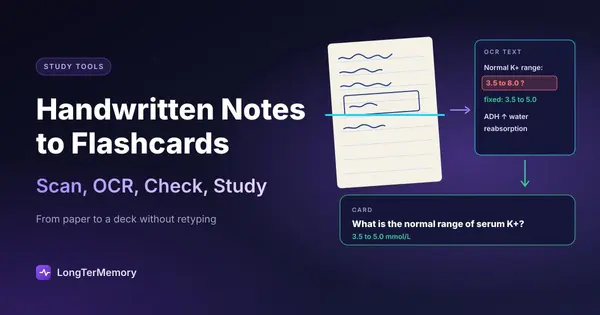
A popular compromise: take handwritten notes in class, then type up and refine them while processing. That second pass doubles as free review. If you’d rather skip the retyping, you can turn handwritten notes into flashcards with a scan and OCR.
Common Mistakes When Combining Methods
- Using every method on every page. More formats do not mean better learning. Choose by purpose.
- Never processing. Raw notes left untouched fade fast. Always do the 24 hour pass.
- Copying the slides. Notes should paraphrase, not duplicate.
- Skipping the cue column. It is the cheapest retrieval tool in the system.
- Over-formatting. Beautiful notes that take two hours to make are a poor trade for ten minutes of self-testing. (An AI quiz generator can even write the questions for you.)
- Changing systems every week. Give any system at least three or four weeks before judging it.
Putting It Together: A One-Week Trial
Test the hybrid system for one week and judge it by how your review sessions feel, not how your notes look. Here is a simple trial plan.
| Day | Task |
|---|---|
| Monday | Capture class notes with outline plus a blank left column |
| Monday evening | Process: add cues and a summary (15 minutes) |
| Tuesday | Self-test on Monday’s cues |
| Wednesday | Capture and process the next class |
| Thursday | Self-test on both days’ cues |
| Friday | Turn the best cues into flashcards |
| Weekend | Spaced review of all cards |
At the end of the week, ask yourself: Did reviewing feel faster? Did I find gaps earlier? Did I spend my time on questions instead of re-reading? If the answers are yes, keep going and adjust the details.
Frequently Asked Questions
Which note-taking method is best for retention?
There is no single best method. The Cornell method has a built-in review step, which helps retention, but the biggest gains come from converting notes to questions and reviewing over time.
Is the Cornell method better than outlining?
Cornell adds cues and summaries, so it supports review better. Outlining is faster in live lectures. Combining them, with outline-style notes inside a Cornell layout, gives you both.
Are mind maps good for studying?
They are excellent for understanding relationships and for essay planning, but less efficient for memorizing large numbers of facts. Use them alongside question-based review.
Should I handwrite or type my notes?
Choose whichever you will actually review. Handwriting encourages summarizing, while typing makes search and flashcard creation easier. A hybrid approach works well.
How soon should I review my notes?
Within 24 hours for the first pass, then at spaced intervals such as 3 days, 1 week, and 3 weeks.
The Bottom Line
Stop asking which note-taking method is best and start asking which one fits this material and this goal. Capture in the format that suits the pace, process within a day by adding cues, summaries, maps, or charts where useful, and then retrieve on a spaced schedule.
Try the one-week trial, keep what works, drop what does not, and let your notes become what they were always meant to be: raw material for remembering.