How to Use the Keyword Method for Foreign Language Study
Learn the keyword method for foreign vocabulary: build sound-alike images, lock them in with spaced repetition, and know when context sentences work better.
Table of Contents
- What the Keyword Method Is and Why It Works
- Setting Up Keyword Connections Between Foreign Words and Native Sounds
- Step 1: Say the foreign word out loud
- Step 2: Find a sound-alike keyword
- Step 3: Build a vivid image linking keyword and meaning
- Step 4: Rehearse in both directions
- Tips for when you're stuck
- Combining Keyword Images With Spaced Repetition for Vocabulary Retention
- Why keywords need review
- The combined workflow
- How many new words per day?
- The Keyword Method vs. Context Sentence Learning: When to Use Each
- When the keyword method shines
- When context sentences work better
- The hybrid approach
- Common Keyword Method Mistakes
- Build Your Vocabulary Deck Without the Busywork
- Frequently Asked Questions
- Does the keyword method really work?
- Does the keyword method work for abstract words?
- Will the keyword method hurt my pronunciation?
- How long does it take to create a keyword?
- Should I use the keyword method for every new word?
- The Bottom Line
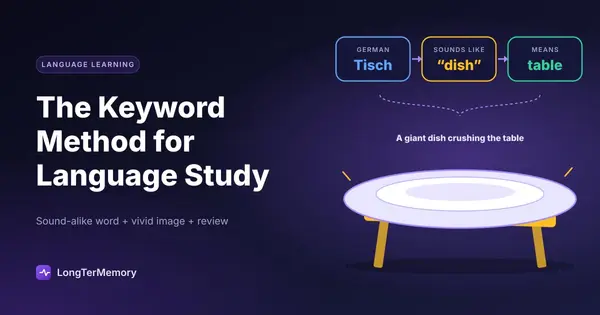
The keyword method helps you memorize foreign vocabulary by linking each word to a familiar word that sounds similar in your own language, then creating a vivid mental image that connects that sound-alike word with the real meaning. For example, German Tisch (table) sounds like “dish,” so you picture a giant dish sitting on a table. Studies since the 1970s show it can substantially boost vocabulary recall, especially when you combine it with spaced repetition.
If you’ve ever stared at a list of 30 new words, repeated them ten times, and then forgotten half of them by the next morning, you know the problem. Repetition alone is a weak glue. Your brain needs a hook, something to hang the new word on. Hooks like this are one piece of a bigger system to memorize fast and keep what you learn.
The keyword method gives it one. It feels a bit silly the first time you try it. Then you notice you still remember the words a week later, and suddenly it doesn’t feel silly anymore.
What the Keyword Method Is and Why It Works
The keyword method is a two-step mnemonic: first an acoustic link (foreign word to a similar-sounding keyword), then an imagery link (keyword to meaning). It works because it turns a meaningless string of sounds into something your memory already knows how to store: a picture and a story.
The method was developed by Richard Atkinson and Michael Raugh at Stanford in the mid-1970s. In their 1975 study on Russian vocabulary, learners using the keyword method recalled about 72% of words on a final test, compared with about 46% for a control group who learned the same words without it. Many later studies have found similar advantages, particularly for concrete nouns.
Why does it work so well?
- It uses what you already know. The keyword is a word you’ve known for years, so it’s easy to retrieve.
- It adds imagery. Psychologist Allan Paivio’s dual coding theory suggests we remember things better when they’re stored both verbally and visually.
- It forces elaboration. Building the image makes you think about the word for 10 to 20 seconds, which creates a deeper memory than simple repetition.
Here’s how it compares with plain rote repetition:
| Method | How it works | Short-term recall | Long-term recall without review |
|---|---|---|---|
| Rote repetition | Say the word and meaning many times | Moderate | Low |
| Keyword method | Sound-alike keyword + vivid image | High | Moderate (fades if not reviewed) |
| Keyword + spaced repetition | Image first, then scheduled reviews | High | High |
That last column matters, and we’ll come back to it.
Setting Up Keyword Connections Between Foreign Words and Native Sounds
A good keyword sounds like the beginning or most of the foreign word, is easy to picture, and leads to an image that clearly includes the real meaning. Here’s the step-by-step process.
Step 1: Say the foreign word out loud
Listen to the pronunciation first, ideally from a native speaker recording (dictionary apps and sites like Forvo have audio). The keyword has to match the sound, not the spelling. French poisson (fish) and poison look alike on paper but sound different, and your keyword needs to follow the sound.
Step 2: Find a sound-alike keyword
Ask yourself: “What does this sound like in my language?” It doesn’t need to be perfect. Matching the first syllable or two is usually enough.
| Foreign word | Meaning | Sounds like (keyword) |
|---|---|---|
| German Tisch | table | ”dish” |
| Spanish caballo | horse | ”cab eye yo” |
| French hérisson | hedgehog | ”hairy son” |
| Italian fragola | strawberry | ”fragile” |
| Japanese neko | cat | ”neck” |
| Spanish carta | letter | ”cart” |
Step 3: Build a vivid image linking keyword and meaning
This is the most important step. The image must interact: the keyword and the meaning should be doing something together, not just standing side by side.
- Tisch = table: a giant dish taking up the whole table, so there’s no room for anything else.
- Caballo = horse: a horse driving a cab, winking one eye, shouting “yo!” out the window.
- Hérisson = hedgehog: your hairy son curled up into a spiky ball on the sofa.
- Fragola = strawberry: a strawberry wrapped in bubble wrap with a “fragile” sticker.
- Neko = cat: a cat wrapped around your neck like a scarf.
The weirder, more exaggerated, and more emotional the image, the better it sticks. A slightly embarrassing image will outlast a polite one every time.
Step 4: Rehearse in both directions
Test yourself from foreign word to meaning (Tisch → dish → table) and from meaning to foreign word (table → dish → Tisch). The second direction is harder, because the keyword only gives you an approximate sound. That’s normal. Your pronunciation practice fills the gap.
Tips for when you’re stuck
- Use part of the word. For long words, only the first syllable needs a keyword. The rest often comes back once you have the start.
- Use names and places. “Paris,” “Elvis,” or a friend’s name can all be keywords.
- Use your other languages. If you speak a second language, a sound-alike from that language works fine.
- Add gender colors. For gendered languages, picture masculine nouns in blue, feminine in red, and neuter in green, or attach a gender-specific scene (for example, feminine nouns are on fire, masculine nouns explode). It’s a simple way to encode gender alongside meaning.
If you want to go further with mnemonics in general, our guide to using mnemonics for complex information covers other techniques that pair well with this one.
Combining Keyword Images With Spaced Repetition for Vocabulary Retention
The keyword method gets a word into memory quickly, and spaced repetition keeps it there. Without review, keyword memories fade. With review, they become permanent, and eventually you don’t even need the image anymore. It’s one of five methods in our guide to memorizing vocabulary fast, along with context sentences and word clusters.
Why keywords need review
Not every study has found long-lasting benefits. A 1995 study by Wang and Thomas found that the keyword advantage could shrink or disappear on delayed tests when learners didn’t review. That’s not a flaw of the keyword method so much as a reminder that every memory needs retrieval to last. A mnemonic gives you a strong start, but it’s not a substitute for practice.
The combined workflow
Here’s the routine I recommend:
- Create the keyword and image when you first meet the word (about 20 seconds per word).
- Make a flashcard with the foreign word on one side and the meaning plus a short note about your image on the other.
- Review on a spaced schedule: roughly 1 day, 3 days, 1 week, 2 weeks, 1 month later.
- Let the image fade naturally. After a few successful reviews, you’ll recall Tisch = table directly. The dish was just scaffolding.
A typical review schedule for new words:
| Review | Interval | What usually happens |
|---|---|---|
| 1 | Next day | You need the image to recall the word |
| 2 | 3 days later | The image comes back quickly |
| 3 | 1 week later | Sometimes you skip the image |
| 4 | 2 weeks later | Direct recall for most words |
| 5 | 1 month later | Word feels “native,” image is optional |
How many new words per day?
Ten to twenty new words a day is a sustainable pace for most learners using keywords plus spaced repetition. More than that, and both image-making and daily reviews start to feel like a chore. At 15 words a day, you’d meet over 5,000 new words in a year, which is more than enough for solid conversational fluency in most languages.
For a deeper look at scheduling, see our guide to spaced repetition for language learning and our post on long-term vocabulary retention.
The Keyword Method vs. Context Sentence Learning: When to Use Each
Use the keyword method for concrete, hard-to-remember words with no obvious link to your language, and use context sentences for abstract words, verbs with tricky usage, and words that are easy to guess from cognates. The best learners use both.
Here’s a practical comparison:
| Factor | Keyword method | Context sentences |
|---|---|---|
| Best for | Concrete nouns, “sticky” difficult words | Abstract words, verbs, phrases, grammar patterns |
| Speed to first recall | Very fast | Slower |
| Teaches usage and grammar | No | Yes |
| Teaches pronunciation | Only roughly | Yes, if you use audio |
| Works for cognates | Unnecessary | Natural fit |
| Effort per word | 15 to 30 seconds | 30 to 60 seconds |
| Risk | Can create a slight pronunciation bias | Can be slow for long lists |
When the keyword method shines
- Beginner vocabulary with lots of concrete nouns: food, animals, objects, body parts
- Exam cramming situations where you need 200 words in two weeks
- Words that just won’t stick after several reviews (“leeches,” as some flashcard users call them)
- Languages very different from yours, like Japanese, Korean, Russian, or Arabic for English speakers, where cognates are rare
When context sentences work better
- Abstract words: “nevertheless,” “responsibility,” “hope” are hard to picture
- Verbs and their patterns: knowing that Spanish pensar is followed by en matters more than a picture
- Words with multiple meanings: context shows which meaning you’re dealing with
- Intermediate and advanced learners who are reading and listening a lot already
The hybrid approach
My favorite combination: use a keyword image to learn the word, then put it in a context sentence on the back of your card. For Tisch: “Das Essen steht auf dem Tisch” (The food is on the table). You get the fast hook and the real usage. Add audio from a native speaker, and you’re covering meaning, usage, and pronunciation in one card.
Common Keyword Method Mistakes
The most common mistakes are weak images, keywords that don’t match the sound, and skipping review. Watch out for these:
- Static images. A dish next to a table is forgettable. A dish crushing a table is not.
- Spelling-based keywords. Always match the sound you hear, not the letters you see.
- Using it for every word. Cognates and simple words don’t need keywords. Save effort for hard words.
- Forgetting pronunciation. Always listen to native audio, so the keyword doesn’t distort how you say the word.
- No review. The keyword is the hook, spaced repetition is the rope.
Build Your Vocabulary Deck Without the Busywork
The keyword method is a creative task, and it’s best done by you. The image you invent is the one you’ll remember. What doesn’t need to be done by hand is all the rest: typing the vocabulary lists, building flashcards, and keeping track of review dates.
With LongTerMemory, you upload your textbook chapter, vocabulary list, or class notes as a PDF, and it generates question and answer cards for you, then schedules them with spaced repetition. You add your keyword images to the trickiest cards and let the system handle the timing. The free trial is a great way to test it on next week’s vocabulary list and see how many words you still know a month later.
Frequently Asked Questions
Does the keyword method really work?
Yes, especially for concrete vocabulary. Atkinson and Raugh’s 1975 study on Russian vocabulary found about 72% recall with the keyword method versus about 46% without it, and many later studies have confirmed a benefit.
Does the keyword method work for abstract words?
It’s harder, because abstract meanings are difficult to picture. You can use a concrete symbol (a scale for “justice,” a heart for “love”), but context sentences often work better for abstract words.
Will the keyword method hurt my pronunciation?
It can slightly bias your pronunciation toward the keyword if you’re not careful. Always learn the word with native audio, and treat the keyword as a memory hook, not a pronunciation guide.
How long does it take to create a keyword?
With practice, 10 to 30 seconds per word. At first it can take longer, but it gets faster within a week or two.
Should I use the keyword method for every new word?
No. Use it for difficult words that don’t stick. Cognates, very common words, and words you learn naturally from reading don’t need it.
The Bottom Line
The keyword method links a foreign word to a sound-alike native word and a vivid image, making vocabulary stick fast, and spaced repetition makes it last. Use it for hard, concrete words, pair it with context sentences for usage, and review on a schedule.
Try it right now: pick five words from your current lesson that keep slipping away. Give each one a keyword and the strangest image you can imagine. Test yourself tomorrow morning, and count how many come back.