How to Sit for a 6-Hour Professional Exam Without Fatigue
Build stamina for a long professional exam: full-length endurance training, a break plan for multi-hour tests, and nutrition, hydration and pacing that hold.
Table of Contents
- Which Exams Are This Long?
- Why Performance Drops in Long Exams
- Physical and Mental Endurance Training for Long Professional Exams
- Step 1: Build up gradually
- Step 2: Simulate the real conditions, all of them
- Step 3: Train your attention in between
- Step 4: Don't ignore the body
- Break Strategy for Multi-Hour Exams: When to Rest and When to Push
- Plan your breaks before exam day
- What to do during a break
- Micro-breaks inside a block
- When to push
- Energy Management Through Nutrition, Hydration, and Pacing
- Breakfast
- Snacks for breaks
- Hydration
- Caffeine
- Pacing
- The Mental Side: Staying Calm for Six Hours
- Your Exam-Week Checklist
- Frequently Asked Questions
- How do I build stamina for a long exam?
- Should I take breaks during a 6-hour exam if I feel fine?
- What should I eat before a long exam?
- How much water should I drink during a long exam?
- What if I feel exhausted halfway through the exam?
- Spend Your Energy on Recall, Not on Card Writing
- The Bottom Line
To get through a 6-hour professional exam without fatigue, train for it like an endurance event: take at least three full-length timed practice exams in the final month, plan every break in advance and always use them, eat a familiar low-sugar breakfast plus small snacks at each break, sip water steadily, and pace each block against checkpoint times. Stamina is a skill you build in practice, not something you hope to have on the day.
Here’s something nobody tells you when you register for a long exam. Plenty of candidates who know the material well still lose points in the last third of the test, not because the questions get harder, but because their brain does. Reading slows down. Careless mistakes creep in. You reread the same sentence three times and still don’t absorb it.
That’s exam fatigue, and it’s predictable. Which means it’s manageable. Most of this happens on exam day, but stamina starts in preparation: our exam study plan builds timed practice in from the start.
Which Exams Are This Long?
Many of the most important professional and licensing exams run 4 to 9 hours, often in one day. Here are some well-known examples (always confirm current details with the official exam body, since formats change):
| Exam | Approximate seat time | Structure |
|---|---|---|
| NCEES FE (engineering) | 6-hour appointment | 110 questions, one scheduled break |
| NCEES PE (most disciplines) | About 9-hour appointment | 80 questions, one scheduled break |
| USMLE Step 1 | 8 hours | 7 blocks of up to 60 minutes, 45 minutes of break time |
| MCAT | About 7.5 hours | 4 sections with optional breaks |
| CFA Level I | About 4.5 hours | 2 sessions with an optional break |
| Uniform Bar Exam (UBE) | 2 days, about 6 hours each | Essays and performance tests on day 1, MBE on day 2 |
Whatever your exam, the principles below apply. The longer the exam, the more they matter.
Why Performance Drops in Long Exams
Mental performance declines with time on task, and the drop is measurable even in normal school tests. A widely cited study by Sievertsen, Gino and Piovesan (PNAS, 2016), based on about 2 million Danish national test results, found that scores fell for every hour later in the day a test was taken, and that a 20 to 30 minute break raised scores by more than the hourly decline cost.
Three things are going on:
- Vigilance decrement. Sustained attention degrades after roughly 30 to 60 minutes of continuous focus. You don’t notice it, but your error rate climbs.
- Decision fatigue. A long exam is hundreds of consecutive decisions. Each one costs a little.
- Physical factors. Dehydration, blood sugar swings, poor posture, and eye strain all add up over 6 hours.
The good news: all three respond to training and planning.
Physical and Mental Endurance Training for Long Professional Exams
The single most effective stamina training is taking full-length practice exams under real conditions: same duration, same start time, same breaks, same food. Short daily sessions build knowledge. Only full-length sessions build endurance.
Step 1: Build up gradually
Don’t jump from 1-hour study sessions to a 6-hour simulation. Increase your continuous work time over 4 to 8 weeks:
| Weeks before the exam | Longest weekly session | Format |
|---|---|---|
| 8 to 6 | 2 to 3 hours | Two timed blocks with a short break |
| 6 to 4 | 3 to 4 hours | Half-length simulation |
| 4 to 1 | Full exam length | At least 3 full-length simulations, about one per week |
| Final week | No full simulations | Short review only, protect your energy |
Step 2: Simulate the real conditions, all of them
A practice exam on your couch with your phone nearby isn’t a simulation. To actually train stamina:
- Start at the same time as your real exam appointment.
- Sit at a desk, on a normal chair, with no music.
- Use only the breaks the real exam allows, timed exactly.
- Eat what you’ll eat on exam day, at the same moments.
- Use the same tools: on-screen calculator, scratch paper or whiteboard, whatever the test center provides.
Step 3: Train your attention in between
Between full simulations, your regular study sessions can quietly build focus capacity:
- Work in 50 to 60 minute blocks without checking your phone, the same rhythm as many exam blocks.
- Practice timed question sets instead of untimed browsing.
- Use active recall instead of rereading. It’s more tiring, which is exactly the point: you’re training under load.
Step 4: Don’t ignore the body
Being physically fit genuinely helps mental endurance. You don’t need to become an athlete:
- Aerobic exercise (brisk walking, cycling, running) 20 to 30 minutes most days improves sleep and attention.
- Posture work: if your back starts aching after 3 hours of sitting, that pain will steal focus on exam day. Fix your chair and desk setup now.
- Sleep: the night before matters, but the week before matters more. Aim for 7 to 9 hours consistently. Our guide on sleep and memory consolidation explains why it also protects what you’ve learned.
Break Strategy for Multi-Hour Exams: When to Rest and When to Push
Take every scheduled break, even when you feel fine, and use it to fully disconnect for a few minutes rather than to review content. The research is clear that breaks restore performance, and “I feel fine” is a poor gauge of attention that has already started to fade.
Plan your breaks before exam day
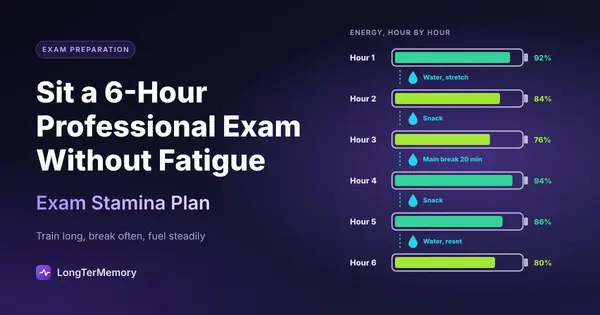
If your exam gives you a pool of break time (like USMLE Step 1’s 45 minutes), decide in advance how you’ll spend it. A sensible plan for an exam with 7 one-hour blocks:
| After block | Break length | Purpose |
|---|---|---|
| 1 | 3 to 5 min | Bathroom, water, stretch |
| 2 | 5 to 7 min | Snack, water |
| 3 or 4 | 15 to 20 min | Main break: real food, short walk |
| 5 | 5 to 7 min | Snack, water |
| 6 | 3 to 5 min | Water, stretch, reset |
For exams with one fixed break (like the NCEES FE or PE), the decision is simpler: always take it, and use the full time.
What to do during a break
- Stand up and move. Walk, stretch your shoulders, neck, and back.
- Eat and drink, even if you’re not hungry. Fatigue shows up later.
- Look at something far away to rest your eyes after hours at a screen.
- Breathe slowly for a minute: a long exhale calms your nervous system.
- Don’t review notes, check forums, or replay questions you weren’t sure about.
Micro-breaks inside a block
You can’t leave the room during a block, but you can reset for 20 to 30 seconds:
- Close your eyes and take three slow breaths.
- Roll your shoulders and sit back in the chair.
- Do this every 20 to 30 questions, or whenever you notice yourself rereading a sentence.
That 30 seconds is cheaper than one careless mistake.
When to push
Push through during a block, not across breaks. If you’re in the middle of a block and feel tired, keep going with a micro-break. If a question is eating your time, flag it, guess, and move on. Staying on schedule is part of stamina: rushing at the end of a block drains far more energy than steady pacing.
Energy Management Through Nutrition, Hydration, and Pacing
Eat a familiar breakfast that mixes protein, fiber, and slow carbohydrates, snack every 1.5 to 2 hours, sip water consistently, and keep caffeine at your usual dose. The goal is boring, steady energy. Exam day is not the day for new foods or extra coffee.
Breakfast
Eat something you’ve already tested during a practice exam. Good examples:
- Oatmeal with nuts and fruit
- Eggs with whole-grain toast
- Greek yogurt with granola and berries
Avoid a large sugary breakfast, which tends to give you a quick rise and a crash a couple of hours later. For more on the science, see how nutrition affects learning and memory.
Snacks for breaks
Pack small, easy-to-eat snacks for every break (check what your test center allows in lockers):
| Snack | Why it works |
|---|---|
| Nuts or trail mix | Protein and fat for slow, steady energy |
| Banana or apple | Quick carbs plus fiber |
| Peanut butter sandwich | Balanced, filling for the main break |
| Granola or protein bar | Compact, no prep |
| Dark chocolate (a few squares) | Small boost, little sugar crash |
Hydration
Research reviewed by Adan (2012) suggests that even mild dehydration, around 2% of body weight, can impair attention and short-term memory. That doesn’t mean drinking a liter at once (you’ll lose break time to the bathroom). Instead:
- Drink a glass of water with breakfast.
- Drink a few sips at every break.
- Avoid large amounts in the 30 minutes before a long block.
Caffeine
If you drink coffee every day, have your normal amount at your normal time. Skipping it brings withdrawal headaches; doubling it brings jitters and bathroom trips. Caffeine’s effects last several hours (its half-life is roughly 5 hours in most adults), so a small top-up at the main break can help in the second half, if you’ve tested it in a practice exam first.
Pacing
Fatigue gets worse when you fall behind and panic. Set checkpoints for each block:
- Divide the block time by the number of questions to get a target time per question.
- Note where you should be at the 25%, 50%, and 75% marks.
- If you’re behind at a checkpoint, guess and flag on the next hard question instead of fighting it.
| Block | Questions | Time | Checkpoint pace |
|---|---|---|---|
| Example: 60 min | 40 | 90 s per question | Q10 at 15 min, Q20 at 30 min, Q30 at 45 min |
The Mental Side: Staying Calm for Six Hours
Long exams almost always include a stretch that feels terrible, and expecting it in advance takes most of its power away. Many candidates hit a wall around the middle of the exam where several hard questions arrive in a row and they become convinced they’re failing. That feeling says almost nothing about your score.
A few things help:
- Treat each block as a new exam. Leave the previous block behind when you click “next section.”
- Use a reset phrase, something like “next question, fresh start,” after a question that rattles you.
- Expect the wall. Say to yourself: “This is the hour where it feels hard. That’s normal.”
If anxiety is a bigger issue for you, our guide on managing exam anxiety with CBT techniques has practical tools you can rehearse beforehand.
Your Exam-Week Checklist
The week before a long exam is about protecting energy, not cramming. Keep this list handy:
- Last full-length simulation at least 5 to 7 days before the exam
- Sleep schedule aligned with your exam start time
- Breakfast and snacks bought and tested
- Break plan written down
- Route, parking, and arrival time checked (arrive 30 minutes early)
- ID and admission documents ready
- Layered clothing (test rooms are often cold)
- Earplugs, if the test center allows them
Frequently Asked Questions
How do I build stamina for a long exam?
Take at least three full-length, timed practice exams in the final month under real conditions: same start time, same breaks, same food. Build up to that gradually over 6 to 8 weeks with longer and longer timed sessions.
Should I take breaks during a 6-hour exam if I feel fine?
Yes. Research shows breaks restore performance, and fatigue often isn’t noticeable until it has already cost you accuracy. Always take scheduled breaks, and use them to move, eat, and drink rather than to review.
What should I eat before a long exam?
A familiar breakfast with protein, fiber, and slow carbohydrates, such as oatmeal with nuts or eggs on whole-grain toast. Bring small snacks like nuts, fruit, or a sandwich for each break.
How much water should I drink during a long exam?
Drink a glass with breakfast and a few sips at every break. Steady small amounts keep you hydrated without forcing extra bathroom trips during timed blocks.
What if I feel exhausted halfway through the exam?
Use a 30-second micro-break inside the block (slow breaths, shoulder rolls), keep to your pace checkpoints, and make the most of your next scheduled break with food, water, and movement. Expect a low point; it’s normal and passes.
Spend Your Energy on Recall, Not on Card Writing
Stamina training only works if you also arrive knowing the material cold. The more automatic your recall, the less mental energy each question costs you in hour five.
LongTerMemory helps with exactly that: upload your prep books, notes, or the official exam outline as PDFs, and it generates question and answer cards automatically, then schedules them with spaced repetition so facts from week one are still sharp on exam day. You save the hours you’d spend writing flashcards and put them into full-length practice instead. The free trial is a good way to test it on your next study block.
The Bottom Line
You can’t fake stamina for a long professional exam on the day. You build it: gradually longer timed sessions, at least three full-length simulations, a written break plan you follow even when you feel fine, and boring, tested food and water habits.
Do that, and hour five feels a lot like hour one. Which is exactly where many candidates lose their points, and where you’ll keep yours.