How to Stay Motivated When Studying Feels Pointless
Struggling to stay motivated while studying? Discover proven strategies to reconnect with your goals and sustain drive through any exam.
Table of Contents
- Why Studying Starts to Feel Pointless
- Reconnecting your study to meaningful long-term goals
- The role of small wins and visible progress in sustaining motivation
- When to push through vs. when to take a real break
- Practical techniques for rebuilding momentum
- Tools and systems that reduce motivation dependency
- The Bottom Line
There comes a point in almost every long study cycle where the material stops feeling like a path to something and starts feeling like a wall. You open your notes and wonder what the point is. The exam feels distant or maybe too close. The content feels arbitrary. You have been at this for weeks, maybe months, and some part of you is quietly asking: why am I still doing this?
This feeling is not a sign that you are lazy, unsuited for your field, or fundamentally lacking discipline. It is a normal psychological response to sustained effort with insufficient feedback, meaning, or progress signals. The good news is that this state is reversible, and the strategies that reverse it are well-supported by research in motivation psychology and behavioral science.
The core principle is simple: motivation is not something you wait for. It is something you rebuild through meaning, evidence, and recovery.
Why Studying Starts to Feel Pointless
Before you can fix the problem, it helps to understand what is actually happening. The sensation that studying is pointless usually has one or more underlying causes.
| Cause | What It Feels Like | The Real Problem |
|---|---|---|
| Temporal discounting | The future reward feels unreal or too far away | Your brain prioritizes immediate rewards over delayed ones |
| Effort-reward imbalance | You are working hard but cannot see results | Lack of visible progress signals |
| Meaning decay | You forget why you started | Disconnection from original purpose |
| Cognitive overload | Everything feels blurry and heavy | Your working memory is overwhelmed |
Research on temporal discounting, led by psychologists like George Ainslie and supported by decades of behavioral economics, shows that humans systematically devalue future rewards. A credential you might earn in six months feels less real than the comfort of stopping right now. This is not a character flaw. It is how the brain is wired. The solution is not to fight the wiring but to work with it.
Another factor is the effort-reward imbalance. A 2018 meta-analysis in the Journal of Educational Psychology found that perceived progress was a stronger predictor of sustained academic motivation than either talent or even initial interest. When you cannot see progress, your brain interprets the effort as wasted, and motivation collapses. That is why strategies that make progress visible are not motivational fluff. They are core infrastructure for sustained effort.
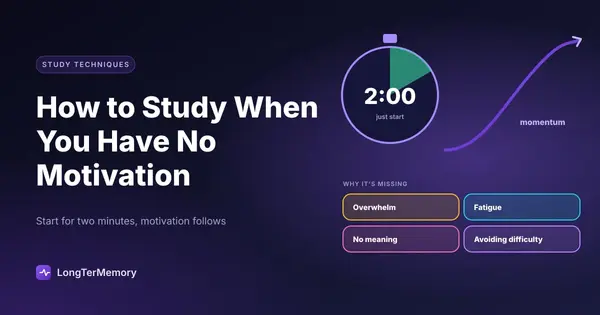
If you are dealing with a complete absence of motivation, our guide on how to study when you have no motivation covers the behavioral activation strategies that get you moving even when you feel completely empty.
Reconnecting your study to meaningful long-term goals
The fastest way to restore motivation when studying feels pointless is to reconnect your daily work with a goal that actually matters to you. Not a goal you think should matter, but one that genuinely does.
This works because of a mechanism psychologists call self-concordance, the alignment between your goals and your core values. Research by Kennon Sheldon and Andrew Elliot at the University of Rochester found that students pursuing self-concordant goals persisted longer, enjoyed the process more, and performed better than students pursuing goals driven by external pressure or guilt. The difference was not effort. It was meaning.
Here is how to do it in practice:
Revisit your original reason. Take 10 minutes and write down, without editing, why you started this path. Not why you should finish it. Why you started. What did you imagine this would make possible? What was the feeling? This is not about manufacturing fake enthusiasm. It is about restoring context that got buried under to-do lists and anxiety.
Connect today’s task to a specific future scenario. Instead of “I need to memorize these pharmacology mechanisms,” try “I need to understand these mechanisms so that when I am prescribing in a clinic six months from now, I know exactly why this drug works and what to watch for.” The more specific and sensory the future scenario, the more your brain treats it as real.
Distinguish between means goals and end goals. A means goal is something you do to get something else, like passing an exam. An end goal is the life outcome you actually want, like working in a role where you feel competent and useful. When you are only connected to means goals, studying feels like drudgery. When you reconnect to end goals, the same studying feels like a necessary step toward something you chose.
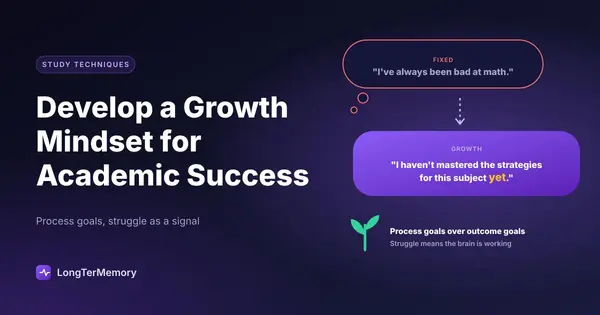
If you want to dig deeper into the mindset side of this, our article on developing a growth mindset for academic success explores how your beliefs about ability shape your willingness to persist.
The role of small wins and visible progress in sustaining motivation
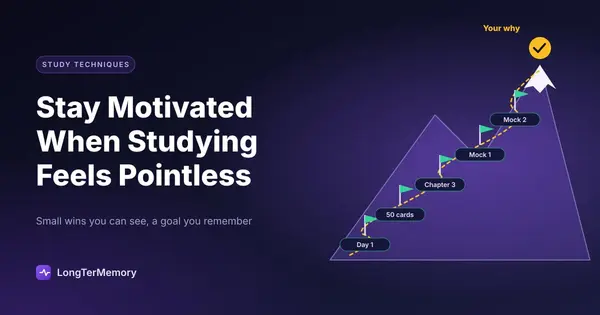
When the big goal feels too far away, the only reliable fuel is evidence that you are moving. Small wins are the single most robust motivator during long study periods, and the research behind this is substantial.
Teresa Amabile’s research at Harvard Business School, spanning thousands of work diaries, found that the single most powerful driver of positive emotion and motivation was making progress on meaningful work. She called this the progress principle. Even small victories, like finally understanding a concept that had been confusing or completing a practice set with a slightly higher score, produced a cascade of positive motivation that carried into subsequent tasks.
The key insight: motivation follows evidence of progress, not the other way around.
Here is how to engineer small wins deliberately:
Shrink the unit of progress. If your only measure of progress is “pass the exam,” you will have no wins for weeks or months. Break it down into units you can complete in a single session: finish one subsection, get 80% on a 10-question quiz, write out one concept from memory. Each completion is a win.
Track visibly. Use a simple checklist, a spreadsheet, or a notebook where you log what you covered each day. Our guide on how to track your study progress and stay motivated walks through exactly how to set this up without overcomplicating it. The act of marking something complete releases dopamine and reinforces the behavior.
Use completion rituals. At the end of each session, spend 30 seconds reviewing what you accomplished. Not what you still need to do. What you did. This brief reflection trains your brain to notice progress instead of only noticing gaps.
Celebrate threshold crossings. When your practice score in a topic crosses 70% for the first time, note it. When you finish the first pass through a major content domain, acknowledge it. These are not vanity metrics. They are proof that the system is working.
A 2011 study in the Journal of Organizational Behavior found that individuals who recorded small accomplishments daily reported 31% higher motivation and 25% greater perceived capability over a four-week period compared to those who did not. The mechanism is straightforward: visible progress counteracts the natural drift toward discouragement that long projects produce.
When to push through vs. when to take a real break
One of the hardest judgment calls in a long study period is knowing whether your resistance means you need to push harder or stop entirely. The wrong call in either direction costs you. Pushing through genuine exhaustion deepens burnout. Stopping too early reinforces avoidance.
The core distinction is between motivational resistance and physiological depletion. Motivational resistance feels like “I don’t want to,” but lifts once you start. Physiological depletion feels like “I cannot,” and it does not lift with starting.
Here is a practical diagnostic:
| Signal | Likely Meaning | Recommended Response |
|---|---|---|
| You feel resistance but can focus once you start | Motivational resistance | Push through with a short commitment (10-15 minutes) |
| You have read the same paragraph three times with zero retention | Cognitive depletion | Stop and recover |
| You feel dread but no physical symptoms | Avoidance of difficulty | Start with the smallest possible piece |
| You feel physically heavy, headaches, irritability | Burnout building | Genuine rest, not just passive scrolling |
| You are making careless errors you would not normally make | Fatigue affecting performance | End the session early |
Research on the ego depletion model, while debated in recent years, consistently shows that sustained self-control draws on a limited resource. A 2019 meta-analysis in Psychological Bulletin concluded that while willpower may not be as strictly limited as originally thought, effortful self-regulation still produces subjective fatigue and performance decline over time. The practical implication: there is a real limit to how much you can force, and crossing it repeatedly makes you slower, not faster.
If you are seeing multiple physical and emotional warning signs, our guide on recognizing the signs of study burnout early can help you distinguish between a rough day and a pattern that needs real intervention.
What counts as a real break? Scrolling on your phone is not recovery. It is distraction, and it does not restore the cognitive resources that studying depletes. Real breaks involve one or more of the following:
- Physical movement, even a 10-minute walk
- Time in natural light or green space
- Social connection that has nothing to do with your studies
- Sleep, especially if you are running a deficit
- A complete cognitive switch, like cooking, drawing, or playing music
The goal of a real break is to let your nervous system downregulate. If you finish your break and feel exactly as tired as when you started, it was not a real break.
Practical techniques for rebuilding momentum
Once you have identified whether you need meaning, progress, or rest, the next step is to rebuild momentum with specific techniques.
The Five-Minute Reconnection Exercise. Before each study session, spend five minutes on one of the following: write your end goal at the top of your notes, review your progress tracker, or do one retrieval practice question from yesterday’s material. This bridges the gap between where you are and where you are going.
The Identity Reframe. Instead of asking “Do I feel like studying?” ask “What would someone who takes their development seriously do right now?” This shifts the decision from emotional state to identity consistency. As we cover in our article on turning procrastination into study momentum, identity-based motivation outlasts mood-based motivation because it does not depend on how you feel.
The One-Thing Rule. On days when everything feels pointless, commit to one thing only. One flashcard review. One page. One problem. Completion of that single item counts as a win for the day. This prevents the all-or-nothing collapse where one missed day becomes a week.
Structured Variation. Sometimes pointlessness comes from monotony. If you have been doing the same type of review for weeks, switch modalities. If you have been reading, try teaching the material out loud. If you have been doing flashcards, try a blank-page recall session. Novelty, even small novelty, re-engages attention. Our article on making studying enjoyable has more ideas on adding variety without sacrificing rigor.
Tools and systems that reduce motivation dependency
The ultimate goal is to build a study system that requires less motivation to activate. Motivation is a useful fuel, but it is unreliable. Systems are reliable.
Habit stacking is one of the most effective ways to reduce motivation dependency. Attach your study session to an existing habit: “After I pour my morning coffee, I will review 15 flashcards.” The existing habit becomes the trigger, and the decision to study stops being a decision.
Environmental design matters too. A dedicated study space, a phone in another room, and browser extensions that block distracting sites all reduce the willpower required to start. The less you rely on motivation to overcome friction, the more consistently you will show up.
This is where the right study tool can make a meaningful difference. LongTerMemory is built to remove the friction that drains motivation before you even begin. Instead of spending hours manually creating flashcards from your notes, you can upload your PDFs or paste web content directly, and the system automatically generates active recall flashcards for you. The spaced repetition scheduling is handled automatically, so you never have to decide what to review or when. You open the app, and there is already a concrete, prioritized queue of exactly what you need to work on.
That kind of pre-built structure eliminates the meta-decisions that make starting so hard. You do not have to figure out what to study. You do not have to build your own review schedule. You do not have to wonder if you are doing the right thing. The system has already decided based on what you are most likely to forget.
If you are in a period where motivation is scarce, removing that overhead is not a minor convenience. It is a strategic advantage. Try LongTerMemory free and see how much easier starting becomes when the path is already laid out in front of you.
For more on why spaced repetition works so effectively for long-term retention, see our deep dive into the science of spaced repetition.
The Bottom Line
Studying feels pointless when meaning, progress, and recovery fall out of balance. The fix is not to force yourself to feel inspired. It is to rebuild the three pillars deliberately.
Reconnect with why this matters to you. Not why it should matter, but why it actually does. Make that connection specific and sensory.
Engineer visible evidence of progress. Break work into small wins, track them, and celebrate them. Motivation follows evidence.
Know when to rest for real. Distinguish between resistance you can push through and depletion that requires genuine recovery. Real breaks restore you. Fake breaks delay you.
And finally, build systems that need less motivation. Habits, environments, and tools that reduce friction make you far more consistent than willpower ever will.
The sessions where you study despite the pointlessness are often the ones that matter most. Not because the content is different, but because every one of them reinforces the habit of showing up. And showing up, especially when it is hard, is what carries you across the finish line.