How to Use the Peg System for Memorizing Numbers
Learn the peg system step by step: build a peg list for 1 to 10 and beyond, link numbers to vivid images, and use it for statistics, dates and formulas.
Table of Contents
- What the Peg System Is and Why It Works
- Does it really work?
- Pegs vs other number techniques
- Setting Up a Basic Peg List for Numbers 1 to 10 and Beyond
- The classic rhyming pegs
- The shape alternative
- Going beyond 10
- Practice routine for the first week
- Linking Numbers to Vivid Imagery
- The four rules of a strong image
- Example: a numbered list
- Example: a single number
- Applying the Peg System to Statistics, Dates and Formulas
- Statistics and percentages
- Dates
- Formulas and ordered steps
- When not to use pegs
- Common Mistakes With Peg Mnemonics
- Pegs + Spaced Repetition: The Durable Combination
- Frequently Asked Questions
- What is a peg mnemonic?
- How are pegs different from a memory palace?
- How long does it take to learn?
- Can number pegs help with math exams?
- Lock in Every Number You Encode
- The Bottom Line
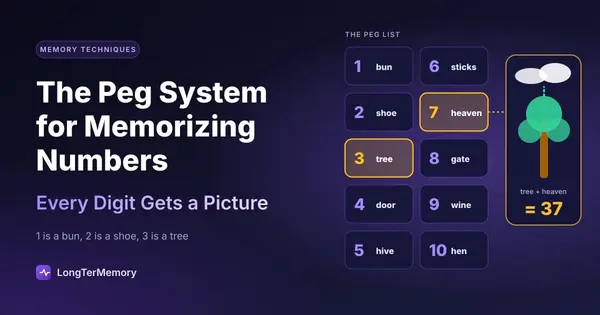
The peg system is a memory technique that turns numbers into images: you memorize a fixed list of “pegs”, one picture for each number (1 is a bun, 2 is a shoe, 3 is a tree), then you remember any number or numbered item by linking it to its peg in a vivid, absurd scene. Learn the 10 rhyming pegs in about 15 minutes, practice linking for a week, then extend the list to 100 with the Major System for longer numbers, dates and formulas.
Numbers are the hardest thing to remember for most people, and there’s a good reason. A number like 37 has no meaning, no shape, no emotion. Your brain evolved to remember where the river is and which berries made you sick, not that a z-score of 1.96 corresponds to 95% confidence. Turning abstract things into images is one of the core moves in any system to memorize things fast.
Pegs fix that mismatch. They give every digit a concrete, visual identity, so a number stops being an abstract symbol and becomes a scene you can picture. It’s one of the oldest mnemonic techniques there is, and one of the easiest to learn.
What the Peg System Is and Why It Works
This technique works because it converts abstract numbers into concrete images, and the brain remembers images far better than symbols. Psychologists call this the picture superiority effect, and it was formalized in Allan Paivio’s dual coding theory: information stored as both a word and an image has two routes back to memory instead of one.
The pegs also give you something most mnemonic methods lack: random access. With a story or a memory palace you usually have to walk through items in order. With pegs, if someone asks “what was item 7?”, you go straight to peg 7 (heaven) and see what’s there.
Does it really work?
Research on peg-word mnemonics goes back decades. In early studies by Bugelski and colleagues in the late 1960s, participants who learned a rhyming peg list and linked new words to it recalled lists far better than control groups who simply rehearsed. Later reviews of mnemonic research consistently rank peg systems alongside the method of loci as effective for ordered lists, as long as learners create interactive images (the peg and the item doing something together) rather than just placing them side by side.
Pegs vs other number techniques
| Technique | How it works | Best for | Learning time |
|---|---|---|---|
| Rhyming pegs | Number rhymes with an image (1 bun, 2 shoe) | Lists of up to 10 to 20 items, short numbers | 15 minutes |
| Shape pegs | Number looks like an image (2 swan, 8 snowman) | Visual learners, short numbers | 15 minutes |
| Major System | Digits become consonant sounds, then words | Long numbers, dates, 00 to 99 | Several hours |
| Memory palace | Items placed along a familiar route | Long ordered lists, speeches | 1 hour to set up |
| Chunking | Group digits (555 0147) | Phone numbers, short codes | None |
The rhyming and shape versions are the entry point. The Major System, which we covered in our guide to memorizing numbers and statistics, is the advanced version for when you need pegs beyond 10.
Setting Up a Basic Peg List for Numbers 1 to 10 and Beyond
Start with the 10 rhyming pegs below, picture each one in detail, and test yourself until you can name every peg instantly, forwards and backwards. The list has to be automatic before you use it, because hesitation breaks the link.
The classic rhyming pegs
| Number | Peg | Picture it as |
|---|---|---|
| 1 | Bun | A warm, sticky cinnamon bun |
| 2 | Shoe | A huge muddy hiking boot |
| 3 | Tree | An old oak with twisted branches |
| 4 | Door | A bright red front door |
| 5 | Hive | A buzzing beehive dripping honey |
| 6 | Sticks | A bundle of firewood |
| 7 | Heaven | Clouds and a golden gate |
| 8 | Gate | A creaking farm gate |
| 9 | Wine | A tipping glass of red wine |
| 10 | Hen | A fat, clucking hen |
Make the pictures specific. Not “a shoe” but your old running shoe with the broken lace. The more detail, the stronger the peg.
The shape alternative
If rhymes don’t stick for you, use shapes instead:
| Number | Shape peg |
|---|---|
| 0 | Ball or ring |
| 1 | Candle or pencil |
| 2 | Swan |
| 3 | Handcuffs (on their side) |
| 4 | Sailboat |
| 5 | Hook |
| 6 | Golf club |
| 7 | Boomerang or cliff |
| 8 | Snowman |
| 9 | Balloon on a string |
Some people mix the two: rhymes for the numbers where the rhyme is strong, shapes where it isn’t. That’s fine, as long as each number has exactly one peg and you never change it.
Going beyond 10
You have three options when 10 pegs aren’t enough:
- Extend the rhymes (11 lever, 12 elf, 13 hurting, 14 courting, 15 lifting, 16 licking, 17 leavening, 18 waiting, 19 pining, 20 plenty). They get weaker past 20.
- Combine pegs for digits. For 37, link peg 3 (tree) and peg 7 (heaven): a tree growing up into the clouds. This works for any number but makes long scenes.
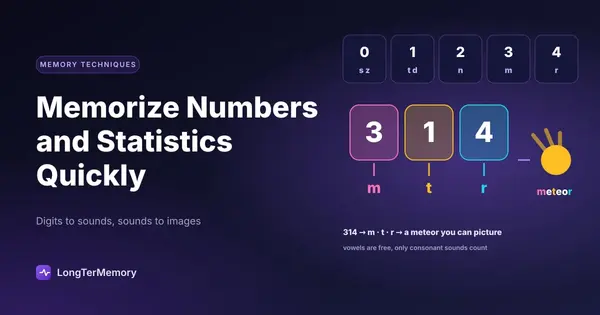
- Learn the Major System for 00 to 99. Each digit maps to a consonant sound (1 = t/d, 2 = n, 3 = m, 4 = r, 5 = l, 6 = j/sh, 7 = k/g, 8 = f/v, 9 = p/b, 0 = s/z), and you fill vowels in between to make words: 37 becomes “mic”, 42 becomes “rain”. It’s a few hours of work, but then every two-digit number has its own peg.
Practice routine for the first week
| Day | Practice | Time |
|---|---|---|
| 1 | Learn the 10 pegs, recite forwards and backwards | 15 minutes |
| 2 | Random-order drill: someone calls a number, you say the peg | 5 minutes |
| 3 to 4 | Memorize a 10-item shopping list with pegs | 10 minutes |
| 5 to 7 | Memorize 2 or 3 real numbers from your study material | 10 minutes |
Turn the pegs themselves into flashcards (“6 →?”) and review them on a spaced schedule for the first month. Once they’re automatic, you never have to review them again; you use them.
Linking Numbers to Vivid Imagery
A link works when the peg and the item interact in a scene that is exaggerated, active and slightly absurd. “A shoe next to an apple” fades in minutes. “A giant boot stomping an apple into juice that sprays everywhere” lasts for days.
The four rules of a strong image
- Interaction: the peg and the item must do something to each other, not sit side by side.
- Exaggeration: make things huge, tiny or multiplied.
- Action: movement is more memorable than a still picture.
- Senses: add sound, smell or texture (the sticky bun, the buzzing hive).
Example: a numbered list
Imagine you need to remember the first five steps of the scientific method in order: observation, question, hypothesis, experiment, conclusion.
| Peg | Item | Scene |
|---|---|---|
| 1 Bun | Observation | A cinnamon bun wearing a giant magnifying glass, observing you |
| 2 Shoe | Question | A boot with a huge question mark for a lace |
| 3 Tree | Hypothesis | A tree whose leaves are covered in scribbled guesses |
| 4 Door | Experiment | Opening the red door releases colored smoke from a lab |
| 5 Hive | Conclusion | Bees forming the word “THE END” in the air |
Close your eyes and walk through the five pegs. You can now recall the list in order, backwards, or answer “what was step 4?” instantly.
Example: a single number
To remember that the speed of sound in air is about 343 meters per second: peg 3 (tree), peg 4 (door), peg 3 (tree). Picture a tree slamming a door in another tree’s face with a sonic BOOM. The sound in the scene is your cue for the topic, and the three pegs give you the digits.
This is where pegs shine compared to rote repetition: a few seconds of imagery replaces dozens of repetitions.
Applying the Peg System to Statistics, Dates and Formulas
For study material, use the pegs to encode the digits and add one “topic anchor” to the scene, so you know which fact the number belongs to. Without the anchor, you remember 1,9,6 but not that it’s the z-score for 95% confidence.
Statistics and percentages
| Fact | Pegs | Scene |
|---|---|---|
| z = 1.96 for 95% confidence | 1 bun, 9 wine, 6 sticks | A bun soaked in wine on a fire of sticks, with a “95%” sticker on the bottle |
| Normal distribution: 68% within 1 SD | 6 sticks, 8 gate | A bell-shaped gate made of sticks |
| Water boils at 212 °F | 2 shoe, 1 bun, 2 shoe | Two boots boiling a bun in a kettle |
For more number-heavy techniques, our guide on memorizing formulas fast pairs well with this method.
Dates
Dates are four digits, which is where the Major System or combined pegs help. Many people drop the century when it’s obvious from context.
- 1215, Magna Carta: drop the 1, keep 215 → shoe, bun, hive. A king’s boot stepping on a bun covered in bees while he signs a charter.
- 1969, Moon landing: keep 69 → sticks and wine. Astronauts planting a stick in the Moon and toasting with wine.
Our article on memorizing dates and historical facts shows more ways to anchor dates to events.
Formulas and ordered steps
Pegs work for formulas when the order of terms matters. For the quadratic formula you can peg each step: 1 bun for “negative b”, 2 shoe for “plus or minus”, 3 tree for “square root of b squared minus 4ac”, 4 door for “over 2a”. But be honest about the limit: pegs help you recall a formula, not understand it. Learn why the formula works first, then use pegs to make sure you don’t blank on the exact form during the exam.
When not to use pegs
- For numbers you use every day (they’ll stick on their own).
- For long tables of data. Understand the trend and memorize only the key values.
- When the exam allows a formula sheet. Spend your effort on applying formulas instead.
Common Mistakes With Peg Mnemonics
- Using pegs before they’re automatic. If you have to think “what was 7 again?”, the method collapses. Drill the list first.
- Weak, static images. “A bun and a statistic” means nothing. Make it act and exaggerate.
- Reusing pegs for too many facts at once. If peg 3 holds ten different scenes from this week, they interfere. Use the Major System for more variety, or give each subject a distinct “setting” (all biology scenes in a lab, all history scenes on a battlefield).
- Never reviewing. Mnemonics make encoding faster, but memories still fade without retrieval. Review the number, not just the image, a few times over the following weeks.
Pegs + Spaced Repetition: The Durable Combination
Pegs make a number easy to learn; spaced repetition makes it hard to forget. The best workflow uses both: create the image once, then test yourself on the number at growing intervals.
- Create the peg image for a fact.
- Write a flashcard: “z-score for 95% confidence?” on the front, “1.96 (bun soaked in wine on sticks)” on the back.
- Review it after 1 day, 3 days, a week, then longer.
- After a few successful reviews, you’ll recall the number directly, without walking through the image. That’s the goal: the mnemonic is scaffolding, not a permanent crutch.
For a broader look at mnemonic techniques that combine well with pegs, see our guides to the memory palace and the story method.
Frequently Asked Questions
What is a peg mnemonic?
It’s a mnemonic technique where you memorize a fixed list of images for the numbers 1 to 10 (or more), then link new items or digits to those images to recall them in order or by position.
How are pegs different from a memory palace?
A memory palace stores items along a route through a familiar place. Pegs store items on number-images, which gives you direct access by position (item 7) and makes them especially good for numbers.
How long does it take to learn?
About 15 minutes to learn 10 rhyming pegs and a week of light practice to use them fluently. The Major System for 00 to 99 takes several hours spread over a couple of weeks.
Can number pegs help with math exams?
It helps you remember constants, critical values and the exact form of formulas. It doesn’t replace understanding or practice problems, but it removes the risk of blanking on a value you know.
Lock in Every Number You Encode
Building a peg image takes ten seconds. Remembering to review it next week is the hard part, and that’s where most mnemonic effort is quietly lost.
LongTerMemory handles the review side. Upload your lecture notes, formula sheets or statistics chapters, and it generates question and answer cards automatically, then schedules each one with spaced repetition so every constant and date returns right before you’d forget it. Add your peg images to the answers and you get vivid encoding plus automatic review, without writing a single card by hand. The free trial is a good way to test it on your most number-heavy subject.
The Bottom Line
The peg method is the fastest way to give numbers a shape your memory can hold. Learn 10 pegs until they’re automatic, link each digit or item in an absurd, active scene, add a topic anchor, and review on a spaced schedule. Start with one statistic or date from your current course today, and you’ll see why this technique has survived for centuries.