How to Use Practice Tests as Your Primary Study Tool
Why practice tests beat rereading, how to use mock exams diagnostically instead of as score checks, and when to schedule them across a long study cycle.
Table of Contents
- Why Practice Tests Outperform Almost Every Other Study Method
- What the research says
- Three hidden benefits beyond memory
- The Test-First Study Cycle
- The four steps
- What if you know nothing yet?
- How to Use Practice Tests Diagnostically, Not Just for Score Checking
- The five error types
- Track lucky guesses as errors
- Keep an error log
- Timing Your Mock Exams Across a Long Study Cycle
- A 12-week example
- How many tests is enough?
- Use spacing between retests
- Where to Get Enough Practice Questions
- Common Mistakes to Avoid
- Frequently Asked Questions
- Can testing yourself replace studying?
- How often should I take a mock exam?
- Is it bad to fail a practice exam?
- Does regular testing help with test anxiety?
- Turn Your Notes Into a Practice Bank Automatically
- The Bottom Line
To use practice tests as your primary study tool, take them early instead of saving them for the end, treat every test as a diagnosis rather than a grade, and let the results decide what you study next. A practical cycle is: test, analyze every miss, study only the gaps, then retest with spaced, timed tests that get longer and more exam-like as the date approaches. Research consistently shows this beats rereading and highlighting, often by a wide margin.
Most students use practice tests the way you’d use a bathroom scale before a wedding: once or twice, near the end, mostly to see if they should panic. That’s the least valuable way to use them. A practice test is not a measurement of your learning. Done right, it is the learning.
This guide shows you how to flip the order: tests first, studying second, and a schedule that turns a long prep period into a series of short feedback loops.
Why Practice Tests Outperform Almost Every Other Study Method
Practice tests work because pulling information out of memory strengthens it far more than putting it in again, a finding known as the testing effect. Every retrieval attempt makes the memory easier to find next time, and every failed attempt shows you exactly what needs work.
What the research says
| Study | What they compared | Result |
|---|---|---|
| Roediger and Karpicke (2006) | Reading a passage 4 times vs reading once and testing 3 times | After one week, the tested group recalled about 61% vs 40% for the rereading group |
| Karpicke and Blunt (2011) | Retrieval practice vs concept mapping | Retrieval practice produced better performance on a test a week later, including inference questions |
| Dunlosky et al. (2013) | Review of 10 common study techniques | Practice testing was one of only two techniques rated “high utility”; highlighting and rereading were rated “low” |
| Adesope et al. (2017) | Meta-analysis of 272 effect sizes | Practice tests produced a moderate to large benefit over other study activities (overall g of about 0.61) |
Two details stand out. First, in Roediger and Karpicke’s study, the rereading group felt more confident right after studying. Rereading creates fluency, the comfortable sense that the material looks familiar, and fluency is easily mistaken for knowledge. Second, the benefit grows with delay: the longer the gap before the real exam, the bigger the advantage of testing.
Three hidden benefits beyond memory
- Calibration. Tests show the difference between what you think you know and what you can actually produce under pressure.
- Transfer. Retrieval practice improves your ability to apply knowledge to new questions, not just repeat answers.
- Lower test anxiety. Studies on frequent low-stakes quizzing suggest students who practice retrieval regularly report less anxiety on the real exam, because test conditions become familiar.
If you want the theory behind this, our article on how the testing effect improves active learning goes deeper.
The Test-First Study Cycle
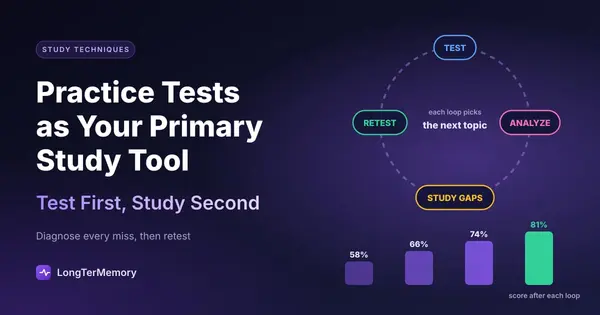
The test-first cycle replaces “read, then test” with “test, analyze, study the gaps, retest.” It feels backwards at first because you’ll get many questions wrong early. That’s the point: errors made during practice, followed by feedback, are among the most effective learning events there are.
The four steps
| Step | What you do | Time share |
|---|---|---|
| 1. Test | Take a block of questions on a topic, timed, closed-book | 25% |
| 2. Analyze | Classify every wrong answer and every lucky guess | 25% |
| 3. Study the gaps | Read, watch or make flashcards only for what the analysis showed | 35% |
| 4. Retest | New questions on the same topics a few days later | 15% |
The analysis step is where most students cut corners. They check the score, glance at the right answers and move on. Plan to spend about as long reviewing a test as you spent taking it.
What if you know nothing yet?
Taking a test before studying a topic sounds pointless, but it isn’t. Research on the pretesting effect (for example Richland, Kornell and Kao, 2009) found that attempting questions before reading, even when you get them wrong, improves learning of the material that follows. You read with a purpose, because you know what will be asked. For a brand-new subject, do a short pretest (10 to 15 questions), then a first pass through the material, then switch to the full cycle.
How to Use Practice Tests Diagnostically, Not Just for Score Checking
A diagnostic review sorts every error by its cause, because the fix depends on why you missed it, not on which question you missed. A score tells you how you did; an error analysis tells you what to do next.
The five error types
| Error type | What it looks like | The fix |
|---|---|---|
| Knowledge gap | You’d never seen the fact or concept | Study it, then make a flashcard |
| Recall failure | You knew it once but couldn’t retrieve it | Spaced review of that fact |
| Misunderstanding | You “knew” something wrong | Rebuild the concept, then write a card that tests the distinction |
| Question reading | You missed “NOT”, “first” or “most likely” | Slow down on stems, underline qualifiers |
| Time pressure | You rushed the last 10 questions | Timed blocks and pacing checkpoints |
Count your errors by type after every test. A student with 20 misses that are mostly knowledge gaps needs more content. A student with 20 misses that are mostly reading errors needs a different test-taking routine, and more content won’t help at all.
Track lucky guesses as errors
If you guessed and got it right, mark it. A lucky guess is a knowledge gap that happened to score a point; on the real exam it may not. Many students find that 10 to 20% of their correct answers are guesses, which means their real score is lower than the one on screen.
Keep an error log
An error log turns scattered misses into patterns. One row per error:
| Date | Topic | Error type | What I’ll do |
|---|---|---|---|
| Nov 3 | Cardiology | Recall failure | Card: first-line drug for stable angina |
| Nov 3 | Statistics | Misunderstanding | Reread sensitivity vs specificity, 2 cards |
| Nov 5 | Cardiology | Question reading | Stem said “contraindicated” |
After two or three weeks, sort by topic. The topics with the most rows are your next study priorities, regardless of what the textbook order says. We go deeper into this method in our guide on learning from your practice test mistakes.
Timing Your Mock Exams Across a Long Study Cycle
Across a long prep period, start with short topic quizzes, move to mixed-topic blocks in the middle, and finish with full-length timed exams in the final weeks. Space them out so each test has time for analysis and gap study before the next one.
A 12-week example
| Weeks | Test type | Frequency | Goal |
|---|---|---|---|
| 1 | Diagnostic test (full or half length) | Once | Baseline score and weakest areas |
| 2 to 5 | Topic quizzes, 20 to 40 questions | 3 to 4 per week | Learn content through retrieval |
| 6 to 9 | Mixed-topic blocks, 40 to 60 questions | 3 per week | Interleaving and transfer |
| 10 to 11 | Full-length timed exams | 1 per week, plus review days | Stamina, pacing, final gaps |
| 12 | One last full exam early in the week, then light review | Once | Confidence, no new material |
Two scheduling rules matter most:
- Leave at least one day between a full-length exam and the next one. The review is where the learning happens, and a full exam can take 3 to 6 hours to analyze properly.
- Mix topics as the exam gets closer. Real exams don’t announce the chapter. Research on interleaving shows that mixed practice feels harder but improves performance on mixed tests, which is exactly what you’ll face. Our article on how interleaving improves test performance covers this in detail.
How many tests is enough?
There’s no magic number, but a useful benchmark is at least three full-length timed exams before a major standardized test, plus hundreds of practice questions in shorter blocks. For a typical university final, one full mock and three or four topic quizzes per subject is a good target.
Use spacing between retests
Don’t retest the same questions the next day; you’ll remember the answers, not the concepts. Wait at least a few days, and preferably use new questions. If you only have one question bank, keep a shuffled set of questions you got wrong and come back to them after a week.
Where to Get Enough Practice Questions
You need more questions than most single sources provide, so combine official tests, commercial banks and questions you generate from your own material.
| Source | Strength | Limitation |
|---|---|---|
| Official practice exams | Closest to the real thing | Limited number, save some for the final weeks |
| Commercial question banks | Large volume, explanations | Cost, varying quality |
| Textbook end-of-chapter questions | Free, aligned with your course | Often easier than the exam |
| Your own flashcards and questions | Exactly your material | Time-consuming to create by hand |
| AI-generated questions from your notes | Fast, unlimited, on your material | Need a quick check for accuracy |
Save official practice exams for the second half of your prep, when your score means something. Use cheaper or self-made questions early, when the goal is learning, not measuring.
If you don’t have a question bank for your course, you can generate one: tools that turn PDFs and notes into questions have improved a lot. We compared the options in our guide to AI quiz generators.
Common Mistakes to Avoid
- Waiting until you “feel ready”. You’ll never feel ready, and you lose weeks of the most effective study method.
- Only looking at the score. Without error analysis, a test is just a stressful hour.
- Taking tests open-book. Retrieval needs to be real. Look things up after you answer, not before.
- Repeating the same questions too soon. You end up testing recognition of the question, not knowledge of the concept.
- Skipping timed conditions. Untimed practice hides pacing problems until exam day.
- Burning all official tests early. Keep at least two for the final weeks.
Frequently Asked Questions
Can testing yourself replace studying?
Not entirely, but they should lead it. Tests tell you what to study; targeted reading and flashcards fill the gaps. Students who use tests as their main tool usually study less material more effectively.
How often should I take a mock exam?
Short quizzes several times a week from the start, and full-length tests about once a week in the final month. Always leave time to review each test before taking the next.
Is it bad to fail a practice exam?
No. Low early scores are expected and useful. Errors followed by feedback are a strong learning event, and a low diagnostic score gives you a clear starting map.
Does regular testing help with test anxiety?
Yes, for many students. Frequent low-stakes testing makes exam conditions familiar, and research on classroom quizzing suggests it can reduce anxiety on the final exam.
Turn Your Notes Into a Practice Bank Automatically
The biggest obstacle to test-first studying is simple: there often aren’t enough good questions on your material. Writing them by hand takes hours.
LongTerMemory solves that. Upload your lecture notes, slides or textbook PDFs, and it generates question and answer pairs automatically, then schedules them with spaced repetition, so every concept you missed comes back for a retest at the right moment. It’s the retest step of the cycle, done for you. Try the free trial with the chapter you’re most worried about.
The Bottom Line
Practice tests are not the final check after studying. They’re the core of studying. Test early, analyze every error by type, study only the gaps, and retest with spacing and increasing realism as the exam approaches. It’s less comfortable than rereading, and that discomfort is exactly why it works.