
How to Deal With Running Out of Time on an Exam
How to stop running out of time on exams: prevention habits, a last 5 minutes recovery plan, and which questions to answer first when time collapses.
Table of Contents
- Why Students Run Out of Time
- Prevention: Time Management Techniques That Make Running Out Rare
- 1. Calculate your time budget before the exam
- 2. Set checkpoints, not a ticking countdown
- 3. Use the 2x rule for skipping
- 4. Do a quick first pass on long exams
- 5. Practice under timed conditions
- 6. Study with retrieval practice
- Recovery: What to Do in the Last 5 Minutes When You're Behind
- Step 1: Take 10 seconds to reset (yes, really)
- Step 2: Count what's left
- Step 3: Run the 5-minute plan
- Step 4: Write outlines, not apologies
- Step 5: Don't change answers in a panic
- Prioritization Under Pressure: Which Questions to Answer When Time Collapses
- The points-per-minute triage table
- Guessing: know the rules before exam day
- Smart guessing beats random guessing
- After the Exam: Fix the Root Cause
- Make Fast Recall Your Default
- Frequently Asked Questions
- What should I do if I'm running out of time on an exam?
- Is it better to leave a question blank or guess?
- Do I get partial credit for an essay outline?
- How can I get faster on exams?
- Why do I always run out of time even when I know the material?
- The Bottom Line
If you’re running out of time on an exam, stop trying to finish everything perfectly and switch to triage: answer every remaining question that takes under a minute, guess on multiple choice if there’s no penalty, and write short, point-earning outlines for long answers. To make it rare in the first place, practice under timed conditions, set checkpoints, and skip-and-return instead of getting stuck. Most time problems come from a few slow questions, not from being slow on everything.
There’s a specific kind of panic that only exams can produce. You glance at the clock, expecting 40 minutes left. It says 12. You still have a full page of questions. Your heart speeds up, your handwriting falls apart, and the question in front of you suddenly reads like a foreign language.
I’ve been there, and I’ve coached hundreds of students who’ve been there. The good news is that running out of time is one of the most fixable exam problems. It’s usually a strategy issue, not an intelligence issue.
Let’s cover it in three parts: preventing it, recovering when it happens, and deciding what to answer when time collapses. Much of the prevention happens during preparation, covered in our guide to studying for exams.
Why Students Run Out of Time
Students usually run out of time because they get stuck on a few hard questions, don’t track pace, or recall answers too slowly because they studied by rereading. Only rarely is the exam genuinely too long for a well-prepared student.
Here are the most common causes:
| Cause | How it shows up | How common |
|---|---|---|
| Getting stuck on hard questions | 8 minutes on one question worth 2 points | Very common |
| No pacing plan | Realizing at the end that you’re 30% behind | Very common |
| Slow recall | Knowing the answer but needing a minute to “find” it | Common |
| Over-writing long answers | Essay 1 is three pages, essay 3 is never started | Common |
| Rechecking as you go | Re-reading every answer before moving on | Moderate |
| Anxiety slowing thinking | Rereading questions several times | Moderate |
That third row is worth highlighting. Slow recall is a study problem that shows up as a time problem. If you studied by rereading, you might recognize the right answer eventually, but you can’t pull it up fast. Students who study with retrieval practice answer faster because they’ve rehearsed exactly that act of pulling information out of memory.
Stress makes it worse. Research by psychologist Sian Beilock and others on “choking under pressure” shows that anxiety eats into working memory, the mental space you use to reason through a problem. Less working memory means slower thinking, and slower thinking means more time pressure. It’s a loop, and the strategies below are designed to break it.
Prevention: Time Management Techniques That Make Running Out Rare
The best prevention is practicing under real time limits, knowing your per-question budget, setting checkpoints, and skipping anything that takes more than about twice its budget. Each of these takes five minutes to learn and saves you on exam day.
1. Calculate your time budget before the exam
Know the format in advance and calculate minutes per point (or per question). Then reserve about 10% of the total time for the end.
| Exam format | Total time | Reserve | Budget |
|---|---|---|---|
| 60 multiple choice questions | 90 min | 9 min | About 80 seconds per question |
| 4 essays, equal weight | 120 min | 12 min | 27 min per essay |
| 30 math problems, mixed points | 60 min | 6 min | About 1 min per point (if 54 points) |
When points vary, the rule is simple: spend time in proportion to points. A 10-point question deserves five times the time of a 2-point question.
2. Set checkpoints, not a ticking countdown
Instead of checking the clock constantly, set 3 or 4 checkpoints. For a 90-minute, 60-question exam: question 20 by minute 28, question 40 by minute 55, question 60 by minute 81. Write them at the top of your scratch paper when the exam starts.
We go deeper into checkpoint planning in our guide on managing your time during a timed exam.
3. Use the 2x rule for skipping
If a question takes more than twice its time budget, mark it and move on. You can come back later. The 2 points you might lose are far less than the 10 points you’ll lose by not reaching the last five questions.
4. Do a quick first pass on long exams
On exams with mixed question types, spend 1 to 2 minutes scanning the whole paper. Note which questions are worth the most and which look quickest. Start with the questions that combine high points and high confidence.
5. Practice under timed conditions
This is the most important prevention habit, and the most skipped. At least two or three times before the real exam, do a full practice test with a real timer, no pauses, and no notes. You’ll find out where your time goes while there’s still time to fix it.
6. Study with retrieval practice
Speed on exam day comes from fast recall, and fast recall comes from practice testing. A widely cited 2013 review by Dunlosky and colleagues rated practice testing as one of the two most effective learning techniques of the ten they examined. When you’ve already answered similar questions dozens of times, exam questions feel familiar and answers come faster. See our guide to active recall techniques for how to set it up.
Recovery: What to Do in the Last 5 Minutes When You’re Behind
In the last 5 minutes, stop perfecting anything, spend 10 seconds calming down, then quickly collect easy points: answer remaining multiple choice, finish half-done answers in note form, and outline anything unstarted. This is a damage-control phase, and done well it can save a surprising number of points.
Step 1: Take 10 seconds to reset (yes, really)
When panic hits, your thinking narrows. Take one slow breath in for 4 seconds and out for 6. Put your pen down for that one breath. Ten seconds of calm will save more than ten seconds of rushed mistakes. If your mind tends to go blank under pressure, our post on focusing when your mind goes blank has more in-the-moment techniques.
Step 2: Count what’s left
Look at what’s unanswered and quickly classify it:
- Quick wins: multiple choice, short answer, true/false
- Half-done: answers you’ve started but not finished
- Not started: long answers, essays, multi-step problems
Step 3: Run the 5-minute plan
| Time left | What to do |
|---|---|
| Minute 5 to 4 | Answer every remaining multiple choice question. Guess if there’s no penalty. |
| Minute 4 to 2 | Finish half-done answers with key points in bullet form. |
| Minute 2 to 1 | Outline unstarted long answers: thesis, 3 key points, conclusion. |
| Final minute | Make sure your name, ID, and answer choices are filled in correctly. |
Step 4: Write outlines, not apologies
Many examiners give partial credit for correct key points, even in bullet form. Check your course or exam rules, but in most essay and short answer exams, an outline beats a blank page every time. Don’t write “ran out of time, sorry.” Write the three points you would have made.
For math and science problems, write the setup: the formula, the known values, and the first step. Method marks are common, and a correct setup often earns a good share of the points.
Step 5: Don’t change answers in a panic
Last-minute answer changes made in a rush are often driven by anxiety rather than a real realization. If you have a clear reason to change an answer, change it. If it’s just a nervous feeling, leave it.
Prioritization Under Pressure: Which Questions to Answer When Time Collapses
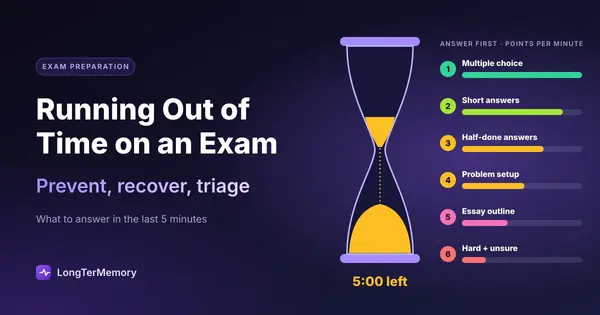
When time collapses, rank remaining questions by points per minute: answer the ones that give the most points for the least time first, and leave long, uncertain questions for last. This is triage, the same logic emergency rooms use to decide who gets seen first.
The points-per-minute triage table
| Priority | Question type | Why |
|---|---|---|
| 1 | Multiple choice you can answer or guess (no penalty) | Points in seconds |
| 2 | Short answers you’re confident about | High certainty, low time |
| 3 | Half-finished long answers | Already invested, a few lines secure partial credit |
| 4 | Setup steps of unstarted problems | Method marks for little time |
| 5 | Outlines of unstarted essays | Some credit is better than none |
| 6 | Hard questions you’re unsure about | Lowest expected points per minute |
Guessing: know the rules before exam day
Guessing strategy depends completely on the scoring rules, so check them in advance:
| Scoring rule | What to do with unanswered multiple choice |
|---|---|
| No penalty for wrong answers | Always guess. A blank is a guaranteed zero. |
| Penalty for wrong answers | Guess only if you can eliminate at least one or two options. |
| Not sure | Ask your instructor or check the exam guidelines before test day. |
Many major tests don’t penalize wrong answers. The SAT dropped its guessing penalty in 2016, and AP exams dropped theirs in 2011. But some university exams and professional tests still use negative marking, so always check.
Smart guessing beats random guessing
If you must guess, take five seconds to eliminate obviously wrong options first. Removing two of four options doubles your odds from 25% to 50%. Clues to look for: options that contradict the question, extreme words like “always” or “never,” and answers that are unrelated to the topic. Our guide on scoring higher on multiple choice exams has more elimination tactics.
After the Exam: Fix the Root Cause
Every time you run out of time, figure out where the time went, so the next exam goes differently. Right after the exam, while you still remember, write down:
- Which question or section took far longer than planned?
- Was it a knowledge problem (didn’t know it), a recall problem (knew it but slowly), or a strategy problem (got stuck, didn’t skip)?
- What will you do differently in your next practice test?
Knowledge and recall problems are solved in your study routine. Strategy problems are solved in timed practice. Our post on learning from every exam walks through a full post-exam review.
Make Fast Recall Your Default
Most time pressure on exam day starts weeks earlier, when material is studied passively and never practiced as questions. The more you answer questions in advance, the faster you’ll answer them on the day.
LongTerMemory makes that practice easy: upload your lecture slides, notes, or textbook PDFs, and it generates question and answer pairs automatically, then schedules them with spaced repetition so you’re practicing recall every day without building flashcards by hand. The free trial gives you enough time to build a full deck before your next exam and walk in already used to answering under pressure.
Frequently Asked Questions
What should I do if I’m running out of time on an exam?
Take one calming breath, answer all remaining quick questions (guess on multiple choice if there’s no penalty), finish half-done answers in bullet form, and outline any unstarted long answers.
Is it better to leave a question blank or guess?
If there’s no penalty for wrong answers, always guess. If there is a penalty, guess only when you can eliminate at least one or two options.
Do I get partial credit for an essay outline?
Often, yes. Many examiners give credit for correct key points, even in note form. Check your exam rules, but an outline almost always beats a blank page.
How can I get faster on exams?
Practice with timed tests, set a time budget per question, skip questions that take more than twice their budget, and study with retrieval practice so recall becomes quick.
Why do I always run out of time even when I know the material?
Usually because of a few slow questions, no pacing plan, or slow recall from studying by rereading. Timed practice and active recall fix all three.
The Bottom Line
Running out of time is mostly a strategy problem: budget your time by points, set checkpoints, skip stuck questions, and when time collapses, triage by points per minute. Prevention happens in timed practice and retrieval-based studying, and recovery is a calm, practiced 5-minute plan.
Before your next exam, do one full practice test with a real timer. Note where you lost time. That one test will teach you more about your pacing than any article, this one included.