How to Focus During an Exam When Your Mind Goes Blank
Why your mind goes blank in exams, what to do in the moment to recover, and how to build retrieval fluency so blanks become rare. Science-backed steps.
Table of Contents
- Why Minds Go Blank in Exams
- Working memory gets crowded out
- Stress hormones interfere with retrieval
- Weakly learned material breaks first
- The main causes at a glance
- How to Prevent Blanks With Preparation
- 1. Study by retrieving, not rereading
- 2. Take full practice exams under real conditions
- 3. Write your worries down before the exam
- 4. Protect your sleep
- 5. Build a pre-exam routine
- In-Exam Recovery: What to Do When You Blank
- Breathe to calm your body
- Skip and come back
- Use retrieval cues
- Reframe the anxiety
- Don't leave it blank
- Building Retrieval Fluency So Blanks Become Rare
- How to build it
- A simple 3-week fluency plan
- How LongTerMemory helps
- When Blanks Are a Sign of Something Bigger
- Frequently Asked Questions
- Why does my mind go blank during exams even when I studied?
- What should I do immediately when my mind goes blank?
- How can I stop going blank in future exams?
- Does writing about worries before an exam really help?
- Is it okay to guess if I can't remember?
- The Bottom Line
When your mind goes blank in an exam, it’s usually stress hijacking your working memory, not missing knowledge. The fix has two parts: in the moment, calm your body and use retrieval cues to “find” the answer; before the exam, practice recalling material under realistic conditions so retrieval becomes automatic. Students who practice retrieval regularly experience far fewer blanks.
You flip the paper over. First question. You know this. You studied this exact topic two nights ago. And then… nothing. Static. The harder you try to remember, the emptier your head feels. Your heart rate climbs, and now you’re thinking about the clock, the student next to you who’s already writing, and what your parents will say.
If that’s happened to you, you’re in good company. Mind blanks are one of the most common exam experiences out there. And the reassuring news is that the knowledge is almost always still in your head. It’s just temporarily locked behind a door that stress has slammed shut.
Let’s look at why that happens, how to open the door again during the exam, and how to make sure it rarely closes in the first place. (Prevention starts long before exam day; our exam study plan covers that part.)
Why Minds Go Blank in Exams
Mind blanks happen because stress hormones and anxious thoughts compete for the same limited working memory you need to retrieve answers. The memory is stored, but your brain’s retrieval system is temporarily overloaded.
Working memory gets crowded out
Your working memory is like a small mental workspace. It can hold only a few things at once. When you’re calm, that space is available for pulling up facts and solving problems. When you’re anxious, worrying thoughts (“I’m going to fail,” “Everyone else knows this”) move in and take up that space.
Psychologist Sian Beilock, who has spent years studying “choking under pressure,” showed that worries literally consume working memory resources. Her research found that the students most vulnerable to choking were often those with the highest working memory capacity, because they relied on it most and had the most to lose when it got crowded.
Stress hormones interfere with retrieval
There’s also a physical side. Acute stress triggers a release of cortisol and adrenaline. These are great for running away from a predator, and pretty terrible for recalling the Krebs cycle. Research reviews on stress and memory consistently show that acute stress around the time of retrieval tends to impair recall of previously learned material, even when learning itself went fine. (We dig into this in how stress impairs memory.)
Weakly learned material breaks first
Here’s the part that’s within your control. Not all memories are equally fragile under stress. Material you’ve retrieved many times holds up much better than material you’ve only reread. A 2016 study published in Science by Smith, Floerke, and Thomas found that people who learned through retrieval practice remembered just as well under stress as without it, while people who learned by restudying showed clear stress-related drops.
That’s huge. It means blanks aren’t random bad luck. They’re more likely when the knowledge is familiar but not truly retrievable.
The main causes at a glance
| Cause | What’s happening | Preventable? |
|---|---|---|
| Anxiety and worry | Working memory filled with worry | Yes, with prep and in-exam techniques |
| Stress hormones | Retrieval temporarily impaired | Partly, with breathing and routine |
| Passive studying | Recognition without recall ability | Yes, with retrieval practice |
| Sleep deprivation | Weaker consolidation and focus | Yes, prioritize sleep |
| Unfamiliar format | Surprise adds stress | Yes, with practice tests |
How to Prevent Blanks With Preparation
The best defense against mind blanks is preparation that mimics the exam: retrieval practice, timed practice tests, and a calm, predictable exam-day routine. These steps reduce both anxiety and retrieval failure.
1. Study by retrieving, not rereading
This is the big one. If you study by testing yourself, you’re rehearsing the exact skill the exam requires: pulling answers from memory without cues. If you study by rereading, you’re rehearsing recognition, which disappears the moment the textbook does. Our active recall techniques guide explains how to set this up.
2. Take full practice exams under real conditions
Sit down with a past paper, a timer, no notes, and no phone. Do it in a quiet room, ideally at the same time of day as your exam. This builds familiarity with the format and trains your brain that “exam conditions” are a normal place to retrieve things.
3. Write your worries down before the exam
A famous 2011 study by Ramirez and Beilock in Science asked students to spend 10 minutes writing about their worries right before a high-stakes exam. Those students scored significantly higher than a control group, roughly the difference between a B- and a B+. Writing it out seems to “offload” the worries so they take up less working memory.
4. Protect your sleep
Sleep consolidates what you’ve studied. Pulling an all-nighter leaves you with weaker memories and a more reactive stress system, a perfect recipe for blanks. Read more in our article on sleep and memory consolidation.
5. Build a pre-exam routine
Same breakfast, same arrival time, same short review of a few key cards, same breathing exercise. Predictability lowers stress. Avoid last-minute cramming in the hallway, which often just exposes you to things you don’t know and spikes anxiety.
In-Exam Recovery: What to Do When You Blank
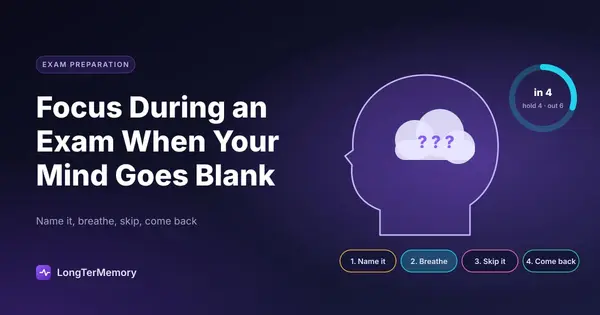
When you blank, stop, breathe slowly for 30 to 60 seconds, skip the question, and come back later using retrieval cues like related facts, context, or a quick brain dump. Fighting the blank head-on usually makes it worse.
Here’s a step-by-step protocol you can memorize before your next exam:
| Step | Action | Time |
|---|---|---|
| 1 | Notice the blank and name it: “This is a blank, it’s normal.” | 5 seconds |
| 2 | Put your pen down and breathe slowly (in 4, hold 4, out 6) | 30 to 60 seconds |
| 3 | Mark the question and move to one you can answer | Immediately |
| 4 | Build momentum with easier questions | A few minutes |
| 5 | Return and use cues to retrieve | 1 to 2 minutes |
Breathe to calm your body
Slow breathing, especially with a longer exhale, activates the parasympathetic nervous system, which counteracts the stress response. You don’t need anything fancy. Try box breathing (in 4 seconds, hold 4, out 4, hold 4) or simply make each exhale longer than the inhale. Three or four slow breaths can noticeably lower your heart rate.
Skip and come back
Staring at a blank question tends to increase panic and lock you into the same failed search. Moving on gives your brain a chance to keep searching in the background. It’s very common for the answer to pop up while you’re working on question 12. Also, later questions often contain cues that help with earlier ones.
Use retrieval cues
When you return, don’t try to pull the answer straight out. Approach it from the side:
- Context reinstatement: Picture where you were when you studied it. The room, the page, the color of your notes, the lecture slide. Memory is tied to context, and recalling the setting can bring the content back.
- Related facts: Write down anything connected to the topic. Related concepts often act as a bridge to the one you’re missing.
- Brain dump: In the margin, jot every word or formula you associate with the topic. Seeing them on paper frequently triggers the missing piece.
- Work backward: For problem questions, start from what the answer should look like (units, type of result) and reason toward it.
- Eliminate: On multiple choice, cross off options you know are wrong. Even partial knowledge can get you to the right answer. Our guide on scoring higher on multiple choice exams covers this.
Reframe the anxiety
Research by Jeremy Jamieson and colleagues found that students who were told that stress arousal can help performance (reappraising a racing heart as “my body getting ready”) performed better on math tests than students who weren’t. Next time you feel the rush, try telling yourself, “This is energy, not danger.”
Don’t leave it blank
If time is running out and the answer still won’t come, write something. Partial credit is real. Write the formula, the first step, the key concept, or your best reasoning. An attempt almost always beats an empty space.
Building Retrieval Fluency So Blanks Become Rare
Retrieval fluency means you’ve recalled information so many times that it comes to mind quickly and reliably, even under pressure. You build it with spaced retrieval practice over weeks, not by cramming the night before.
Think of retrieval fluency like a well-worn path. If you’ve walked it once, it’s easy to get lost in the dark. If you’ve walked it 20 times, you could find it with your eyes closed, which is basically what you’re doing when anxiety turns the lights off.
How to build it
- Space your practice. Review material across days and weeks, not all at once. Each spaced retrieval strengthens the memory and makes it more resistant to stress. See the science of spaced repetition.
- Practice retrieving in different ways. Answer flashcards, explain concepts out loud, solve problems, draw diagrams from memory. Varied retrieval creates more pathways to the same information.
- Practice under mild pressure. Use timers. Do quick quizzes with a friend. Your brain gets used to retrieving with a little stress in the mix.
- Keep going after you get it right. Getting an answer right once is not mastery. Researchers call continued practice beyond the first correct answer “overlearning,” and spaced sessions of it make knowledge sturdier.
A simple 3-week fluency plan
| Week | Focus |
|---|---|
| Week 1 | Turn notes into questions, daily active recall for each topic |
| Week 2 | Spaced reviews, mix topics, start timed question sets |
| Week 3 | Full practice exams, review weak areas, keep daily flashcards short |
How LongTerMemory helps
Building enough retrieval practice for an entire course takes a lot of cards, and making them by hand is slow. LongTerMemory generates question and answer pairs directly from your PDFs, slides, and notes, then schedules them with spaced repetition. That means you spend your time actually retrieving, which is what builds fluency, instead of formatting flashcards.
When Blanks Are a Sign of Something Bigger
If you blank frequently, feel intense panic before most exams, or avoid tests altogether, you might be dealing with significant test anxiety. That’s common and treatable. Cognitive behavioral techniques can help a lot, and our post on managing exam anxiety with CBT techniques is a good place to start. Many universities also offer free counseling and exam accommodations.
Frequently Asked Questions
Why does my mind go blank during exams even when I studied?
Stress and anxious thoughts crowd your working memory and stress hormones interfere with retrieval. The knowledge is usually still there, just temporarily hard to access.
What should I do immediately when my mind goes blank?
Pause, breathe slowly for 30 to 60 seconds, skip the question, and return later using cues like related facts or a quick brain dump.
How can I stop going blank in future exams?
Study with retrieval practice instead of rereading, take timed practice exams, sleep well, and use a consistent pre-exam routine.
Does writing about worries before an exam really help?
Yes. A 2011 study in Science found that 10 minutes of expressive writing about worries before an exam improved scores, especially for anxious students.
Is it okay to guess if I can’t remember?
Yes. Write partial answers or make educated guesses. Partial credit and elimination strategies often earn points that a blank never will.
The Bottom Line
Mind blanks are a retrieval problem caused by stress, and they’re largely preventable. Calm your body, skip and return, use cues, and above all, prepare with spaced retrieval practice so your knowledge holds up under pressure.
Before your next study session, take one topic and quiz yourself on it without notes. That one habit, repeated over a few weeks, is the most powerful anti-blank strategy there is.