How to Study in 15-Minute Intervals Throughout Your Day
Learn how to study in 15-minute intervals using distributed practice and spaced repetition, with a sample daily micro-session schedule that fits any day.
Table of Contents
- Why distributed micro-sessions outperform single long blocks
- Designing your 15-minute study sprints for maximum retention
- What fits in 15 minutes (and what doesn't)
- Using spaced repetition apps to fill micro-sessions efficiently
- A sample daily micro-session schedule
- Conclusion
- FAQ
- Is 15 minutes really enough time to learn anything?
- How many 15-minute study sessions should I do per day?
- What should I study in a 15-minute session?
- Can micro-sessions replace long study blocks entirely?
You don’t need a three-hour library marathon to learn something well. You need fifteen minutes, used properly, several times a day. That’s the whole premise of micro study intervals, and it’s not a productivity hack cooked up for social media. It’s one of the most solidly supported findings in a century of memory research.
Here’s the problem most students and working professionals run into: they wait for a “real” study block that never arrives. The free evening gets eaten by a late meeting, the weekend plan collapses, and suddenly the exam is ten days away and nothing has stuck. Meanwhile, the average person burns well over an hour a day on fragmented downtime, commuting, waiting rooms, coffee lines, the gap between meetings. Those fragments are exactly where 15-minute study sprints live.
In this post I’ll walk you through why distributed micro-sessions beat long cram blocks according to the research, how to design a 15-minute sprint so it actually builds memory instead of just feeling busy, and how to use spaced repetition apps to fill those windows with zero setup friction. I’ll finish with a sample daily schedule you can steal.
Why distributed micro-sessions outperform single long blocks
The core answer: spreading the same total study time across multiple short sessions produces dramatically better long-term retention than concentrating it in one block. This is the spacing effect, and it might be the most replicated finding in all of learning science.
The evidence is not subtle. In their massive 2006 meta-analysis, Cepeda, Pashler, Vul, Wixted, and Rohrer reviewed 254 studies involving more than 14,000 participants and found that distributed practice consistently outperformed massed practice across verbal tasks, skills, and age groups. In many of the underlying experiments, students who split their study time across days retained roughly twice as much on delayed tests as students who did the same total time in a single sitting. Same hours. Wildly different outcomes.
Dunlosky and colleagues reached a similar verdict in their influential 2013 review of ten popular learning techniques. They rated distributed practice and practice testing as the two highest-utility methods available to students, while the crowd favorites, rereading and highlighting, landed at the bottom as low-utility. If you want the full story on the science, my post on the science of spaced repetition digs into the mechanisms.
Why does spacing work so well? A few reasons stack up:
- The forgetting curve works for you. Ebbinghaus showed back in 1885 that we forget newly learned material fast, losing the majority within days unless it’s revisited. Every time you catch a memory just as it starts to fade, the relearning resets the curve at a slower decay rate. Micro-sessions spread across the day hit memories at exactly these vulnerable, high-value moments.
- Each session is a fresh retrieval context. When you study in one long block, everything happens in the same mental state, same room, same mood. Memories encoded in varied contexts are easier to recall later, because they’re not chained to one environment.
- Attention is a scarce resource. Realistically, deep focus degrades well before the two-hour mark. Fifteen minutes is short enough that you can genuinely sprint at full intensity the whole time, instead of coasting through hour three on autopilot.
- Consolidation happens between sessions. Sleep and idle time are when your brain files memories into long-term storage. Five sessions separated by hours give your brain five rounds of consolidation. One block gives it one.
There’s one honest caveat: micro-sessions are terrible for tasks that need long uninterrupted immersion, like writing a first draft or working through a multi-step proof. What they’re perfect for is the memory side of learning, the facts, concepts, vocabulary, formulas, and procedures you need at instant recall. And for most exams and certifications, that’s the majority of the battle.
Designing your 15-minute study sprints for maximum retention
The core answer: a good 15-minute sprint has one clear target, active retrieval as the main activity, and a two-minute wrap-up that sets up your next session. Vague “review my notes” sprints waste the window; surgical ones compound.
Fifteen minutes is brutally short, which is the point. There’s no room for setup rituals, no room for rereading a whole chapter, no room for “getting into it.” You have to arrive knowing exactly what you’ll do. Here’s the structure I recommend:
| Phase | Minutes | What you do |
|---|---|---|
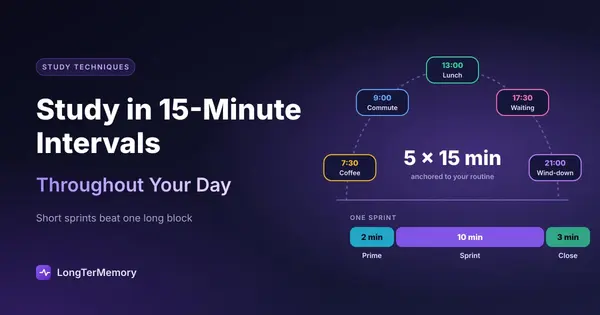
| Prime | 0 to 2 | Open your material to one pre-decided target (a deck, a section, a question set) |
| Sprint | 2 to 12 | Pure active recall: answer flashcards, do practice questions, or blank-page recall |
| Close | 12 to 15 | Flag what you missed, jot one line on where to pick up next time |
A few design rules that make or break the format:
1. Decide the target before the window opens. The biggest micro-session killer is spending the first eight minutes figuring out what to study. Pre-load your sprints. If you’re using flashcards, your queue decides for you. If you’re working through a textbook, leave a sticky note at the exact page where the next sprint starts.
2. Retrieval only, no passive review. In a 15-minute window, rereading is a catastrophic waste. Karpicke and Roediger’s classic 2008 experiments showed that students who practiced retrieval retained about 80% of the material a week later, compared to roughly 33% for students who repeatedly restudied. You cannot afford the inferior method when your time budget is this tight. Test yourself, answer questions, write from memory. If you need a refresher on the techniques, my guide to active recall techniques covers the practical playbook.
3. One sprint, one topic. Don’t try to touch three subjects in fifteen minutes. Task-switching costs real cognitive time, and in a short window it’s pure loss. Depth beats breadth per sprint; variety comes from running different topics across the day’s multiple sprints.
4. Protect the start. The first two minutes are the hardest, so remove every decision. Phone on the flashcard app already, notebook open already, timer already set. This is basically habit stacking applied to studying: anchor each sprint to an event that already happens every day, like your morning coffee, your commute, or lunch.
5. Track completions, not minutes. Checking off “finished sprint 3 of 5” feels like winning a small game. Watching a timer feels like serving a sentence. The mindset difference sounds trivial, but it’s what keeps the habit alive past week two.
What fits in 15 minutes (and what doesn’t)
To calibrate your expectations, here’s what a well-run sprint realistically holds:
- 25 to 40 flashcard reviews with an app that schedules them for you
- 10 to 15 practice questions with immediate answer checking
- One blank-page recall of a single lecture or textbook section
- One concept explained out loud (Feynman style) to an imaginary beginner
- Two or three worked examples redone from memory, not copied
What doesn’t fit: starting a new chapter, watching a lecture video at 1x, reorganizing your notes, making flashcards by hand. Those are setup tasks, and they belong in your one weekly planning block, not in the sprints themselves. Which brings us to the tooling question, because the setup burden is exactly where most micro-study systems fall apart.
Using spaced repetition apps to fill micro-sessions efficiently
The core answer: a spaced repetition app is the natural engine for micro-study intervals, because it removes the two things that kill short sessions, deciding what to study and scheduling when to review it. You open the app, and the right cards are already waiting.
Here’s why this pairing works so well. The spacing effect research says reviews should happen at expanding intervals, roughly a day later, then a few days, then a week, then longer, adjusted to how well you actually remember each item. Doing that math by hand for hundreds or thousands of facts is absurd. An SRS algorithm (like the SM-2 family that most apps descend from) does it automatically, so every time you open the app, the cards shown are precisely the ones your forgetting curve says are due right now.
That means a 15-minute sprint becomes zero-friction:
- Open the app (five seconds).
- Answer the due queue (the algorithm chose it, not you).
- Close the app when the timer ends. Done.
No planning, no sorting, no guilt about what you “should” be reviewing. The queue is always the mathematically optimal use of your next fifteen minutes. Compare that to the manual alternative, where half your sprint evaporates into flipping through a notebook deciding what to look at.
A few tips for getting the most out of app-based micro-sessions:
- Keep your daily review cap realistic. If your queue regularly exceeds what five sprints can clear, reduce new cards rather than skipping days. A skipped day doesn’t just delay reviews, it lets cards slide down the forgetting curve, and they come back harder.
- Never let a day hit zero. Consistency matters more than volume. One sprint on a brutal day preserves the habit and protects your retention; zero sprints breaks both.
- Mix difficulty, not subjects. Good SRS queues naturally interleave easy and hard cards, which keeps the sprint engaging. If you’re tempted to only review the comfortable deck, that’s the fluency illusion talking.
- Let the tool handle creation too, if it can. The hidden cost of flashcard study has always been making the cards. Manually converting a 60-page PDF chapter into Q&A cards can eat an entire evening, which is time stolen from actual retrieval practice.
That last point is exactly why I built my own workflow around LongTerMemory. I drop in a PDF lecture, a textbook chapter, or a web article, and it generates the Q&A flashcards for me, then schedules them with automatic spaced repetition. So my 15-minute windows are 100% retrieval and 0% admin. If the card-creation grind is what’s keeping you from running micro-sessions, you can try it free and see how much of the setup it deletes. For an honest breakdown of how it compares to the DIY approach, see my Anki vs LongTerMemory comparison.
A sample daily micro-session schedule
The core answer: aim for four to six 15-minute sprints anchored to events that already happen every day, totaling 60 to 90 minutes of high-quality study without ever touching your calendar’s “real” blocks.
Here’s a template that works for a typical workday or class day. Adjust the anchors to your life, but keep the structure:
| Time | Anchor event | Sprint content |
|---|---|---|
| 7:30 AM | Morning coffee | SRS review queue (the overnight due cards) |
| 12:30 PM | After lunch | New material: one section turned into recall questions |
| 3:00 PM | Afternoon slump | SRS review queue, second pass |
| 6:00 PM | Commute or gym cooldown | Flashcards or practice questions on phone |
| 9:30 PM | Before bed wind-down | Light review of what you missed today |
Total: five sprints, 75 minutes, and here’s the beautiful part, that 75 minutes of spaced, retrieval-focused work will outperform a two-hour evening rereading session for retention, and it doesn’t require sacrificing a single evening. One warning from experience: don’t over-schedule. Start with three anchors and add more only after the habit survives two weeks. I wrote a whole post on avoiding over-scheduling your study time because it’s the number one way people kill an otherwise great system.
Conclusion
Studying in 15-minute intervals works because it aligns your schedule with how memory actually works. The spacing effect, confirmed across hundreds of studies and meta-analyzed by Cepeda and colleagues in 2006, says distributed beats massed. Retrieval practice, validated by Karpicke and Roediger, says testing beats rereading. And the forgetting curve says little-and-often beats heroic-and-rare. Put those together and the logical conclusion is a handful of short, focused, retrieval-based sprints spread through your day.
Start small: pick three daily anchors, load a spaced repetition app with your material, and run one sprint per anchor for two weeks. If building the flashcard library is the bottleneck, let LongTerMemory turn your PDFs and web sources into scheduled Q&A cards automatically, so every one of those fifteen minutes goes into learning instead of prep. Your future self, sitting in the exam calmly recalling things you studied in line at the coffee shop, will thank you.
FAQ
Is 15 minutes really enough time to learn anything?
Yes, if the time is spent on active retrieval. Research on the spacing effect shows that the same total study time produces better retention when split into short distributed sessions. The catch is that passive activities like rereading barely work in long sessions either, so short sprints must be retrieval-focused to pay off.
How many 15-minute study sessions should I do per day?
Three to five is the sweet spot for most people, totaling 45 to 75 minutes. That’s enough to keep a spaced repetition queue healthy and make steady progress on new material. More than six usually means you’re scheduling sprints you won’t actually do, which erodes the habit.
What should I study in a 15-minute session?
Discrete, recall-friendly content: flashcard reviews, practice questions, vocabulary, formulas, definitions, or a blank-page recall of one small section. Save deep-work tasks like essay drafting or complex problem sets for longer blocks.
Can micro-sessions replace long study blocks entirely?
Mostly, for memorization-heavy goals like exams, certifications, and language learning. But if your goal involves producing something (writing, projects, proofs), you still need occasional longer blocks. The ideal system uses micro-sessions for memory maintenance and one or two weekly blocks for deep work.