How to Study for the CNS Clinical Nurse Specialist Exam
A practical CNS certification study plan: the three spheres of practice, core clinical concepts, a 12-week timeline, and how spaced repetition locks it in.
Table of Contents
- The three spheres of CNS practice and how they map to exam content
- Which exam are you actually taking?
- Core clinical concepts tested in CNS board exams
- How CNS questions are written
- Study resources and timeline for CNS certification
- A 12-week plan that works around a full-time job
- Resources worth your money
- Why most CNS candidates still forget what they study
- A weekly routine that fits real life
- Common mistakes to avoid
- Conclusion
- FAQ
- How hard is the CNS certification exam?
- How long should I study for the CNS exam?
- Which CNS exam should I take, ANCC or AACN?
- What are the three spheres of CNS practice?
- Can spaced repetition really help with CNS board prep?
You’ve finished your master’s or DNP, you’ve logged your supervised clinical hours, and now the CNS certification exam is the last gate between you and the credential. If you’re a working nurse, you’re probably also wondering where exactly you’ll find the study time between shifts.
Here’s the short version. The CNS exam is a clinical judgment exam, not a trivia contest. It rewards candidates who can reason through a patient scenario, a nursing-practice problem, or a system-level issue, and it punishes candidates who only memorized lists. The good news is that this is a very learnable skill, and the plan below is built around it: understand the three spheres of CNS practice, master the core clinical concepts, then use retrieval practice and spaced repetition to make the knowledge stick for exam day (and beyond).
One note before we start: the details of the exam (number of questions, time limit, test plan percentages) depend on your population focus and your certifying body, and they change from time to time. Always confirm the current numbers in the official candidate handbook. I’ll point out where.
The three spheres of CNS practice and how they map to exam content
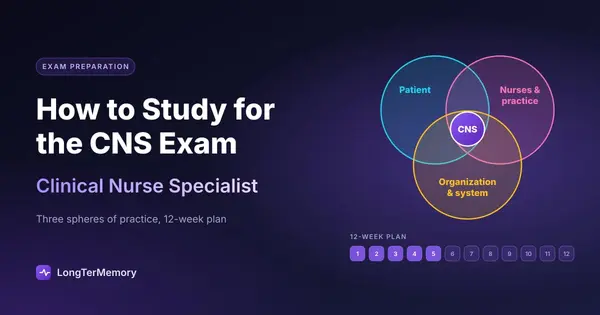
The core answer: CNS practice is organized into three spheres of influence, defined by the National Association of Clinical Nurse Specialists (NACNS), and the exam is built to test whether you can function in all three, not just at the bedside.
This is the single most important framing for the whole exam, because it explains why CNS questions feel different from a typical NP or RN exam. Here’s how the spheres break down:
| Sphere | What it covers | What the exam asks you to do |
|---|---|---|
| Patient / Client | Direct care of patients and families, advanced assessment, diagnosis, and treatment of complex conditions | Interpret findings, prioritize interventions, anticipate complications |
| Nurses and Nursing Practice | Mentoring, education, and improving how nurses deliver care | Choose the best way to teach, coach, or change a nursing practice |
| Organization / System | Quality improvement, policy, evidence-based practice, cost and outcomes | Pick the right QI approach, interpret outcome data, lead change |
A few points that trip candidates up:
- The spheres are not equally “comfortable.” Most nurses are strong in the patient sphere because that’s what we do all day. The nursing-practice and system spheres are where I see people lose points, because they involve change theory, quality methods, and program evaluation that clinicians rarely get to practice.
- The best answer is often the system-level answer. If a scenario describes a recurring problem (repeated falls, a spike in CAUTI rates), the CNS answer usually addresses the process or the practice pattern, not just the single patient in front of you.
- Evidence-based practice is everywhere. Expect questions that ask you to appraise evidence, interpret basic statistics, and decide when a finding is strong enough to change a protocol.
Which exam are you actually taking?
CNS certification is offered through more than one body, depending on your population focus. The two you’ll encounter most often:
| Certifying body | Typical credentials | Good to know |
|---|---|---|
| ANCC (American Nurses Credentialing Center) | Adult-Gerontology CNS, Pediatric CNS, Psychiatric-Mental Health CNS | Computer-based; test content outline published in the handbook |
| AACN Certification Corporation | ACCNS-AG, ACCNS-P, ACCNS-N (adult-gerontology, pediatric, neonatal) | Strong emphasis on acute and critical care; built around the Synergy Model |
Download the current test content outline for your specific exam before you do anything else. It lists each domain with its weight, and it should drive how you divide your study hours. If a domain is worth 25% of the exam, it should get roughly 25% of your time, with extra on the areas where you score lowest.
Core clinical concepts tested in CNS board exams
The core answer: expect advanced pathophysiology, pharmacology, diagnostics, and evidence-based practice for your population focus, plus a healthy dose of leadership, quality improvement, and ethics.
Think of the content as five buckets. Use this as a self-assessment checklist and rate yourself 1 to 5 in each one:
- Advanced pathophysiology and assessment. Disease mechanisms, atypical presentations, and what the abnormal labs and imaging actually mean in context. For acute-care CNS candidates, this includes hemodynamics, ventilation, and multi-system failure.
- Pharmacology. Drug classes, mechanisms, major adverse effects, interactions, and dosing adjustments in renal or hepatic impairment. If this is your weak area, my guide on studying pharmacology drug classes and mechanisms will help.
- Evidence-based practice and research. Reading a study critically, understanding sensitivity, specificity, confidence intervals, and the levels of evidence, and deciding what belongs in a practice guideline.
- Quality improvement and systems. PDSA cycles, root cause analysis, process measures versus outcome measures, benchmarking, and change management models.
- Professional role, ethics, and leadership. Scope of practice, consultation, ethical dilemmas, interprofessional collaboration, and teaching strategies for staff nurses and patients.
How CNS questions are written
Most items are short clinical or practice scenarios that end with a “best,” “first,” or “most appropriate” question. Several answer choices are usually defensible, and you’re being tested on prioritization. A few reliable rules:
- Safety and stability first. Airway, breathing, circulation, and immediate risk beat everything else.
- Assess before you act, unless the patient is unstable.
- Prefer the answer that fits the CNS role. If a choice has you doing a task a staff nurse would do, and another has you coaching the team or changing the process, the second is often the better CNS answer.
- Use evidence, not tradition. “We’ve always done it this way” is never the right answer.
If you want to sharpen the test-taking side of this, my posts on active recall techniques and learning from practice test mistakes cover how to turn every missed question into a lasting improvement. Nursing candidates preparing for other exams may also find the NCLEX-PN prep guide a useful comparison point for how nursing exams reward prioritization.
Study resources and timeline for CNS certification
The core answer: plan for 10 to 12 weeks at 6 to 8 hours per week, use the official test outline as your map, take a full-length practice test early, and review facts with spaced repetition instead of rereading.
A 12-week plan that works around a full-time job
| Weeks | Focus | Weekly output |
|---|---|---|
| 1 | Download the handbook and test outline, take a baseline practice test, rate yourself in each domain | Gap list ranked by weight and weakness |
| 2 to 4 | Weakest domain plus pathophysiology and pharmacology for your population | 50 to 75 practice questions, flashcards for every miss |
| 5 to 7 | Evidence-based practice, research methods, QI and systems content | 75 practice questions, 3 one-page summaries |
| 8 to 9 | Professional role, ethics, leadership, teaching and change theory | Mixed practice blocks of 50 questions |
| 10 to 11 | Full-length timed practice exam, error analysis, weak-spot repair | Two full exams, review every miss |
| 12 | Light review of flashcards, sleep, logistics. No new content | Daily 20-minute card review |
Resources worth your money
You don’t need everything. You need a handful of things done well:
- The official candidate handbook and test content outline from your certifying body. Free, and the only source that tells you what’s actually fair game.
- One question bank that matches your population focus. Most CNS-specific banks are smaller than NCLEX banks, so supplement with advanced practice and critical care question sources when needed.
- A core text for your specialty (a CNS review book or your graduate program’s main reference), used as a reference rather than read cover to cover.
- Professional organization materials. The NACNS competency statements are worth skimming so the sphere framework becomes second nature.
- Peers. A study partner, or a hospital CNS who has already passed, can explain how the exam thinks. Some candidates find this kind of insight in online communities too, and I covered how to do it safely in using Reddit and forums for certification exam tips.
Why most CNS candidates still forget what they study
Here’s the problem that no resource list solves. You’ll spend weeks absorbing pathophysiology, drug classes, and QI frameworks, and without review, most of it fades. This is the forgetting curve that Ebbinghaus described in the 1880s: without reinforcement, you lose a large share of new material within days.
The research on how to counter it is some of the strongest in education science:
- Karpicke and Roediger (2008, Science) found that students who practiced retrieval remembered about 80% of the material a week later, versus about 34% for students who simply reread it.
- Cepeda and colleagues (2006) reviewed more than 300 experiments and concluded that spacing study sessions out over time produces better long-term retention than massing them together.
- Dunlosky and colleagues (2013) ranked practice testing and distributed practice as the two most useful learning techniques among the ten they evaluated.
In practical terms: a deck of flashcards you review on an expanding schedule will beat any amount of highlighting and rereading. I explain the mechanics in the science of spaced repetition.
The catch is the work of building the deck. A CNS candidate can easily generate 600 to 1,200 flashcard-worthy facts across pathophysiology, pharmacology, QI methods, and research concepts. Writing those cards by hand can cost 10 to 15 hours, which is hours you don’t have after a 12-hour shift.
That is exactly what LongTerMemory automates. You upload your review book PDFs, your lecture notes, or a web page, and it generates Q&A flashcards automatically and schedules each one with spaced repetition, so cards come back right before you’d forget them. You skip the card-writing and keep the part that actually builds memory, the daily retrieval. If you’d like to see how it feels with your own material, you can try LongTerMemory for free.
A weekly routine that fits real life
- Monday to Friday, 20 minutes: flashcard review, ideally before work or on a break.
- Two evenings, 60 to 90 minutes: one focused content block plus 25 to 40 practice questions.
- One weekend session, 2 hours: a timed question block and error analysis. For each miss, write down why you missed it (knowledge gap, misread the question, wrong priority) and make a card from it.
Common mistakes to avoid
| Mistake | Better approach |
|---|---|
| Studying only patient-sphere content | Give nursing-practice and system content proportional time |
| Rereading the review book | Close the book and test yourself from memory |
| Skipping the test outline | Let the domain weights set your schedule |
| Doing questions without reviewing rationales | Review every question, including the ones you got right |
| Cramming in the last week | Spend the last week on light review and sleep |
Conclusion
To pass the CNS exam, think like a CNS. Learn the three spheres of practice and answer from the role, not just the bedside. Build your plan from the official test content outline, spend your hours where the weight and your weaknesses overlap, and practice with scenario questions long before exam week. Then protect everything you learn with daily, spaced retrieval so that it’s still there when you sit down at the testing center. Twelve steady weeks beat three frantic ones every time. You’ve already done the hard clinical work, now give it a smart plan.
FAQ
How hard is the CNS certification exam?
It is challenging mainly because the questions test judgment across three spheres of practice rather than recall of isolated facts. Candidates with solid clinical experience and a structured plan, including practice questions and spaced repetition, generally do well. Check your certifying body’s published pass rates for current figures.
How long should I study for the CNS exam?
Most working nurses do well with 10 to 12 weeks at 6 to 8 hours per week. If your graduate program ended a while ago, or if you work night shifts, lean toward the longer end and start with a baseline practice test to find your gaps.
Which CNS exam should I take, ANCC or AACN?
It depends on your population focus and practice setting. ANCC offers adult-gerontology, pediatric, and psychiatric-mental health CNS exams, while AACN Certification Corporation offers ACCNS exams for adult-gerontology, pediatric, and neonatal acute and critical care. Check eligibility requirements and your employer’s preference before registering.
What are the three spheres of CNS practice?
They are the patient or client sphere, the nurses and nursing practice sphere, and the organization or system sphere. The exam tests your ability to apply CNS competencies across all three, so study each one rather than focusing only on direct patient care.
Can spaced repetition really help with CNS board prep?
Yes. Research on retrieval practice and distributed practice consistently shows better long-term retention than rereading. Turning missed questions and key concepts into flashcards reviewed on a spaced schedule is one of the most efficient ways to retain a large volume of material over a 12-week prep period.