How to Learn a Foreign Language for a Job Interview
You can't get fluent in a month, but you can get interview ready. Build a focused word bank, rehearse real questions, and handle the moments you get stuck.
Table of Contents
- How Much Can You Really Achieve in Your Timeline?
- First, Find Out What You'll Actually Be Tested On
- Prioritize Professional Vocabulary Over Conversational Fluency
- Build Your Three Word Banks
- Learn Chunks, Not Single Words
- Practice Strategies for Interview Scenarios
- The Questions to Prepare First
- A Five-Step Routine for Each Answer
- Train Your Ears Too
- Prepare for the Moment You Get Stuck
- Building Enough Proficiency in a Short Timeline
- A 30-Day Plan at 45 Minutes a Day
- Make Flashcards That Practice Speaking
- Consider Your Time Pressure When Scheduling Reviews
- The Last Two Days Before the Interview
- Mistakes That Waste Your Preparation
- Let Your Documents Do Some of the Work
- FAQ
- Can I learn a language in one month for an interview?
- Should I tell the interviewer my level honestly?
- What if I don't understand a question?
- Is it okay to memorize my answers?
- Which is more important, grammar or vocabulary?
- The Bottom Line
The interview is in five weeks, it’s partly in German, and your German stops somewhere around ordering coffee. Sound familiar?
Here’s the good news: you don’t need to become fluent, you need to become fluent in one very small conversation. A job interview is one of the most predictable conversations you’ll ever have. You know the topic (you), you can guess most of the questions, and you can prepare your answers in advance. That makes it a far smaller target than “learning a language”.
So forget the beginner app that teaches you to say the cat is under the table. This guide shows you what to learn first, how to practice for the real scenario, and how much you can honestly expect from the time you have.
How Much Can You Really Achieve in Your Timeline?
You can’t reach general professional fluency in a few weeks, but you can usually prepare a solid, rehearsed performance on a narrow set of topics. Keep those two goals separate and the whole project becomes manageable.
For scale, the US Foreign Service Institute’s commonly cited estimates put professional working proficiency at around 600 to 750 class hours for languages closest to English, such as Spanish or French. Harder languages run to about 1,100 hours, and the hardest group, including Japanese and Arabic, to about 2,200. Those figures also assume intensive classes plus self-study.
An interview doesn’t need all of that. Here’s a realistic picture, assuming about an hour a day:
| Time available | Realistic goal if you start from scratch | Realistic goal if you already have some basics |
|---|---|---|
| 2 weeks | A memorized introduction, a few polite phrases, a graceful switch back to English | Rehearsed answers to the 5 most likely questions |
| 6 weeks | A short self-presentation and simple answers about your work | Answers to 10 to 15 questions, with basic follow-ups |
| 3 months | Simple, slow but real exchanges on your job and experience | A convincing interview on familiar topics, with some improvisation |
These are planning estimates rather than research results, and they’ll shift with how close the language is to one you already speak.
One honest warning: if the job truly requires daily work in that language, interview preparation won’t replace the skill. A rehearsed answer can get you through a screening, but it won’t carry you through client calls. Be straight about your level, because “I’m at an intermediate level and improving quickly, and I prepared for this conversation” is a strong position. Claiming fluency on your CV is a trap that closes the moment someone asks an unexpected question.
First, Find Out What You’ll Actually Be Tested On
Before you study a single word, find out how the language will be used in the process. One short message to the recruiter can save you weeks of preparing for the wrong thing.
Ask, politely and directly:
- Will the whole interview be in the language, or only part of it?
- Is there a formal language assessment or a required level, such as a CEFR B2?
- Who’s interviewing me, and will they be native speakers?
- Is it live, by video, or a recorded one-way interview?
The answers change your plan completely. A recorded interview rewards polished, memorized answers. A surprise switch to the other language in the last ten minutes rewards your introduction and a few strong stories. A formal test needs broader grammar and vocabulary work, so don’t rely on this guide alone for that.
Prioritize Professional Vocabulary Over Conversational Fluency
The fastest route is to learn the words of your own job and story first, and leave general conversation for later. Most courses teach restaurants, hobbies and family because those are universal. You’re after a very different list.
Frequency research explains why this approach works. In Paul Nation and Robert Waring’s well-known work on vocabulary, about 2,000 word families cover close to 80% of ordinary written text, and an even larger share of informal speech. So a small core does a lot of the work, and you should learn it if you don’t already have it. On top of that, a specialized interview is even more repetitive than ordinary text: you’ll use the same few dozen terms from your field over and over.
Build Your Three Word Banks
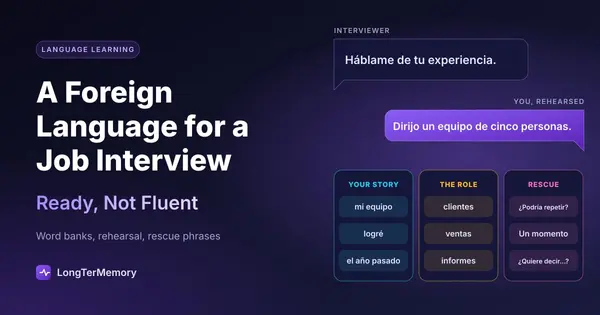
Instead of a generic list, build three small banks from your real material.
| Bank | What goes in it | Where to find it | Target size |
|---|---|---|---|
| Your story | Your job titles, duties, achievements, numbers, reasons for moving | Your CV, translated and corrected | 50 to 100 items |
| The role | Technical terms, tools, processes, industry words | The job posting, the company’s site, LinkedIn profiles of people in the role | 50 to 100 items |
| Rescue phrases | Asking for repetition, buying time, rephrasing, correcting yourself | The list below, adapted with a tutor | 15 to 25 items |
The job posting is your best single document. If it exists in the target language, read it line by line and collect every word you’d want to use yourself. Those are the exact words the interviewer has in mind, and they’re the terms you should be able to say without hesitating.
Learn Chunks, Not Single Words
Fluent speakers don’t assemble sentences one word at a time, they pull out ready-made phrases. A 2006 study by Frank Boers and colleagues found that learners who were taught to notice and use these fixed expressions were rated as more proficient by judges in oral tests. That effect is exactly what you want in an interview.
So don’t memorize “responsible” alone. Memorize “I was responsible for a team of five”. Don’t memorize “increase”. Memorize “we increased sales by 20% in one year”. You can swap the details later, but the frame stays the same and comes out automatically under pressure.
Useful frames to prepare in your target language:
- “In my current role, I’m responsible for…”
- “One of my biggest achievements was…”
- “I’m interested in this position because…”
- “For example, last year we…”
- “What I learned from that was…”
- “Could you tell me more about…?”
Practice Strategies for Interview Scenarios
The method that works is simple: write your answers, get them corrected, then practice saying them from memory until you can do it without the page. Reading them over and over feels like practice, but it only trains recognition. In the interview, you have to produce the sentences yourself.
The Questions to Prepare First
Most interviews draw on the same small pool of questions, so start with the ones that are almost certain to appear.
| Priority | Question | Why it matters |
|---|---|---|
| 1 | Tell me about yourself | Nearly always the opener, and it sets the first impression |
| 2 | Why do you want this job? | Shows motivation and that you researched the company |
| 3 | Describe your current role | Uses your core professional vocabulary |
| 4 | Tell me about a problem you solved | One flexible story can answer many questions |
| 5 | What are your strengths? And weaknesses? | Standard, and easy to prepare |
| 6 | Why are you leaving your current job? | Needs careful, diplomatic wording |
| 7 | Do you have any questions for us? | Gives you a chance to lead the conversation |
A Five-Step Routine for Each Answer
- Draft it in simple language. Write what you’d really say, aiming for short sentences and words you can pronounce. If a sentence is hard to say, it’s the wrong sentence.
- Get it corrected. A tutor is ideal, and AI tools are useful for a first pass. Ask specifically for natural wording that suits a professional setting, since formal and informal address can matter a lot.
- Shrink it to keywords. Replace the full text with 4 or 5 prompts. This stops you from reciting a script word for word.
- Say it from memory, out loud. Record yourself, listen back, and fix what sounds wrong. Then record it again.
- Get interrupted. Ask a tutor or friend to cut in with follow-ups: “Why did you do that?”, “How long did it take?”, “What would you change?”
Repetition isn’t cheating here. Martin Bygate’s research on task repetition found that when learners redo the same speaking task, their performance improves as attention shifts from finding the message to expressing it well. Your fifth attempt at an answer really is better than your first, and not simply more memorized.
Train Your Ears Too
Plenty of candidates prepare beautiful answers and then miss the question. To avoid that, make sure you can understand a question in several wordings. “Tell me about yourself”, “Could you introduce yourself?” and “Walk me through your background” should all trigger the same answer.
Collect these variations and listen to them spoken at normal speed. Ask your tutor to record them, or use videos of interviews in the language. Retrieval practice for listening helps here: listen once, then try to say what was asked before you check.
Prepare for the Moment You Get Stuck
You will get stuck, so prepare for it like any other part of the interview. A candidate who handles a gap calmly often makes a better impression than one who’s flawless until the moment they freeze.
Here’s what that bank of rescue phrases might look like, using Spanish as an example:
| You need to | Example in Spanish | Meaning |
|---|---|---|
| Ask for a repeat | ¿Podría repetir la pregunta, por favor? | Could you repeat the question, please? |
| Ask for slower speech | ¿Podría hablar un poco más despacio? | Could you speak a little more slowly? |
| Buy thinking time | Déjeme pensarlo un momento. | Let me think about that for a moment. |
| Check you understood | ¿Quiere decir que…? | Do you mean that…? |
| Admit a missing word | No sé cómo se dice, pero es… | I don’t know how to say it, but it’s… |
| Switch language gracefully | ¿Le importa si lo explico en inglés? | Do you mind if I explain this in English? |
Practice these until they come out without effort. They’re probably the highest-value sentences you’ll learn all month.
Building Enough Proficiency in a Short Timeline
To make a short timeline work, review little and often, and spend most of your session speaking rather than studying. Daily consistency matters far more than a long weekend session, because spaced repetition strengthens memory across days, including the sleep between them.
A 30-Day Plan at 45 Minutes a Day
| Week | Main focus | Daily split |
|---|---|---|
| 1 | Pronunciation basics, your story, your self-introduction | 15 min flashcards, 15 min drafting, 15 min speaking |
| 2 | Questions 2 to 4, role vocabulary | 15 min flashcards, 10 min listening, 20 min speaking |
| 3 | Remaining questions, rescue phrases, first mock interview | 10 min flashcards, 10 min listening, 25 min speaking |
| 4 | Two or three full mock interviews, polish weak answers | 10 min flashcards, 35 min mock practice and review |
If you can afford a tutor, one or two sessions a week is the best money you’ll spend. Tell them exactly what you need: “Please be a tough interviewer for 20 minutes, and correct me at the end.”
Make Flashcards That Practice Speaking
Build your cards so that they make you produce the language. A card that shows the foreign word and asks for the meaning trains recognition. For an interview, flip it around.
- Front: “Say in German: I led a team of five people.”
- Back: The correct sentence, ideally with audio.
Say the answer out loud before you turn the card. Keep your cards in phrases, not isolated words, and put the most useful sentences from your answers straight into the deck. If you use Anki, these language-specific settings are a good starting point, and these vocabulary retention methods will help if you want to keep the language after the interview.
Consider Your Time Pressure When Scheduling Reviews
Normal spaced repetition plans for the long term, with intervals that can stretch for months. With an interview date in sight, keep the intervals shorter so everything is fresh on the day. Reviewing each phrase at 1, 3 and 7 days, and then every week or so until the interview, works well. Be careful in the last 48 hours: review lightly, and don’t add anything new.
The Last Two Days Before the Interview
Your job in the last 48 hours is to protect what you’ve built, not to add to it.
- Two days before: Do your last full mock interview, then fix only the biggest problems.
- The day before: Say each answer once from keywords, review your rescue phrases, and stop early. Sleep will do more for you than a late-night cram.
- On the day: Warm up by speaking the language for 15 minutes beforehand, not silently reading it. Listen to something in the language on the way there, or just before you log on. Say your opening answer out loud at least twice.
- In the interview: Slow down. Candidates usually speak too fast when nervous, and slower speech makes you both clearer and more accurate. Accept your mistakes and carry on, because most interviewers care more about whether you communicate than whether your grammar is perfect.
Mistakes That Waste Your Preparation
- Starting with a general app. It’s useful for long-term learning, but it won’t teach you to explain your job in five weeks.
- Memorizing long, complicated answers. If one word goes missing, the whole script collapses. Short sentences survive pressure.
- Practicing silently. Reading and listening don’t prepare your mouth. Speak every day, even if only to your phone.
- Using vocabulary you can’t pronounce. A simpler word said clearly beats an impressive word that nobody understands.
- Ignoring the register. Many languages distinguish formal and informal address. Learn which one applies, because using the wrong form can sound odd in a professional setting.
- Never practicing with surprises. Rehearsing alone won’t reveal how you cope with unexpected questions, so get someone to interrupt you.
Let Your Documents Do Some of the Work
The slowest part of this process is often turning your material into something you can review: the job posting, the company’s pages, your translated CV, your corrected answers. That’s where LongTerMemory can save you time. Upload those documents and it generates question-and-answer pairs from them, then schedules your reviews with spaced repetition, so your limited preparation goes into speaking instead of typing cards. The free trial is enough to try it with your own job posting and see whether it fits your routine.
If you need to study on top of a full workday, these tips for studying while working will help you find the hours. And if the role also has a technical round, add our guide to technical interview preparation to your plan.
FAQ
Can I learn a language in one month for an interview?
You can’t learn the language in a month, but you can usually prepare a solid introduction and answers to the most common questions. Starting from zero, expect a short and simple exchange. With some existing knowledge, a month of daily practice can make a real difference.
Should I tell the interviewer my level honestly?
Yes. State your real level and frame it positively, for example “I’m at an intermediate level and working on it daily”. Exaggerating creates problems in the interview and in the job, and honesty combined with visible effort tends to come across well.
What if I don’t understand a question?
Ask them to repeat or rephrase it, using a phrase you’ve already practiced. It’s completely normal, and it’s far better than answering the wrong question. You can also check your understanding by restating the question in simple words.
Is it okay to memorize my answers?
Yes, as long as you memorize key points and useful phrases rather than a word-for-word script. A script breaks the moment the wording of the question changes. Practicing from keywords keeps your answers natural and flexible.
Which is more important, grammar or vocabulary?
For an interview, prioritize vocabulary and ready-made phrases, then fix the grammar mistakes you make repeatedly. Correct chunks give you accurate grammar without having to think about the rules while you speak.
The Bottom Line
You won’t master a language before your interview, and you don’t need to. Find out how it’ll be used, build your own small bank of words and phrases, practice your answers out loud from memory, and prepare for the moments you’ll get stuck. A narrow, well-rehearsed conversation is achievable in weeks, and the phrases you learn along the way are a good start on the real language you’ll keep building once you’ve got the job.