How to Prepare for the ABIM Internal Medicine Board Exam
What the ABIM internal medicine board exam tests, the highest-yield content areas and resources, and a practice question strategy and timeline to pass.
Table of Contents
- What the ABIM Exam Tests
- Exam format at a glance
- Task types: it's not just "what's the diagnosis?"
- The content blueprint
- High-Yield Content Areas and Study Resources
- What's especially high-yield
- Don't neglect the "small" areas
- Core resources compared
- Use your ITE scores
- Practice Question Strategy
- How to do questions the right way
- Why your mistakes are gold
- Target benchmarks
- A Study Timeline for Internal Medicine Boards
- Sample 6-month plan
- Fitting it around residency
- Exam Day Tips
- Making Your Review More Efficient
- Frequently Asked Questions
- How long should I study for the ABIM internal medicine boards?
- What is the best resource for the ABIM exam?
- What is the ABIM pass rate?
- Which subjects are most important on the ABIM exam?
- Are ITE scores predictive of passing the ABIM?
- The Bottom Line
To pass the ABIM Internal Medicine Certification Exam, base your plan on the official blueprint, spend most of your time on cardiology, pulmonary and critical care, GI, infectious disease, endocrinology, rheumatology, and hematology and oncology, and work through a full question bank twice with spaced review of your mistakes. Most residents do well with 3 to 6 months of steady preparation alongside work, roughly 1 to 2 hours on weekdays.
You’ve survived residency. You’ve managed DKA at 3 a.m., talked families through hard conversations, and learned to round on 18 patients before noon. And now there’s one more hurdle between you and “board-certified internist”: a long day in a testing center answering clinical vignettes across the entire breadth of internal medicine.
The ABIM exam isn’t designed to trick you. It’s designed to check that you can make sound clinical decisions across the full scope of general internal medicine. But it’s broad, and breadth is exactly what makes it tough to study for while working.
Here’s how to approach it efficiently.
What the ABIM Exam Tests
The ABIM Internal Medicine Certification Exam tests your clinical judgment across all internal medicine subspecialties, mostly through patient vignettes that ask about diagnosis, testing, treatment, and prevention. It’s a computer-based, single-best-answer exam taken over a full day.
Exam format at a glance
| Feature | Detail |
|---|---|
| Format | Single-best-answer multiple choice, mostly clinical vignettes |
| Length | Roughly 220 to 240 questions, divided into timed sessions |
| Duration | A full testing day (about 10 hours including breaks) |
| Delivery | Computer-based at a testing center |
| Pass rate | First-time pass rates have typically been in the high 80s to around 90% |
| Scoring | Scaled score, pass/fail against a set standard |
Always confirm the current details on the ABIM website before you register. Formats and session structures get updated.
Task types: it’s not just “what’s the diagnosis?”
The blueprint also weights questions by the clinical task. The exam spreads questions across:
- Diagnosis: what’s causing this?
- Testing: what’s the next best test?
- Treatment and care decisions: what’s the right management?
- Risk assessment, prognosis, and epidemiology
- Pathophysiology and basic science (a smaller share)
In practice, a big chunk of questions boil down to “What’s the next best step?” That’s a very different skill from recalling facts, and it’s why practice questions matter so much.
The content blueprint
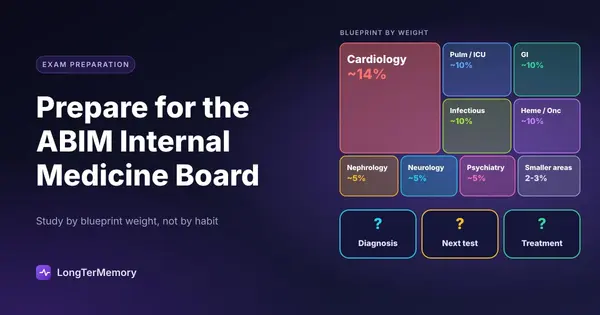
The ABIM publishes a detailed blueprint with approximate weights for each content area. Here’s a simplified view of how the weighting breaks down (check the current blueprint for exact numbers):
| Weight tier | Content areas |
|---|---|
| Highest (around 14%) | Cardiovascular disease |
| High (around 9 to 12% each) | Pulmonary and critical care, gastroenterology, infectious disease, endocrinology, rheumatology and orthopedics, hematology and oncology (combined) |
| Medium (around 4 to 6% each) | Nephrology and urology, neurology, psychiatry |
| Smaller (around 2 to 3% each) | Allergy and immunology, dermatology, geriatrics, obstetrics and gynecology, ophthalmology, otolaryngology, miscellaneous |
The big takeaway: roughly two thirds of the exam comes from the “big” subspecialties. If your time is limited, that’s where it should go.
High-Yield Content Areas and Study Resources
The highest-yield strategy is to master common, guideline-based management in the major subspecialties, then fill gaps in smaller areas you rarely see in residency. Use one core text or curriculum and one major question bank, rather than many resources.
What’s especially high-yield
Based on the blueprint and the feedback of countless test-takers, these themes come up again and again:
- Cardiology: ACS management, heart failure therapy, atrial fibrillation (anticoagulation and rate vs rhythm), valvular disease, preoperative evaluation, hypertension.
- Pulmonary and critical care: COPD and asthma step therapy, pulmonary embolism, interstitial lung disease, sepsis, ventilator management basics, lung nodule follow-up.
- GI and hepatology: GI bleeding, cirrhosis complications, IBD, pancreatitis, colorectal cancer screening.
- Infectious disease: pneumonia, endocarditis, HIV management and prophylaxis, antibiotic selection, vaccines.
- Endocrinology: diabetes management (including newer agents), thyroid disease, adrenal disorders, calcium and bone.
- Hematology and oncology: anemia workup, anticoagulation, thrombocytopenia, oncologic emergencies, cancer screening.
- Rheumatology: inflammatory arthritis, gout, lupus, vasculitis, joint aspiration interpretation.
- Nephrology: acid-base, electrolytes (sodium and potassium disorders), AKI, CKD management.
And across all of it: preventive medicine and screening guidelines. These show up everywhere and are pure points if you know them.
Don’t neglect the “small” areas
Dermatology, ophthalmology, and ENT are individually small, but together they add up to meaningful points. They’re also areas many residents rarely see in depth. The good news: these topics are often very visual and pattern-based, which makes them perfect for short, spaced flashcard review.
Core resources compared
| Resource | Best for | Notes |
|---|---|---|
| MKSAP (ACP) | Comprehensive text plus questions, written for this exam | Gold standard for content, can be long |
| UWorld Internal Medicine | Exam-style questions with detailed explanations | Very popular for question practice |
| NEJM Knowledge+ | Adaptive question bank | Good for identifying weak areas |
| Board review courses (live or video) | Structured overview, motivation | Helpful if you need accountability |
| Your in-training exam (ITE) reports | Identifying weak subspecialties | Free, personalized data |
| Your own flashcard deck | Retaining details over months | Best when built from your mistakes |
You don’t need everything. A common, effective combination is MKSAP plus one question bank, plus a flashcard system for retention.
Use your ITE scores
Your In-Training Examination results are one of the best predictors of where you stand. They show performance by subspecialty. Start your plan by ranking your weakest areas from your most recent ITE, and give those extra time early on.
Practice Question Strategy
Questions are your main study tool, not just your assessment tool. Plan to complete one full question bank at least once, ideally with a second pass on missed and flagged questions, and review every explanation carefully.
How to do questions the right way
- Start in tutor mode by subject for the first pass if your foundation feels shaky. This lets you learn as you go.
- Switch to timed, random blocks after the first month. The real exam mixes topics, so you need to practice switching between cardiology and dermatology in two questions. This mixing, called interleaving, also improves your ability to choose the right approach. Our post on interleaving and test performance explains why.
- Review every explanation, including for questions you got right. Sometimes you got it right for the wrong reason.
- Turn every miss into a flashcard. Write a short question that captures the exact decision point you got wrong.
- Track your accuracy by subject. Revisit weak areas every couple of weeks.
Why your mistakes are gold
Question banks have thousands of questions. Your missed questions are a personal, curated list of exactly what you don’t know yet. If you review those missed concepts with spaced repetition, at increasing intervals over weeks and months, you’ll keep them for exam day instead of re-missing them on your second pass.
There’s strong evidence behind this. A 2006 meta-analysis by Cepeda and colleagues found that spaced study reliably beats massed study for long-term retention, and medical education research by Price Kerfoot and colleagues at Harvard has shown that spaced, question-based education improves knowledge retention among physicians and trainees. Our guide on the science of spaced repetition covers the research in more depth.
Target benchmarks
| Stage | What to aim for |
|---|---|
| Early first pass | 50 to 60% correct is normal, don’t panic |
| End of first pass | Steadily improving, around 60 to 65% |
| Second pass and self-assessments | Consistently in the mid-60s or higher on new questions |
These are rough guides that many test-takers report. Your question bank’s own peer comparisons are more useful than any single number.
A Study Timeline for Internal Medicine Boards
Most residents do best with a 4 to 6 month plan that starts lightly during PGY-3 and ramps up in the final two months. If you have less time, compress the first phase, but keep daily questions and spaced review.
Sample 6-month plan
| Months out | Focus | Weekly volume |
|---|---|---|
| 6 to 5 | Review ITE results, pick resources, read MKSAP on weakest areas | 5 to 7 hours |
| 4 to 3 | Question bank first pass by subject, start flashcards from misses | 8 to 10 hours |
| 2 | Timed random blocks, cover remaining subjects, daily flashcards | 10 to 12 hours |
| Last 4 weeks | Second pass on missed questions, self-assessments, guideline review | 12 to 15 hours |
| Last week | Light review, flashcards, sleep and logistics | Light |
Fitting it around residency
- Do 10 to 20 questions on weekdays and longer blocks on days off.
- Use dead time (between patients, on the commute if you’re not driving) for flashcard reviews on your phone.
- Protect lighter rotations for heavier study.
- Don’t study post-call if you’re exhausted. Sleep consolidates memory, and studying while sleep-deprived is inefficient. Read more in our article on exam performance after poor sleep.
If you prefer an organ-system approach, our post on studying internal medicine with a systems approach pairs well with this timeline.
Exam Day Tips
On exam day, pace yourself, use breaks strategically, and don’t let one hard block shake your confidence. The exam is long, and stamina matters.
- Know your pace: about 2 minutes per question. Flag and move on if you’re stuck.
- Use every break to eat, hydrate, and move. Don’t review content during breaks.
- Read the last line first on long vignettes so you know what’s being asked.
- Choose the most standard, guideline-based answer. The exam favors evidence-based, common practice.
- Don’t change answers without a clear reason. First instincts based on knowledge are often right.
Making Your Review More Efficient
Building a deck of guideline points, screening intervals, and drug choices from MKSAP chapters and your question bank misses takes many hours. That’s time residents don’t have.
LongTerMemory can generate question and answer cards automatically from PDFs, such as guideline summaries, your own notes, or review handouts, and schedule them with spaced repetition. You review a few minutes each day, and the system brings back the concepts you’re about to forget. Add your own cards from missed questions, and you’ll have a personalized review system running in the background of residency.
For more medical exam strategies, see our guides to the USMLE Step 3 and bar exam and medical board prep.
Frequently Asked Questions
How long should I study for the ABIM internal medicine boards?
Most residents study for 3 to 6 months, about 1 to 2 hours on weekdays and longer on days off, with the most intense work in the final 6 to 8 weeks.
What is the best resource for the ABIM exam?
MKSAP is the most widely used comprehensive resource, usually combined with a question bank like UWorld or NEJM Knowledge+ for exam-style practice.
What is the ABIM pass rate?
First-time pass rates for the internal medicine certification exam have generally been in the high 80s to around 90% in recent years. Check ABIM’s site for current data.
Which subjects are most important on the ABIM exam?
Cardiology carries the most weight, followed by pulmonary and critical care, GI, infectious disease, endocrinology, rheumatology, and hematology and oncology.
Are ITE scores predictive of passing the ABIM?
Yes, research has found that in-training exam scores correlate with board performance, and they’re very useful for identifying weak subspecialties early.
The Bottom Line
Study for the ABIM by following the blueprint, prioritizing the big subspecialties, doing questions as your main learning tool, and reviewing your mistakes with spaced repetition. Three to six months of steady, focused work beats a frantic final month every time.
Pull up your most recent ITE report today, write down your three weakest subspecialties, and do 10 questions in the weakest one tonight. That’s day one of your board prep.