How to Study for the MPJE Pharmacy Jurisprudence Exam
A practical MPJE study plan: balancing federal and state pharmacy law, studying in a way that transfers to the exam, and how many hours you really need.
Table of Contents
- What the MPJE Actually Is
- The content areas
- Federal vs. State Law: Getting the Balance Right
- Why the balance trips people up
- A three-layer study model
- Where to find your state law
- How to Study Pharmacy Law So It Transfers to the Exam
- Turn every rule into a question
- Build "what changes the answer?" cards
- Use spaced repetition for the details that keep slipping
- Study in scenarios, not chapters
- Practice Resources and Recommended Study Hours
- Recommended resources
- A sample 4-week MPJE plan
- What about pass rates?
- Common MPJE Mistakes to Avoid
- Building Your MPJE Deck Faster
- Frequently Asked Questions
- How long should I study for the MPJE?
- Is the MPJE harder than the NAPLEX?
- Should I study federal or state law first?
- What happens when federal and state law conflict?
- Can I go back and change answers on the MPJE?
- Do I need to memorize statute numbers?
- The Bottom Line
To pass the MPJE, study your state’s pharmacy law first, learn federal law as the baseline it builds on, and practice with scenario questions until you can apply the stricter rule without thinking. Most candidates need about 40 to 80 focused hours spread over three to five weeks. The exam rewards application, not memorized statute numbers.
If you just finished the NAPLEX, you might feel like the hard part is over. Then you open your state’s pharmacy practice act and realize it reads like a contract written by people who really, really don’t want to be sued. Welcome to the MPJE.
The good news: the MPJE is very passable with the right approach. The bad news: the approach that got you through pharmacology (lots of reading, some flashcards, hope) tends to fail here. Law questions are slippery. They test whether you can apply a rule to a messy situation, not whether you can recite it.
Let’s break down how to study for it properly.
What the MPJE Actually Is
The Multistate Pharmacy Jurisprudence Examination (MPJE) is a computer-based law exam from NABP that tests federal and state-specific pharmacy law for the jurisdiction where you want a license. You take a separate MPJE for each state you want to practice in (with a few states using their own law exams instead).
Here are the key numbers, based on NABP’s published candidate information:
| Feature | Detail |
|---|---|
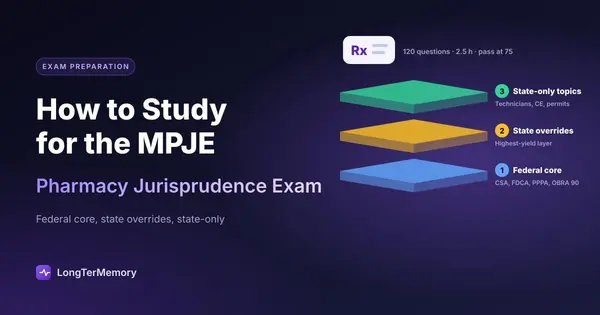
| Number of questions | 120 (100 scored, 20 unscored pretest) |
| Time limit | 2.5 hours |
| Score scale | 0 to 100, passing score is 75 |
| Question review | You cannot go back to previous questions |
| Content | Federal and state law, blended into one exam |
| Retakes | Waiting period required, check NABP for current rules |
Two details matter more than people expect.
First, you cannot skip ahead and return. Once you answer, it’s locked. That means you need to be able to make a confident decision on every question in about 75 seconds.
Second, nobody tells you which questions are federal and which are state. The exam is framed around practice in your jurisdiction. So the question is always, effectively, “What is the law in this state?” Sometimes that answer comes from federal law, sometimes from state law, and the tricky part is knowing which one wins.
The content areas
NABP’s competency statements group the exam into three areas. The weighting is very lopsided:
- Pharmacy practice (the vast majority of the exam, roughly 80%+): dispensing, prescription requirements, controlled substances, compounding, record keeping, counseling, transfers, emergency refills.
- Licensure, registration, and operational requirements (around 15%): licenses for pharmacists, technicians, interns and facilities, inspections, discipline, staffing ratios.
- General regulatory processes (a small slice): how laws and regulations are made and enforced.
Practical takeaway: if you’re spending hours on the history of the FDCA amendments and very little on prescription transfer rules for Schedule III to V drugs in your state, you’ve got your priorities upside down.
Federal vs. State Law: Getting the Balance Right
The golden rule of the MPJE is simple: when federal and state law differ, you follow the stricter one. Almost every tricky question is built around this principle, so your whole study plan should revolve around spotting where your state is stricter than federal law.
Why the balance trips people up
Many candidates study federal law extensively (because commercial review books cover it in depth, and it’s the same for every state) and then skim their state law at the end. That’s backwards. Federal law is the foundation, but state law is where the points are hiding, because that’s where the exam differentiates you.
A useful way to think about it:
| Topic | Federal baseline | What to check in your state |
|---|---|---|
| Schedule II prescriptions | No refills, written or electronic, limited emergency oral | Day-supply limits, e-prescribing mandates, expiration windows |
| Schedule III to V refills | Up to 5 refills within 6 months | Shorter validity periods, quantity caps |
| Prescription transfers | One-time transfer for C-III to V (unless sharing a real-time database) | Whether non-controlled transfers have extra limits |
| Technician ratios | Not set federally | Exact ratio and supervision rules |
| Emergency refills | Not defined federally for non-controlled drugs | Allowed quantity, documentation, notification |
| Pseudoephedrine sales | Combat Methamphetamine Epidemic Act daily and monthly limits | Stricter state limits, prescription requirements |
| Partial fills of C-II | Allowed under specific federal conditions | Any extra state restrictions |
A three-layer study model
I recommend organizing your notes in three layers:
- Federal core: the Controlled Substances Act, the FDCA, the Poison Prevention Packaging Act, OBRA ‘90 counseling requirements, HIPAA basics, the DEA Pharmacist’s Manual, and drug supply chain rules.
- State overrides: every place your state’s practice act or board regulations set a stricter or different rule. This is your highest-yield layer.
- State-only topics: things federal law simply doesn’t cover, like technician registration, intern hours, continuing education, facility permits, and board disciplinary procedures.
When you make a flashcard or a summary note, tag it with its layer. During review, if you notice you know layer 1 cold and layer 2 feels fuzzy, you know exactly where to go next.
Where to find your state law
Go to the primary source: your state board of pharmacy website. Download the pharmacy practice act and the board rules or regulations. Also check for recent board newsletters, which often announce rule changes that the exam may already reflect. Commercial state-specific guides are helpful for structure, but they can lag behind current rules, so cross-check anything that seems outdated.
How to Study Pharmacy Law So It Transfers to the Exam
The MPJE tests application, so your study method must involve applying rules to scenarios, not rereading statutes. Rereading creates a feeling of familiarity that collapses the moment a question adds one unexpected detail.
This is the core problem with law exams. You read “a prescription for a Schedule II drug may not be refilled” and think, “Got it.” Then the exam asks about a partial fill for a terminally ill patient in a long-term care facility, 45 days after the prescription was written, and suddenly you’re not sure about anything.
Turn every rule into a question
Here’s the single most effective change you can make: convert rules into questions you must answer from memory. This is called active recall, and it’s one of the most robust findings in learning science. A widely cited 2013 review by Dunlosky and colleagues rated practice testing as one of only two techniques with “high utility” across ages and subjects. (If you want the deeper backstory, our guide to active recall techniques explains why it works.)
Compare these two ways of studying the same fact:
- Passive: “C-III to V prescriptions may be refilled up to 5 times within 6 months of the date written.”
- Active: “A C-IV prescription was written 5 months ago with 5 refills. The patient has used 2. How many can they still get, and until when?”
The second version forces you to apply the rule, which is exactly what the exam does.
Build “what changes the answer?” cards
Law questions usually hinge on one detail. So train yourself to spot those details. For each major rule, write cards like:
- “What changes if the patient is in hospice?”
- “What changes if the prescriber is out of state?”
- “What changes if the pharmacies share a real-time online database?”
- “What changes if this is a technician instead of a pharmacist?”
This is how you build the flexible understanding the MPJE demands.
Use spaced repetition for the details that keep slipping
There’s a lot of detail in pharmacy law: time windows, quantities, record retention periods, form numbers (DEA 222, 106, 41), and reporting deadlines. Cramming these the week before is a classic way to confuse them on test day.
Spaced repetition, reviewing each fact at gradually increasing intervals, is the best-supported method for keeping this kind of detail stable. A large 2006 meta-analysis by Cepeda and colleagues, covering hundreds of experiments, found that spacing study sessions consistently beats massing them for long-term retention. For an exam you’ll take in a few weeks, that means short daily reviews instead of one weekend marathon.
Here’s a quick reference of the numbers people most often mix up:
| Detail | What to memorize |
|---|---|
| DEA 222 | Ordering C-I and C-II |
| DEA 106 | Reporting theft or significant loss |
| DEA 41 | Registrant record of destroyed controlled substances |
| Controlled substance records | Federal minimum of 2 years (check if your state requires longer) |
| C-II inventory | Exact count required |
| C-III to V inventory | Estimated count allowed (unless container holds more than 1,000 units) |
| Biennial inventory | Every 2 years |
Study in scenarios, not chapters
Once you’ve covered the basics, stop studying topic by topic and start mixing them. On the real exam, a controlled substance question is followed by a technician question, then a compounding question. Mixing topics during practice, known as interleaving, trains you to identify which rule applies, which is half the battle. Our article on interleaved practice explains the research behind it.
Practice Resources and Recommended Study Hours
Most successful candidates spend 40 to 80 hours over three to five weeks, combining a state-specific review guide, the primary state law documents, and a large bank of practice questions. If you work full time, plan for the longer end of that window.
Recommended resources
| Resource type | What it’s good for | Watch out for |
|---|---|---|
| State practice act and board rules | The actual source of truth | Dense, hard to read without structure |
| DEA Pharmacist’s Manual | Clear federal controlled substance rules | Federal only |
| State-specific MPJE review guides | Organizing state law into exam topics | May lag behind recent rule changes |
| Practice question banks | Application practice and pacing | Quality varies, verify answers against sources |
| NABP Pre-MPJE practice exam | Closest experience to the real format | Limited, use near the end |
| Your own flashcard deck | Locking in details long term | Time consuming to build manually |
A sample 4-week MPJE plan
| Week | Focus | Daily time |
|---|---|---|
| 1 | Federal law core: CSA, FDCA, DEA rules. Start flashcards. | 1.5 to 2 hours |
| 2 | State practice act and rules: build your “state overrides” list. | 2 hours |
| 3 | Mixed practice questions, review every wrong answer against the source. | 2 to 2.5 hours |
| 4 | Timed practice sets, Pre-MPJE, daily flashcard review, light final pass. | 1.5 to 2 hours |
A few tips for making this work:
- Review flashcards daily from week 1, even for just 15 minutes. That’s what keeps week-1 material alive by week 4.
- Every wrong practice question becomes a new card. Your mistakes are the most valuable study material you have.
- Practice at exam pace. About 75 seconds per question, no going back. Get used to committing.
What about pass rates?
NABP publishes MPJE pass rates by school and year. In recent years, roughly three out of four first-time candidates from accredited programs have passed, which is noticeably lower than NAPLEX pass rates. In other words, people underestimate the MPJE. Don’t be one of them. Plan real study time.
Common MPJE Mistakes to Avoid
The most common mistakes are over-studying federal law, under-studying state rules, and relying on rereading instead of practice questions. Here are the ones I see again and again:
- Treating it as a “quick” exam after the NAPLEX. It’s shorter, but the failure rate is real.
- Memorizing without applying. If you can’t answer a scenario question, you don’t really know the rule.
- Ignoring recent rule changes. Check your board’s site for updates in the last year or two.
- Second-guessing on test day. You can’t go back, so read carefully once, apply the stricter rule, and move on.
- Cramming the last 48 hours. Tired brains confuse similar numbers. Sleep matters more than one more chapter. (See our post on sleep and memory consolidation.)
Building Your MPJE Deck Faster
Creating good law flashcards by hand is slow. You’re translating dense legal text into clear questions, and that can eat up the time you need for practice.
This is where LongTerMemory can help. Upload your state’s practice act, board rules, or your review guide as a PDF, and it automatically generates question and answer pairs from the material. Then it schedules them with spaced repetition, so the details you keep forgetting show up more often and the ones you know stay out of your way. You still need to add your own scenario cards and practice questions, but the base deck is built in minutes instead of evenings.
If you’re also preparing for the NAPLEX or brushing up on pharmacology, our guide to studying pharmacology drug classes is a good companion, and professional certification study strategies covers the bigger picture of studying while working.
Frequently Asked Questions
How long should I study for the MPJE?
Most candidates study 40 to 80 hours over three to five weeks. If you’re taking it right after the NAPLEX, two to three weeks of focused study can be enough.
Is the MPJE harder than the NAPLEX?
It’s shorter, but many candidates find it trickier because questions hinge on small details and you can’t go back. First-time pass rates are typically lower than for the NAPLEX.
Should I study federal or state law first?
Learn federal law first as your foundation, then spend most of your time on where your state differs. State-specific rules are where most candidates lose points.
What happens when federal and state law conflict?
Follow the stricter law. This principle answers a large share of MPJE questions.
Can I go back and change answers on the MPJE?
No. Once you submit an answer, you cannot return to it, so practice making confident decisions at a steady pace.
Do I need to memorize statute numbers?
Generally no. Focus on what the rules require. Form numbers like DEA 222 and DEA 106 are worth knowing, but citation numbers rarely matter.
The Bottom Line
Pass the MPJE by learning federal law as your baseline, mastering where your state is stricter, and practicing scenario questions with daily spaced review. Give it real time, 40 to 80 hours, and treat every wrong answer as a new flashcard.
Today, download your state’s practice act and write down five rules where your state is stricter than federal law. That list is the start of your highest-yield study material.