How to Study During School Holidays Without Losing Progress
Keep your progress over school holidays with 15 to 30 minutes a day of spaced review, a schedule that protects rest and family time, and no new material stress.
Table of Contents
- Why Holidays Cost You Progress
- Minimum Daily Study Commitments That Maintain Progress Over Holidays
- Pick your minimum, then stick to it
- What counts as "active" study
- The "don't break the chain" trick
- Designing a Holiday Study Schedule That Preserves Rest and Family Time
- Step 1: Mark the "no study" days first
- Step 2: Choose one fixed time slot
- Step 3: Tell people your plan
- Step 4: Rest on purpose
- Using Holiday Time for Spaced Review Without Adding New Material Stress
- Why review beats "getting ahead"
- A simple spaced review plan for the break
- The one exception: a light preview at the end
- Getting Back Into Term Without a Slump
- Common Holiday Study Mistakes
- Make Holiday Review Effortless
- Frequently Asked Questions
- Should I study during school holidays at all?
- How many hours should I study over summer holidays?
- Is it better to study new topics or review over the holidays?
- What if I miss several days of my holiday study plan?
- How do I stay motivated to study on vacation?
- The Bottom Line
To study during school holidays without losing progress, commit to a small daily minimum (15 to 30 minutes of active review on most days), schedule it at a fixed time that doesn’t clash with family plans, and use the break to review what you already learned instead of starting new material. That’s enough to stop most forgetting while still giving you a real break.
Every school break, I watch the same two strategies play out. Some students declare “I’ll study four hours a day over the holidays” and quit on day two. Others decide “it’s a holiday, I’m not touching anything” and spend the first two weeks of the next term relearning what they knew in December.
There’s a middle path, and it’s much easier than either extreme. This guide is about school breaks specifically (winter, spring, and summer holidays). If you’re also traveling, my colleague’s guide to staying consistent during holidays and travel covers the on-the-road side.
Why Holidays Cost You Progress
Breaks cause forgetting because memories that aren’t retrieved fade, and a two to ten week break is long enough for a lot of recent learning to slip. The effect is well documented.
The research on “summer learning loss” is the clearest example. A widely cited meta-analysis by Harris Cooper and colleagues (1996) found that students’ test scores were, on average, about one month of learning lower at the end of summer than at the beginning, with the biggest losses in math computation and spelling. Later studies vary in the size of the effect, but the pattern is consistent: skills and facts that aren’t used decline.
Shorter breaks matter too. Two or three weeks away is enough for the forgetting curve to do real damage on material from the last weeks of term, which is often the newest and least consolidated.
| Break | Typical length | Main risk |
|---|---|---|
| Winter holidays | 2 to 3 weeks | Losing the last unit before break, slow restart |
| Spring break | 1 to 2 weeks | Disrupted momentum right before exams |
| Summer holidays | 8 to 12 weeks | Significant skill and fact loss |
| Mid-term breaks | About 1 week | Small, but habit breaks easily |
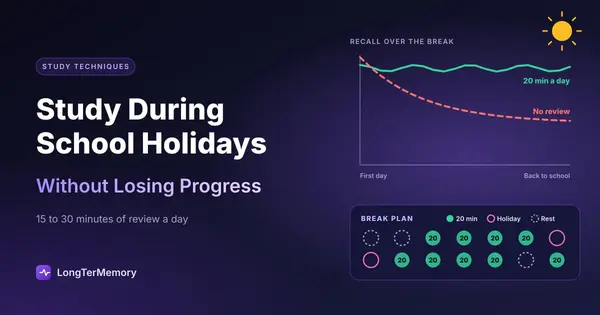
The good news: retrieving something even once during the break dramatically slows the forgetting. You don’t need to study a lot. You need to touch the material regularly.
Minimum Daily Study Commitments That Maintain Progress Over Holidays
For most students, 15 to 30 minutes of active recall on five or six days a week is enough to maintain what they learned. Maintenance takes far less time than learning.
That’s the key insight. Learning a chapter might take you five hours. Keeping it alive takes a few minutes of questions every few days.
Pick your minimum, then stick to it
Decide on a minimum based on your situation:
| Your situation | Daily minimum | Days per week |
|---|---|---|
| Younger student, short break | 10 to 15 min | 5 |
| High school, normal break | 15 to 25 min | 5 to 6 |
| High school, exams right after break | 30 to 60 min | 6 |
| University, finals after break | 45 to 90 min | 6 |
| Summer, no exams soon | 15 to 20 min | 4 to 5 |
These are minimums. On days you feel like doing more, great. But the plan only counts the minimum, so a lazy day still counts as success.
What counts as “active” study
Fifteen minutes of rereading notes is almost worthless for maintenance. Fifteen minutes of answering questions is powerful. Good holiday activities:
- Flashcards (answer before flipping)
- A few practice problems from last term’s units
- Blank page recall: write everything you remember about one topic, then check
- Explaining a topic out loud to a family member (they’ll love it, probably)
The “don’t break the chain” trick
Put a calendar on the wall and tick each day you do your minimum. After a week, the chain itself becomes motivation. If you miss a day, the rule is simple: never miss two days in a row.
Designing a Holiday Study Schedule That Preserves Rest and Family Time
A good holiday schedule protects rest first, then fits study into one small, fixed slot, usually in the morning, before the day’s plans start. If study competes with family time, family time should win, and your plan should already account for that.
Step 1: Mark the “no study” days first
Start with the calendar and block out the days that are off-limits: holiday celebrations, travel days, visits, birthdays. Plan zero study on these days. Seriously, zero.
A typical two-week winter break might look like this:
| Day | Plan |
|---|---|
| Days 1 to 2 | Full rest, no study |
| Days 3 to 6 | 20-minute morning review |
| Days 7 to 8 | Holiday, no study |
| Days 9 to 12 | 20-minute morning review, one 45-minute session |
| Day 13 | Rest |
| Day 14 | Preview of next term + 20-minute review |
That’s about 3 to 4 hours of study across two weeks. Small, but enough to come back sharp.
Step 2: Choose one fixed time slot
Mornings work best for most students over holidays, because evenings fill up with plans. “After breakfast, before anything else” is a great anchor. The decision is made once, not every day.
Step 3: Tell people your plan
Let family know that 9:00 to 9:30 is your study time. It’s short enough that nobody minds, and it prevents the “can you help me with this?” interruption.
Step 4: Rest on purpose
Rest isn’t wasted time. Sleep is when the brain consolidates memories, and well-rested students learn faster when term starts again. Plan for late mornings, outdoor time, and screens off at night. If you’ve been running on empty, watch for the signs of study burnout and give yourself a real break.
Using Holiday Time for Spaced Review Without Adding New Material Stress
The best use of holiday study is spaced review of what you already learned, not starting next term’s content. Review protects past work with low effort; new material adds pressure and usually gets forgotten anyway.
Why review beats “getting ahead”
It’s tempting to use the break to get ahead on next term. But learning new material without the class context, and then not revisiting it for weeks, is mostly wasted. Meanwhile, the stuff you did learn is quietly fading.
Here’s the comparison:
| Holiday approach | Effort | Stress | Value when term starts |
|---|---|---|---|
| No study at all | None | Low now, high later | Relearn old material |
| Get ahead on new content | High | High | Mixed, often forgotten |
| Spaced review of old content | Low | Low | Strong foundation for new units |
A simple spaced review plan for the break
Divide last term’s material into units. Then rotate through them, giving extra time to the units you found hardest:
- List last term’s units for each subject (e.g. 6 units in biology)
- Rate each one: green (solid), yellow (shaky), red (weak)
- Review red units every 2 to 3 days, yellow every 4 to 5 days, green once a week
- Use questions, not notes: every session is recall first, checking second
This is spaced repetition, applied to a holiday. If you don’t use an app, a paper box system works fine, see my guide to spaced repetition without an app.
The one exception: a light preview at the end
In the last two or three days of the break, a 20-minute look at what’s coming next term is useful. Skim the first chapter, read the headings, and write two questions you want answered. That primes your brain without adding stress.
Getting Back Into Term Without a Slump
Plan your first school week before the break ends, and do a short review the day before classes restart. The first week back is when routines are rebuilt, so make it easy.
- On the last day of the break, review your red units one more time
- Pack your bag and set up your desk the night before
- Plan your first week’s study slots in advance
- Expect to feel a bit slow for two or three days; that’s normal
Students who kept a daily minimum usually notice the difference immediately. The first quiz of the term feels like a review instead of a surprise.
Common Holiday Study Mistakes
The biggest mistakes are planning too much, studying only new material, and abandoning everything after one missed day. Watch out for these:
- The four-hours-a-day plan. It never survives contact with the holidays. Start small.
- Rereading instead of recalling. Active questions beat passive reading every time.
- Studying in the evening. Holiday evenings are for plans. Mornings are reliable.
- Guilt spirals. Missed a day? Do the minimum tomorrow. One day doesn’t matter.
- Zero rest. Coming back exhausted defeats the purpose of the break.
Make Holiday Review Effortless
The easiest holiday plan is one where the “what should I review today” decision is already made for you. That’s where a spaced repetition tool helps most.
With LongTerMemory, you can upload last term’s notes, slides, or PDFs before the break, and it automatically turns them into question and answer cards. Then it schedules each review at the right interval, so your 20-minute holiday session is simply “open it, answer what’s due, done.” No flashcard writing, no deciding what to study, and it works on your phone, wherever the holiday takes you. The free trial is a nice fit for a two-week break: you can test the whole routine before term starts.
Frequently Asked Questions
Should I study during school holidays at all?
Yes, a little. 15 to 30 minutes of review on most days prevents most of the forgetting that happens over breaks, while still leaving you plenty of time to rest.
How many hours should I study over summer holidays?
For maintenance, 15 to 20 minutes on four or five days a week is enough. If you have exams soon after the summer, increase to 30 to 60 minutes a day in the last three to four weeks.
Is it better to study new topics or review over the holidays?
Mostly review. Reviewing old material protects what you learned with little effort. Save new material for a short preview in the last few days.
What if I miss several days of my holiday study plan?
Just restart with your minimum the next day. Don’t try to make up lost time. A few missed days have a small effect; quitting entirely has a big one.
How do I stay motivated to study on vacation?
Keep sessions short, do them at the same time each morning, and track a streak on a calendar. Small, visible progress is far more motivating than big plans.
The Bottom Line
Studying during school holidays isn’t about doing a lot; it’s about doing a little, regularly. A 15 to 30 minute daily minimum of active review, scheduled in the morning and focused on what you already learned, stops most of the holiday slide and lets you enjoy the break.
Before your next holiday starts, mark the no-study days, pick your daily minimum, and choose your morning slot. That’s the whole plan.