
How to Build a Study Schedule You Will Actually Follow
Why most study schedules fail in two weeks, and how to build a realistic study plan around your real life, with buffers that keep it on track.
Table of Contents
- Why Most Study Schedules Fail Within Two Weeks
- 1. The planning fallacy
- 2. Planning for the ideal self
- 3. No slack
- 4. All-or-nothing thinking
- Designing a Schedule Around Your Real Life, Not Your Ideal Life
- Step 1: Track one real week
- Step 2: Block fixed commitments first
- Step 3: Match tasks to your energy
- Step 4: Use shorter sessions than you think you need
- Step 5: Anchor sessions to existing habits
- How to Build Flexibility Into a Study Plan Without Losing Structure
- Feature 1: The 70 to 80 percent rule
- Feature 2: A weekly buffer slot
- Feature 3: The minimum viable session
- Feature 4: The 15-minute weekly review
- Feature 5: Plan tasks, not just time
- What to Do When You Fall Behind
- Common Study Schedule Mistakes
- Let Your Review Schedule Plan Itself
- Frequently Asked Questions
- How many hours a day should I study?
- Why do I always give up on my study schedule?
- Should I study at the same time every day?
- How do I catch up after falling behind?
- What's the best study schedule app?
- The Bottom Line
A study schedule you will actually follow is built around your real week, not your ideal one: it starts from fixed commitments, uses short sessions tied to existing routines, plans for only about 70 to 80 percent of your free time, and includes a weekly buffer for catching up. Most schedules fail because they’re designed for a person who never gets tired, sick, or busy.
Be honest. How many study schedules have you made? I’ve made dozens. Color-coded spreadsheets, beautiful planner spreads, apps with notifications. They all looked fantastic on Sunday night. By the second Thursday, most of them were dead.
The problem was never the format. It was the design. Once I started building schedules around how life actually goes, the schedules started surviving. Here’s how to do the same.
Why Most Study Schedules Fail Within Two Weeks
Most study schedules fail because they overestimate available time, underestimate how long tasks take, and have no plan for the days that go wrong. One missed session makes the whole plan feel broken, and then it’s abandoned.
Let’s look at the main causes.
1. The planning fallacy
Psychologists call our habit of underestimating task time the planning fallacy. In a classic 1994 study, Roger Buehler and colleagues asked students to predict when they’d finish their senior theses. The average prediction was about 34 days. The average actual time was about 56 days. Even their “worst case” predictions were too optimistic for most students.
Your study schedule has the same bias built in. “Chapter 5 in one hour” usually means two.
2. Planning for the ideal self
On Sunday night, you plan for the version of you who wakes up at 6 a.m., never scrolls, and has endless energy after work. On Wednesday, the real you shows up. The gap between those two people is where schedules die.
3. No slack
A schedule with zero free space fails on the first unexpected event: a sick day, a late shift, a friend’s birthday. Then you’re behind, and catching up feels impossible.
4. All-or-nothing thinking
Miss one session and it’s tempting to think “I’ve blown it this week.” That one missed session turns into five.
Here’s a summary:
| Failure cause | What it looks like | The fix |
|---|---|---|
| Planning fallacy | Tasks take twice as long as planned | Add 50% to every estimate |
| Ideal-self planning | 3-hour sessions after a full workday | Plan for your tired self |
| No slack | One bad day breaks the week | Schedule only 70 to 80% of free time |
| All-or-nothing | One missed day leads to quitting | Have a “minimum version” of every session |
| Vague goals | ”Study biology” | Specific tasks: “20 flashcards + 1 practice set” |
Designing a Schedule Around Your Real Life, Not Your Ideal Life
Start with an honest audit of one normal week, block in everything fixed, and only then place study sessions in the gaps that are realistically left. This takes about 30 minutes, and it’s the most important half hour of the whole process.
Step 1: Track one real week
Before planning anything, look at last week (or track this one). Write down when you:
- Work, go to class, or commute
- Sleep (be honest)
- Eat, exercise, and handle chores
- Spend time with family and friends
- Had energy, and when you were drained
Most people are surprised. The “free” evenings often turn out to be two usable hours, not four.
Step 2: Block fixed commitments first
Put everything non-negotiable into your weekly calendar: work, classes, sleep, meals, family time, exercise. Study goes in what’s left, not the other way around. If you try to squeeze life around your study plan, life wins every time.
Step 3: Match tasks to your energy
Not all hours are equal. Use your high-energy windows for hard work and your low-energy windows for easy tasks.
| Energy level | Best study tasks | Example time slots |
|---|---|---|
| High | New material, practice problems, writing | Early morning, after a break |
| Medium | Practice questions, summarizing, flashcards | Lunch break, early evening |
| Low | Light flashcard review, audio, organizing notes | Commute, late evening |
If you’re not sure when your peak is, our post on studying with your chronotype can help.
Step 4: Use shorter sessions than you think you need
Short, frequent sessions beat long, rare ones, both for memory and for consistency. Spaced practice is one of the most robust findings in learning research: a 2006 meta-analysis by Cepeda and colleagues found that spreading study over time consistently beats cramming for long-term retention. And a 30-minute session is much easier to start than a 3-hour one.
A sample week for someone working full time:
| Day | Session | Length | Task |
|---|---|---|---|
| Monday | Lunch break | 25 min | Flashcard review |
| Tuesday | After dinner | 45 min | New chapter |
| Wednesday | Commute | 20 min | Audio or flashcards |
| Thursday | After dinner | 45 min | Practice questions |
| Friday | None | Rest | |
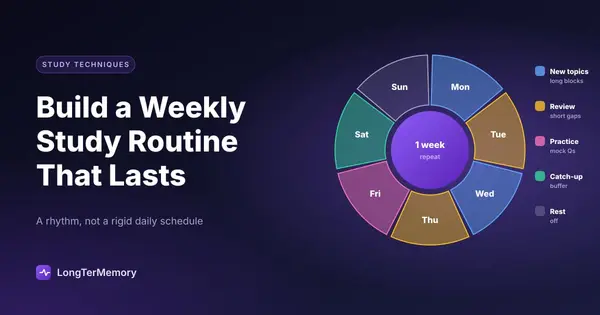
| Saturday | Morning | 90 min | Deep session + weekly review |
| Sunday | Buffer | 0 to 60 min | Catch up only if needed |
That’s about 4 hours a week. Done every week for three months, it adds up to around 50 hours, which is a lot more than most “perfect” schedules ever deliver.
Step 5: Anchor sessions to existing habits
Tie each session to something you already do every day. “After I finish lunch, I review flashcards for 20 minutes.” This is called an implementation intention, and the evidence is strong. A 2006 meta-analysis by Gollwitzer and Sheeran, covering 94 studies, found that if-then plans had a medium-to-large effect on actually following through on goals.
A few examples:
- “After I make my morning coffee, I do 15 minutes of flashcards.”
- “When I sit on the train, I open my review app.”
- “After dinner on Tuesdays and Thursdays, I do one practice set at my desk.”
For more ideas, see our guide to habit stacking.
How to Build Flexibility Into a Study Plan Without Losing Structure
Flexibility comes from three built-in features: a weekly buffer, a minimum version of every session, and a weekly review where you adjust the plan. Structure comes from keeping the same days and anchors every week.
Feature 1: The 70 to 80 percent rule
If you have 10 free hours a week, schedule 7 to 8. The rest is breathing room. It feels like you’re under-planning. You’re not. You’re planning for reality.
Feature 2: A weekly buffer slot
Pick one block each week (Sunday afternoon is popular) that stays empty unless you fell behind. If you’re on track, it’s free time, which is a reward that makes the whole schedule feel lighter.
Feature 3: The minimum viable session
For every session, define a tiny fallback version you can do on a terrible day:
| Normal session | Minimum version |
|---|---|
| 45 min new chapter | Read 2 pages |
| 25 min flashcards | 10 cards |
| 1 practice set | 3 questions |
| 90 min deep session | 20 min focused review |
Doing the minimum keeps the habit alive. Research by Phillippa Lally and colleagues in 2010 found it took participants a median of 66 days to form a new daily habit (with a wide range, from 18 to 254 days), and that missing a single day didn’t significantly derail the process. So a bad day isn’t a failure. Abandoning the routine is.
Feature 4: The 15-minute weekly review
Once a week, ask yourself four questions:
- What did I actually complete?
- Which sessions did I skip, and why?
- What’s coming up next week (deadlines, events, busy days)?
- What one change would make next week easier?
Then adjust. Move a session. Shorten one. Swap days. A schedule that changes a little every week is a schedule that lasts.
Feature 5: Plan tasks, not just time
“Study 7 to 8 p.m.” is vague. “Do 20 flashcards and chapter 6 practice questions” is a clear finish line. Specific tasks make it easier to start and easier to feel done. If you’re working toward an exam date, our guide to backward planning from your exam date shows how to break a big goal into weekly tasks.
What to Do When You Fall Behind
When you fall behind, don’t try to make up every missed hour. Drop low-priority tasks, use your buffer, and restart with the next scheduled session. Trying to double up usually leads to burnout and a second, bigger collapse.
A simple recovery protocol:
- Missed 1 session: do the minimum version today, carry on tomorrow.
- Missed 2 to 3 sessions: use your buffer slot, and skip one lower-priority task.
- Missed a full week: don’t catch up. Reset. Re-plan the remaining weeks with your weekly review and cut what’s not essential.
Researchers have also described a fresh start effect: people are more likely to start new goals at temporal landmarks like a new week or month (Dai, Milkman, and Riis, 2014). Use that. Monday is a natural restart, not a reminder of failure.
If accountability is what’s missing, see our post on building accountability into your study schedule.
Common Study Schedule Mistakes
- Planning 3-hour sessions you’ve never done before. Start with what you can actually do now.
- Scheduling every free minute. You’ll be behind by Tuesday.
- Ignoring sleep. Cutting sleep to study usually costs you more in memory than it gains in hours. (See our post on sleep and memory consolidation.)
- Using a different schedule every week. Consistency of days and anchors matters more than perfection.
- Not reviewing. New material without review leaks away. Reserve part of every week for spaced review.
Let Your Review Schedule Plan Itself
The trickiest part of any study plan is review: what to revisit, and when. Doing that by hand means spreadsheets, sticky notes, and guesswork.
With LongTerMemory, you upload your notes or PDFs and it turns them into question and answer cards automatically, then schedules every review with spaced repetition. Your daily session becomes simple: open it during your anchored slot and answer what’s due. Ten minutes on a busy day, longer when you have time, and the system adjusts. The free trial lets you try it for a couple of weeks inside the schedule you just built and see whether it sticks.
Frequently Asked Questions
How many hours a day should I study?
It depends on your goal and your life, but for most working adults, 30 to 90 minutes on weekdays plus one longer weekend session is sustainable. Consistency matters more than daily hours.
Why do I always give up on my study schedule?
Usually because it was built for an ideal week. Plan around fixed commitments, schedule only 70 to 80% of your free time, and define a minimum version for every session.
Should I study at the same time every day?
It helps. Anchoring sessions to the same daily routine (after lunch, on the commute) makes them automatic faster than random timing.
How do I catch up after falling behind?
Don’t try to make up every hour. Use your buffer slot, drop low-priority tasks, and restart with the next planned session.
What’s the best study schedule app?
Any calendar works for scheduling sessions. For deciding what to review, a spaced repetition tool saves the most planning time, because it decides the review schedule for you.
The Bottom Line
A study schedule you’ll actually follow is realistic, short-session based, anchored to habits, and built with buffers and minimum versions. Plan for your real life, not your best-case week, and review the plan every Sunday.
Start today: write down your fixed commitments for this week, find three gaps of 25 minutes or more, and attach each one to a habit you already have. That’s your first real schedule.