
How to Study During Exam Season Without Neglecting Other Subjects
Keep every subject alive during exam season with minimum viable review, smart spaced repetition, and a plan to return to neglected courses without relearning.
Table of Contents
- Why Subjects Fall Apart During Exam Season
- The "all or nothing" mindset
- Minimum Viable Review: Keeping Non-Exam Subjects Alive
- What counts as minimum viable review
- How much time per subject?
- A sample exam week
- Spaced Repetition Scheduling for Subjects Not in Focus
- Why spaced repetition is perfect for exam season
- Practical setup tips
- Mixing subjects can actually help
- Coming Back to Neglected Subjects After Major Exams
- The 4-step re-entry plan
- How long does re-entry take?
- Planning the Whole Semester So Exam Season Isn't a Crisis
- Making This Easier With the Right Tools
- Frequently Asked Questions
- How do I balance studying for multiple exams at once?
- Is it okay to completely ignore a subject during exam week?
- What's the minimum amount of review to avoid forgetting?
- How do I catch up on a subject I neglected for a month?
- Does studying multiple subjects in one day hurt my focus?
- The Bottom Line
The secret to surviving exam season without abandoning your other subjects is “minimum viable review”: short, scheduled reviews that keep non-exam subjects from decaying while most of your energy goes to the exam in front of you. Ten to fifteen minutes a day per background subject, driven by spaced repetition, is usually enough to avoid relearning from zero later.
You know the pattern. Midterms hit. You throw everything into the two exams happening next week. Statistics, the class with the quiz in three weeks, quietly gets pushed to “later.” Then later arrives, you open your stats notes, and it feels like reading a foreign language.
That’s not a discipline problem. It’s a forgetting problem, and it’s very predictable. Which means it’s also very fixable.
Let me show you how to keep all your subjects alive, even during the most chaotic weeks of the semester. For the method to use on each subject, see our exam study guide.
Why Subjects Fall Apart During Exam Season
When you stop reviewing a subject entirely, your memory of it decays fast, especially in the first few days and weeks. That’s the forgetting curve, and it doesn’t pause just because you’re busy with something else.
Hermann Ebbinghaus first mapped this in the 1880s, and modern replications (like Murre and Dros in 2015) have confirmed the general shape: a steep drop soon after learning, then a slower decline. The exact numbers depend on the material, but the lesson is clear. Three weeks of zero contact can wipe out a lot of what you learned.
Here’s roughly what that looks like for a subject you stop touching:
| Time without review | What it feels like |
|---|---|
| 1 to 3 days | Mostly fine, a few details fuzzy |
| 1 week | Key concepts there, formulas and definitions slipping |
| 2 to 3 weeks | You recognize topics but can’t reproduce them |
| 1 month+ | “Did I ever actually learn this?” |
The trap is that during exam season, you’re making a reasonable short-term decision (focus on what’s urgent) that creates a painful long-term cost (relearning everything later, often right before the next exam).
The “all or nothing” mindset
Most students think about subjects in a binary way: either I’m studying it seriously, or I’m not studying it at all. But there’s a middle state that’s hugely underrated: maintenance mode. You’re not making progress, but you’re not losing ground either.
That middle state is what this whole article is about.
Minimum Viable Review: Keeping Non-Exam Subjects Alive
Minimum viable review means doing the smallest amount of retrieval practice needed to stop a subject from decaying, usually 10 to 15 minutes a day or a few short sessions per week. The goal is maintenance, not mastery.
Think of it like watering plants while you’re busy. You don’t need to repot them, prune them, or move them into the sun. You just need to keep them from dying.
What counts as minimum viable review
Not all review is equal. Rereading your notes for 15 minutes does very little. Testing yourself for 15 minutes does a lot. That’s because retrieval practice (pulling information out of memory) strengthens memories far more than passive review. A classic 2006 study by Roediger and Karpicke found that students who practiced recalling a passage remembered significantly more a week later than students who reread it, even though the rereaders felt more confident.
Good minimum viable review activities:
- Flashcard reviews of key definitions, formulas, and concepts
- One or two practice problems for problem-based subjects (math, physics, chemistry)
- A two-minute “brain dump”: write everything you remember about one topic, then check your notes
- Explaining one concept out loud as if teaching a friend
Weak minimum viable review activities:
- Rereading a chapter
- Watching a lecture recording on 2x speed while scrolling your phone
- Highlighting anything at all
How much time per subject?
Here’s a practical guideline based on how far away the next assessment is:
| Next assessment for that subject | Mode | Suggested time |
|---|---|---|
| This week | Full focus | As much as needed |
| 2 to 3 weeks away | Light maintenance | 15 to 20 min/day |
| 4+ weeks away | Minimum viable review | 10 min/day or 3x per week |
| No exam this term (but needed later) | Deep maintenance | 2x per week |
Notice that even the “background” subjects get some time. That’s the whole point.
A sample exam week
Here’s what a day might look like for a student with two exams this week and three other courses:
| Time block | Activity |
|---|---|
| Morning (2.5 hours) | Exam subject A: practice problems and past papers |
| Late morning (15 min) | Background subject C: flashcard review |
| Afternoon (2.5 hours) | Exam subject B: active recall and practice questions |
| Late afternoon (10 min) | Background subject D: two practice problems |
| Evening (10 min) | Background subject E: brain dump on last week’s lecture |
That’s about 35 minutes total spent on three other subjects. Small enough not to steal from your exams, large enough to keep those subjects warm.
Spaced Repetition Scheduling for Subjects Not in Focus
Spaced repetition handles background subjects automatically: it shows you only the material that’s about to be forgotten, so a few minutes a day covers a surprising amount. This is what makes minimum viable review actually efficient.
The idea is simple. Instead of reviewing everything every day, you review each item at increasing intervals: maybe after 1 day, then 3 days, then a week, then two weeks. Each successful recall pushes the next review further out. The material you know well barely costs you any time. The material that’s fading gets surfaced right before you lose it.
This is backed by more than a century of research. The 2006 meta-analysis by Cepeda and colleagues reviewed hundreds of experiments and found spaced practice consistently outperforms massed practice for long-term retention. (Our deep dive into the science of spaced repetition covers the details.)
Why spaced repetition is perfect for exam season
During exam season, your time is extremely limited. Spaced repetition is basically a triage system for your memory:
- It skips what you already know, so you don’t waste time.
- It catches what’s slipping, so you don’t lose it.
- It works in short bursts, so it fits between exam study blocks.
Practical setup tips
- Keep a separate deck per subject. This lets you control how much time each subject gets.
- Pause new cards for background subjects. During exam season, don’t add much new material for non-exam subjects. Just review what’s due.
- Cap daily reviews. If a background deck shows 200 reviews due, set a limit (say, 30 per day). You’ll fall slightly behind on some cards, but you’ll keep the core alive.
- Review background decks first. They’re short, and doing them early prevents them from being skipped when you’re exhausted at night.
Mixing subjects can actually help
Here’s a nice bonus: switching between subjects within a day isn’t just about maintenance. Research on interleaving shows that mixing different types of material can improve your ability to tell concepts apart and choose the right strategy. If you’re worried that studying several subjects at once will make them blur together, our guide on studying multiple subjects without confusing them has specific techniques for that.
Coming Back to Neglected Subjects After Major Exams
If a subject did get neglected, you almost never have to relearn it from zero: memories that seem forgotten come back much faster the second time, a phenomenon called “savings.” The trick is to start with retrieval, not rereading.
Ebbinghaus discovered savings over a century ago. He found that relearning a list he had “forgotten” took much less time than learning it originally. Modern research agrees: even when you can’t recall something, the underlying memory traces often still exist, and they reactivate quickly with practice.
So, if you’ve just survived exams and now face a subject you haven’t touched in a month, don’t panic. Follow this process.
The 4-step re-entry plan
Step 1: Diagnostic recall (30 minutes). Before opening your notes, write down everything you remember about the course: topics, key ideas, formulas. Don’t worry about gaps. This shows you what’s still there.
Step 2: Map the gaps (15 minutes). Open your syllabus or notes and compare. Mark each topic as green (still solid), yellow (partly there), or red (gone).
Step 3: Rebuild reds and yellows with active recall. Skim each red topic briefly, then immediately test yourself on it. Don’t do long rereading sessions. Short exposure, then retrieval.
Step 4: Rejoin the spaced schedule. Once a topic is back, put it into your spaced repetition system so it doesn’t fall apart again.
How long does re-entry take?
| How long neglected | Typical recovery effort |
|---|---|
| 1 to 2 weeks | 1 to 2 short sessions |
| 3 to 4 weeks | 2 to 4 sessions over a week |
| 1 to 2 months | About 30 to 50% of the original learning time |
| A full term | Treat it as a structured refresher course |
These are rough estimates, but the pattern is real. The longer you wait, the more it costs, but it’s still far cheaper than starting from scratch.
Planning the Whole Semester So Exam Season Isn’t a Crisis
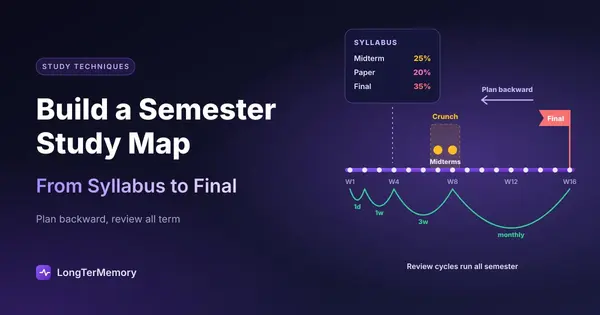
The best way to protect your subjects during exam season is to plan backward from all your exam dates at the start of the term, not just the next one. When you can see every deadline, you can schedule maintenance before it becomes an emergency.
A few habits that make a huge difference:
- Put every exam on one calendar at the start of the term. Our guide to backward exam calendar planning walks through how.
- Create flashcards as you go, right after each lecture, instead of the week before exams.
- Protect a daily 20-minute review slot that you never cancel, even during busy weeks.
- Identify your “fragile” subjects (the ones that fade fastest, usually math-heavy or vocabulary-heavy courses) and give them slightly more maintenance.
If you’re juggling a lot of courses, our post on memorizing multiple subjects has more strategies for keeping a heavy load organized.
Making This Easier With the Right Tools
The biggest obstacle to minimum viable review isn’t time. It’s setup. If you don’t already have flashcards for a background subject, making them during exam season feels impossible.
That’s exactly where LongTerMemory helps. Upload your lecture slides, textbook chapters, or notes as PDFs, and it automatically generates question and answer cards for each subject. Then it schedules reviews with spaced repetition, so each day you see just the cards that need attention across all your courses. You can keep background subjects in maintenance mode with a few minutes a day, without spending your evenings building decks.
Frequently Asked Questions
How do I balance studying for multiple exams at once?
Prioritize by date and difficulty, give the nearest exam the most time, and keep every other subject in short daily maintenance using flashcards or practice problems.
Is it okay to completely ignore a subject during exam week?
A few days is fine. Beyond a week, forgetting accelerates, so keep at least 10 minutes of review every couple of days for subjects you’ll need later.
What’s the minimum amount of review to avoid forgetting?
For most subjects, 10 to 15 minutes of active recall a day, or three short sessions a week, is enough to maintain what you know.
How do I catch up on a subject I neglected for a month?
Start with a written brain dump, map what’s missing, rebuild gaps with short active recall sessions, then add the material back into a spaced review schedule.
Does studying multiple subjects in one day hurt my focus?
Not if you use clear time blocks. Switching subjects can even improve learning by forcing you to retrieve and distinguish different types of material.
The Bottom Line
During exam season, focus hard on your upcoming exams, but never drop any subject to zero. Ten minutes of spaced, active review a day keeps background courses alive, and if something does slip, savings means relearning is faster than you fear.
Right now, list every course you’re taking and next to each one write “full focus,” “light maintenance,” or “minimum viable review.” Then schedule that 10 minutes for tomorrow. Your future self, the one facing that stats final, will thank you.