How to Learn French With Spaced Repetition
Learn French faster with spaced repetition: the best vocabulary and grammar decks by level (A1 to C1), top 5000 frequency lists, and Anki picks.
Table of Contents
- Why spaced repetition works so well for French
- Building French vocabulary and grammar decks for different proficiency levels (A1 to C1)
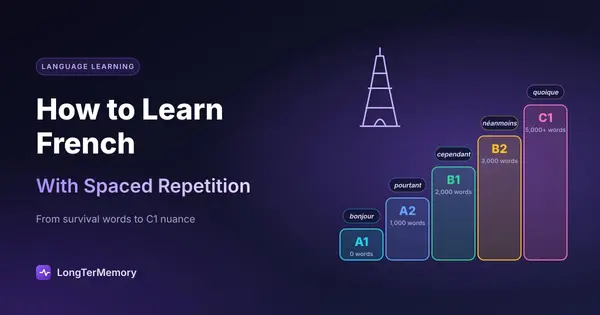
- A1 to A2: the survival core (words 1 to 1,000)
- B1 to B2: grammar patterns and connector words (words 1,000 to 3,000)
- C1: nuance, register, and the long tail (words 3,000 to 5,000+)
- Integrating French SRS with listening, speaking, and reading practice
- Recommended Anki decks and frequency lists for French language learning
- Conclusion
- FAQ
- How many French words do I need to know for fluency?
- How long does it take to learn French with spaced repetition?
- Should I make my own French flashcards or use premade Anki decks?
- Is Anki or LongTerMemory better for learning French?
If you’ve ever spent months grinding French vocabulary, then frozen mid-sentence because bruyant or cependant refused to come out of your mouth, you already know the problem. French is not hard because the words are weird. French is hard because there are thousands of words, dozens of verb forms, and a brain that forgets almost all of it unless you fight back on a schedule.
Spaced repetition (SRS) is that schedule. It is a flashcard system where an algorithm shows you each card right before you are about to forget it, stretching the interval from one day to three days to a week to a month as the memory gets stronger. For a language like French, where fluency is basically a giant pile of vocabulary plus automatic grammar patterns, nothing else comes close. In this post I will show you exactly how to build French decks by level (A1 to C1), how to combine SRS with listening, speaking, and reading, and which Anki decks and frequency lists are actually worth your time.
Why spaced repetition works so well for French
The short answer: French fluency requires thousands of items at instant recall, and SRS is the only method that keeps thousands of items alive in long-term memory with a manageable daily workload.
Here is the science in one paragraph. Hermann Ebbinghaus mapped the forgetting curve back in the 1880s: without review, you lose most new information within days, and the loss is exponential. A century later, Karpicke and Roediger’s famous 2008 study showed that retrieval practice (testing yourself instead of rereading) roughly doubled long-term retention in the same study time. And Dunlosky and colleagues, in their 2013 review of every major study technique, ranked practice testing and distributed practice as the two highest-utility methods, while rereading and highlighting (the stuff most French learners actually do) landed at the bottom.
French amplifies all of this. Consider what you are up against:
- Verb conjugation: even “regular” verbs have dozens of forms, and the subjunctive and passé composé vs imparfait distinction trips up learners for years.
- Gender: every noun is masculine or feminine, and you have to know it to get articles, adjectives, and agreement right.
- Vocabulary breadth: you need around 2,000 to 3,000 word families for comfortable conversation and 5,000+ for reading novels and watching films without subtitles.
That is a memory problem, not an intelligence problem. If you want the deeper dive into why the scheduling algorithm beats every alternative, I wrote a full breakdown in the science of spaced repetition. For the general approach to applying this to any language, check out spaced repetition for language learning.
Building French vocabulary and grammar decks for different proficiency levels (A1 to C1)
The core answer: match your deck content to your CEFR level, start with a frequency list (the top 1,000 words cover roughly 85% of spoken French, and the top 3,000 cover close to 95% of everyday text), and cap new cards at 10 to 20 per day so reviews never snowball.
The single biggest mistake I see French learners make is grabbing a random 10,000-card mega deck and drowning in it by week three. Your deck should grow with your level, not ahead of it. Here is the level-by-level breakdown I recommend.
A1 to A2: the survival core (words 1 to 1,000)
At beginner level, every card should pull triple duty. You are not just learning a word, you are learning its gender, its pronunciation, and a real sentence that uses it. A good A1 card looks like this:
- Front: How do you say “to rent / to hire”? (plus a hint sentence with a blank)
- Back: louer (with audio), example sentence: On va louer un appartement à Lyon.
A few rules for this stage:
- Always include gender on noun cards: not just chien but un chien (m.). If you skip gender now, you will be relearning 1,000 nouns later.
- Audio on every card: French spelling-to-sound rules are learnable but not obvious (looking at you, œufs), and early bad pronunciation habits fossilize fast.
- One idea per card: do not make a card that asks for a word, its plural, and three example sentences. Small cards get reviewed fast; bloated cards get dreaded.
Keep pace at 10 to 15 new cards a day. That sounds slow, but after a month you will know 300 to 450 words with 90%+ retention, and your daily review will still be under 20 minutes.
B1 to B2: grammar patterns and connector words (words 1,000 to 3,000)
This is where French starts to feel like a real language instead of a phrasebook, and where most learners plateau. The fix is to expand your decks in two directions at once: keep climbing the frequency list, and start a dedicated grammar pattern deck.
Grammar cards work best as production cloze deletions, not rules. Instead of a card that says “explain when to use the subjunctive,” make cards like:
-
Front: Il faut que tu ___ (venir) demain.
-
Back: viennes (il faut que + subjunctive)
-
Front: I was eating when she arrived. Translate: Je ___ (manger) quand elle est arrivée.
-
Back: mangeais (imparfait for the ongoing background action)
These sentence-level cards train the exact retrieval you need in conversation: not reciting a rule, but producing the right form under pressure. This is active recall applied to grammar, and the same principle drives everything I covered in my post on active recall techniques.
Also at B1, start mining your own cards. Every time you hit a word you do not know in a podcast, article, or Netflix show, that is a card. Self-mined vocabulary sticks dramatically better than list vocabulary because it arrives with context and emotional hooks already attached.
C1: nuance, register, and the long tail (words 3,000 to 5,000+)
At advanced level, frequency lists still matter, but the cards change shape. You are now learning:
- Register distinctions: boulot vs travail, bouquin vs livre, and when each is appropriate.
- Connectors and discourse markers: en revanche, toutefois, du coup, quoi qu’il en soit. These are the grease of fluent speech and they almost never appear in beginner decks.
- Idioms and fixed expressions: avoir le cœur sur la main, poser un lapin.
- The top 5,000 frequency band, especially nouns and verbs from domains you actually read (news, literature, your professional field).
For the frequency side, I strongly recommend working from Lexique, the open French lexical database built by New, Pallier, Brysbaert, and Ferrand (lexique.org). It is based on film subtitle and book corpora, so its frequency rankings reflect French as people actually speak and write it, not French as textbooks wish it were.
Integrating French SRS with listening, speaking, and reading practice
The core answer: SRS builds your recall foundation, but it only converts to fluency if you run it alongside real input and output every day. Think of flashcards as strength training and immersion as the actual sport. You need both.
Karpicke and Roediger’s work shows why cards alone are not enough: retrieval practice locks in what you test, and French fluency is also listening speed, accent, and reading stamina. So the smart move is a loop where every skill feeds the others:
- Input first: watch, listen, or read something in French at your level (innerFrench podcast for B1 learners, France Inter for C1, graded readers for A2).
- Mine the gaps: every word or structure that blocked your comprehension becomes a card that same day.
- Let SRS do its thing: the algorithm resurfaces those items at expanding intervals until they are automatic.
- Output weekly: speak or write using your recent cards. Language exchanges, journaling, or talking to yourself in the shower all count.
Here is what that looks like as a realistic daily routine for someone with 45 to 60 minutes:
| Time | Activity | What it trains |
|---|---|---|
| 20 min | SRS reviews + 10 new cards | Vocabulary and grammar recall |
| 20 min | Podcast or video with transcript | Listening comprehension |
| 10 min | Read 1 to 2 pages, mine unknown words | Reading + new card fodder |
| 10 min | Speak out loud or write 5 sentences using today’s cards | Production and fluency |
Two warnings from watching people get this wrong. First, do not let SRS eat your whole study budget. If your review pile creeps past 30 minutes, suspend low-value cards ruthlessly instead of skipping immersion. Second, never let a review day hit zero. The Ebbinghaus curve does not take weekends off; a skipped week can gut a third of your retention, and 20 minutes of daily maintenance is far cheaper than rebuilding.
Recommended Anki decks and frequency lists for French language learning
The core answer: start with a frequency-based shared deck matched to your level, prioritize decks with native audio and example sentences, and treat any deck as a starting template you customize rather than gospel.
Here are the options that consistently come out on top in the French learning community:
| Deck or list | Size | Best for |
|---|---|---|
| 5000 Most Common French Words (Anki shared) | 5,000 | A2 to C1, comprehensive base |
| Lexique frequency lists | Full corpus | Building your own ranked lists |
| Fluent Forever French pronunciation deck | ~1,000 cards | A1, sound-spelling foundations |
| French A1 to B1 CEFR decks (shared) | 800 to 2,000 each | Structured level progression |
| DELF/DALF exam decks | 500 to 1,500 | Certification-focused learners |
A quick evaluation checklist before you commit to any deck:
- Audio for every card? If not, move on or add text-to-speech yourself.
- Example sentences? Words learned in isolation are harder to retain and nearly impossible to use in conversation.
- Gender marked on all nouns? Non-negotiable for French.
- Reasonable card format? Front in French with audio, back with English plus a sentence, is the sweet spot for most learners.
If you are aiming at an official certification, the deck strategy changes: you want exam-targeted vocabulary, timed writing prompts, and listening drills on top of your SRS base. I mapped the whole DELF and DALF prep approach in how to study French for DELF or DALF certification, and it pairs well with everything in this post.
One more honest note on tooling. Anki is powerful, but building and maintaining French decks by hand (typing sentences, hunting audio, formatting gender markers, tagging levels) eats hours every week that could be going into actual French. That is exactly the bottleneck LongTerMemory was built to remove: you drop in a French PDF, a podcast transcript, or a web article, and it generates Q&A flashcards with automatic spaced repetition scheduling for you. The mining step that used to take 30 minutes takes two. If you want to see how the two approaches compare in detail, my Anki vs LongTerMemory comparison lays out the trade-offs, or you can just try LongTerMemory free and feel the difference on your next French article. For a general comparison of the tools, see the best spaced repetition apps.
Conclusion
Learning French with spaced repetition comes down to five moves: start with a frequency-based core deck matched to your CEFR level, always capture gender and audio, add grammar cloze cards once you hit B1, mine your own vocabulary from real French input, and never skip a review day. Do that for six months and you will have 2,000+ words at instant recall while the rereading-and-highlighting crowd is still relearning the word for “environment” for the fourth time. The algorithm handles the forgetting curve. Your only job is showing up daily.
FAQ
How many French words do I need to know for fluency?
Roughly 1,000 words covers about 85% of everyday spoken French, 2,000 to 3,000 gets you comfortable conversation, and the top 5,000 lets you read novels and watch films with minimal lookups. Depth of recall matters more than raw count, which is why SRS beats passive exposure for getting there.
How long does it take to learn French with spaced repetition?
The Foreign Service Institute estimates about 600 to 750 hours for English speakers to reach professional working proficiency in French. With a daily SRS-plus-immersion routine of 45 to 60 minutes, most motivated learners hit solid B1 conversational level in 8 to 12 months.
Should I make my own French flashcards or use premade Anki decks?
Use a premade frequency deck as your foundation, then layer in self-mined cards from your own listening and reading. Premade decks give you coverage; self-made cards give you stickiness, because every card arrives with a memory of where you found it.
Is Anki or LongTerMemory better for learning French?
Both run on the same scheduling science. Anki gives you total control at the cost of hours of manual card creation and formatting. LongTerMemory generates Q&A flashcards automatically from French PDFs, transcripts, and web pages, then schedules the reviews for you. Pick based on whether your scarce resource is customization or time.