How to Use Spaced Repetition for Surgery Board Review
Use spaced repetition for surgery board review: what to put on surgical flashcards, how to organize decks, and how to tie cards to cases for ABSITE and the QE.
Table of Contents
- Why Spaced Repetition Fits Surgical Board Prep
- The exams you're preparing for
- High-Yield Surgical Content for Flashcard-Based Board Preparation
- What belongs on cards
- What does not belong on cards
- Write cards that test decisions, not definitions
- Organizing Surgical Anatomy, Pathology and Management Decks
- A deck structure that scales from PGY-1 to the QE
- How much to review each day
- Use pre-made decks carefully
- Integrating Surgical Board SRS With Operative and Clinical Case Review
- The case-to-card loop
- The question-bank-to-card loop
- Preparing for the oral exam: different cards
- A Sample Week for a Busy Resident
- Common Mistakes With Surgical Flashcards
- Frequently Asked Questions
- Is spaced repetition useful for the ABSITE?
- How many surgical flashcards do I need?
- Should I use Anki or another app for surgery boards?
- When should I start preparing for the surgery Qualifying Exam?
- Build Your Surgical Deck in Minutes, Not Weekends
- The Bottom Line
To use spaced repetition for surgery board review, turn only high-yield, testable facts (management algorithms, thresholds, anatomy relationships and complications) into short question-and-answer cards, organize them in three decks (anatomy, pathology and management), review them daily in 20 to 40 minutes, and add a card every time a case or question exposes a gap. Spaced repetition handles retention; question banks and real cases handle application. You need both.
Surgical residents are in an odd position. You’re surrounded by surgery all day, yet the ABSITE still asks about the Ranson criteria you haven’t thought about since medical school, the hernia that bears a famous name, and the exact sodium correction rate you know you’ve seen somewhere. Clinical exposure is enormous but random. Board questions are not.
That’s the gap spaced repetition fills. It takes the scattered facts from reading, cases and question banks and makes them stick, with a review schedule that fits between a 5 a.m. pre-round and a late case.
Why Spaced Repetition Fits Surgical Board Prep
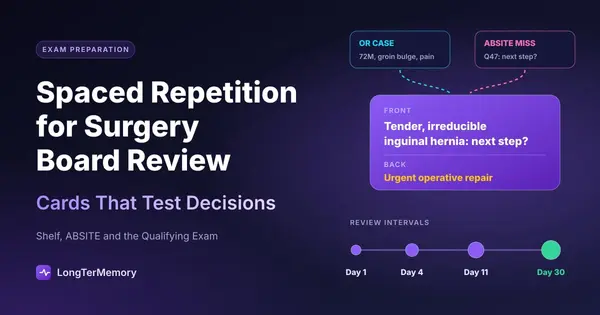
Spaced repetition works for surgery boards because the exams reward a large volume of discrete, testable facts, and residents have only short, unpredictable blocks of study time. Reviewing each fact at growing intervals (1 day, 4 days, 11 days, a month) beats rereading the same chapter twice, and it works in 15-minute pockets.
The research base is solid. A classic meta-analysis by Cepeda and colleagues (2006) pooled more than 300 experiments and found that spacing study sessions consistently improves long-term retention over massed study. In medical education specifically, Kerfoot and colleagues ran a series of randomized trials in the late 2000s showing that spaced email-based questions improved urology knowledge among residents and medical students, with gains that persisted for months.
The exams you’re preparing for
| Exam | Who takes it | Format (check the official site for current details) |
|---|---|---|
| NBME Surgery Shelf | Third-year medical students | 110 multiple-choice questions in 2 hours 45 minutes |
| ABSITE (In-Training Exam) | General surgery residents, every year | About 250 multiple-choice questions, taken each January |
| ABS Qualifying Exam (QE) | Graduating chief residents | About 300 multiple-choice questions, one day |
| ABS Certifying Exam (CE) | After passing the QE | Oral exam built on clinical scenarios |
All four test overlapping content. That’s good news: a well-built deck started during your shelf rotation or PGY-1 keeps paying off all the way to the QE. Cards for oral exam prep look different, more on that below.
High-Yield Surgical Content for Flashcard-Based Board Preparation
The best surgical flashcards target facts that are testable, stable and easy to forget: thresholds, classifications, next-step decisions, anatomy relationships and complications. Don’t card things you use every day on the wards; you’ll remember those anyway.
What belongs on cards
| Content type | Example card | Why it’s high-yield |
|---|---|---|
| Thresholds and numbers | ”AAA in a man: diameter threshold for elective repair?” (5.5 cm) | Boards love exact cutoffs |
| Classifications | ”Hinchey stages of diverticulitis?” | Classification usually drives management |
| Next step in management | ”Stable patient, blunt trauma, positive FAST: next step?” | Most questions are “what do you do next?” |
| Anatomy relationships | ”Nerve at risk in a lateral neck dissection near the posterior triangle?” (spinal accessory) | Complications questions depend on anatomy |
| Complications and timing | ”Fever on postoperative day 5 to 7: most likely source?” | Postoperative care is tested heavily |
| Eponyms | ”Courvoisier sign: what does it suggest?” | Short, easily confused, easily forgotten |
| Drugs and doses | ”Reversal agent for dabigatran?” | Perioperative pharmacology questions |
What does not belong on cards
- Long lists to memorize whole. Split “causes of postoperative fever” into several cards, one cause per card, or tie each cause to a timeframe.
- Things you can only understand, not recall. The physiology of shock needs reading and a diagram; the card should test a consequence (“Septic shock: SVR high or low?”).
- Rare trivia from a single question. If a question bank item tests something you’ll never see again, read the explanation and move on.
Write cards that test decisions, not definitions
The weakest surgical card is “What is a Whipple?” The strongest is “Pancreatic head adenocarcinoma, no vascular involvement, no metastases: operation?” Same fact, but the second version mirrors how the ABSITE and the QE ask it. As a rule, put the clinical trigger on the front and the decision on the back.
Keep each card to one fact. A good test: you should be able to answer it in under 10 seconds. If you need longer, split it. For more on writing tight cards, see our guide to using mnemonics to remember complex information and our medical terminology memorization strategies.
Organizing Surgical Anatomy, Pathology and Management Decks
Organize your cards in three parent decks (anatomy, pathology and management), with subdecks by organ system, and tag each card with its exam and source. This structure lets you focus on a weak system before a rotation without breaking the shared review schedule.
A deck structure that scales from PGY-1 to the QE
Surgery Boards
├── 1 Anatomy
│   ├── Head and neck
│   ├── Thorax
│   ├── Abdomen and hernias
│   └── Vascular
├── 2 Pathology
│   ├── Foregut and hepatobiliary
│   ├── Colorectal
│   ├── Endocrine and breast
│   └── Oncology
└── 3 Management
    ├── Trauma and critical care
    ├── Perioperative care
    └── Complications
Add tags like ABSITE, QE, oral and source-bank so you can filter later. A card about hyperkalemia in a trauma patient belongs to Management, tagged both trauma and critical-care.
How much to review each day
| Phase | New cards per day | Daily review time | When |
|---|---|---|---|
| Intern year, busy rotations | 10 to 15 | 15 to 25 minutes | Before rounds or between cases |
| 4 to 6 months before ABSITE | 20 to 30 | 30 to 40 minutes | Daily, including call days (lighter) |
| QE year | 20 to 40 | 40 to 60 minutes | Paired with a question bank block |
The number that matters most is consistency. Missing a day doubles tomorrow’s queue; missing a week makes people quit. On call, do the reviews and skip new cards. Our neurology board review guide and pediatrics board review guide use the same daily rhythm for other specialties.
Use pre-made decks carefully
Shared surgery decks can save time, but they come with someone else’s priorities and gaps, and sometimes with outdated guidelines. A reasonable approach: use a pre-made deck for anatomy (stable content), and build your own management cards from your review book and question bank, because management guidelines change and you want to own the reasoning.
Integrating Surgical Board SRS With Operative and Clinical Case Review
Spaced repetition works best for surgery boards when every card connects to something real: a case you scrubbed, a patient you admitted or a question you missed. Cases give meaning; cards give durability.
The case-to-card loop
After a case or a memorable admission, spend five minutes on this loop:
- Name the decision point. What did the attending decide, and why? (“Laparoscopic vs open for this perforated ulcer?”)
- Find the guideline or review-book page behind that decision.
- Write one or two cards with the clinical trigger on the front.
- Add the patient as context in a short note on the back (“Saw on 11/3, 72M, Graham patch”).
That personal context is a powerful memory cue. Months later, the card brings back the OR, and the OR brings back the reasoning. This is the same principle we covered in our article on studying surgical principles for medical licensing: anchoring facts to concrete situations.
The question-bank-to-card loop
Question banks are where you discover gaps. Use them like this:
- Do a timed block of 20 to 40 questions.
- For every miss or lucky guess, identify the single fact you didn’t know.
- Make one card for that fact, worded as a decision.
- Tag it
source-bankso you can see which systems keep producing misses.
After a month, filter your source-bank tag by system. If half your misses come from endocrine, that’s your next reading block. For a full method, see our guide on how to learn from practice test mistakes.
Preparing for the oral exam: different cards
The Certifying Exam tests how you talk through a case, not single facts. Cards still help, but they change shape:
- Front: “Postoperative day 2 after a colectomy, tachycardia, abdominal pain. Walk through your approach.”
- Back: a short ordered list (resuscitate, examine, labs, imaging, decision point, operative plan).
Review these cards out loud. Saying the sequence trains the fluency the examiners are looking for.
A Sample Week for a Busy Resident
A realistic week uses daily card reviews as the backbone and adds question blocks and reading where the schedule allows. Here’s an example for a PGY-2 four months before the ABSITE.
| Day | Cards | Question bank | Reading |
|---|---|---|---|
| Monday | 30 min reviews + 20 new | 20 questions, timed | None |
| Tuesday (call) | 15 min reviews only | None | None |
| Wednesday | 30 min reviews + 20 new | 30 questions | 30 min, weakest system |
| Thursday | 30 min reviews + 20 new | 20 questions | None |
| Friday | 30 min reviews + 20 new | 30 questions | 30 min |
| Saturday | 40 min reviews | 40-question mixed block | 1 hour |
| Sunday | 20 min reviews | Review the week’s misses | Plan next week |
That’s roughly 4 hours of cards and 160 questions a week. Over four months it adds up to about 2,000 new cards and more than 2,500 questions, enough to change an ABSITE percentile.
Common Mistakes With Surgical Flashcards
- Making too many cards in the first week, then drowning in reviews. Cap new cards and let the queue stabilize.
- Copying review book paragraphs onto cards. One fact per card, worded as a question.
- Never deleting cards. If a card is wrong, outdated or useless, suspend it.
- Using cards instead of questions. Cards build recall; only questions build the pattern recognition of a vignette.
- Stopping after the ABSITE. The same deck is your foundation for the QE. Keep reviews running, even at a low daily volume.
Frequently Asked Questions
Is spaced repetition useful for the ABSITE?
Yes. The ABSITE tests a broad base of facts every year, and spaced repetition is the most efficient way to keep that base active across residency. Combine it with a question bank for application practice.
How many surgical flashcards do I need?
Most residents end up with 1,500 to 4,000 cards over several years. Quality matters more than volume: a focused card on a decision point beats five cards copied from a textbook.
Should I use Anki or another app for surgery boards?
Anki is popular among residents because it’s free and flexible, but creating cards takes time. If you study mostly from PDFs and review books, an app that generates cards from your documents can save hours each week.
When should I start preparing for the surgery Qualifying Exam?
Many residents start dedicated QE prep 6 to 12 months before the exam, but a deck built from PGY-1 onward means you’re reviewing, not relearning, when that time comes.
Build Your Surgical Deck in Minutes, Not Weekends
The hardest part of using spaced repetition in residency isn’t reviewing. It’s finding the time to write the cards after a 14-hour day.
LongTerMemory handles that step. Upload a review book chapter, a guideline PDF or your rotation notes, and it generates question and answer cards automatically, then schedules them with spaced repetition so each fact returns right before you’d forget it. You spend your scarce free time reviewing and doing questions, not typing cards. Start with the free trial on your weakest system and see how much easier your next block of questions feels.
The Bottom Line
Surgery boards reward breadth, and residency gives you depth in random places. Spaced repetition connects the two. Card only high-yield, decision-focused facts, keep three clean decks, review a little every day, and feed the system from your cases and your question bank misses. Start early, keep it running through call months, and the ABSITE and the QE become a review of what you already know.