How to Study Dental Licensing Exams (INBDE)
Prepare for the INBDE with a clear plan: what the integrated exam tests, how to balance basic and clinical sciences, and a realistic study timeline.
Table of Contents
- INBDE Format and Content Areas: What the Integrated Exam Tests
- Foundation Knowledge and Clinical Content
- What integrated questions look like
- Clinical Sciences vs. Basic Sciences: Balancing Study for the Dental Boards
- A common trap
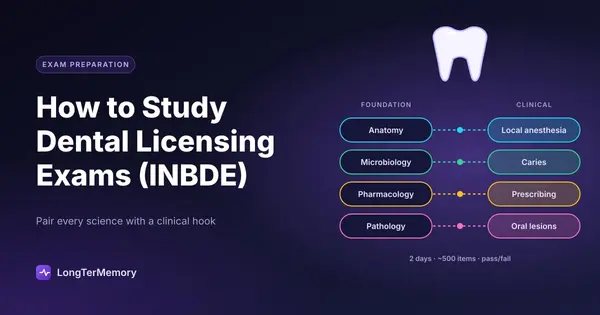
- Pair every science topic with a clinical hook
- Don't forget the "soft" areas
- Study Resources and Timeline for INBDE Preparation
- Resource categories to consider
- A sample 10-week plan
- Practice questions are the engine
- Using spaced repetition for the high-volume facts
- Weekly Routine for a Busy Dental Student
- Exam-Day Strategy and Stamina
- Common Mistakes to Avoid
- The Bottom Line
You’ve survived years of dental school, wet labs, and clinic requirements, and now there’s one more mountain: the Integrated National Board Dental Examination (INBDE). It’s the exam that decides whether you move on to licensure, and it looks very different from the old two-part boards your mentors took.
Here’s the short version. The INBDE is a single, integrated, case-based exam that tests whether you can apply basic science and clinical knowledge to real patient situations, not whether you can recite isolated facts. The best way to prepare is to learn the exam’s structure, study basic and clinical sciences together rather than in silos, and use a timeline built around practice questions and spaced repetition.
A quick note before we go on: exam details such as format, timing, fees, and scoring policies are set by the Joint Commission on National Dental Examinations (JCNDE) and the American Dental Association, and they get updated. Always confirm the current numbers in the official INBDE candidate guide before you build your schedule.
INBDE Format and Content Areas: What the Integrated Exam Tests
The core answer: the INBDE replaced the older NBDE Part I and Part II with one computer-based exam, introduced in 2020, that blends foundational science with clinical decision making. It’s scored pass/fail, so your goal is clearing the standard, not maximizing a number.
Here’s the general picture. Check the official guide for exact figures.
| Feature | What to know |
|---|---|
| Administrator | JCNDE (ADA), delivered at Prometric test centers |
| Format | Computer-based, multiple choice, with many questions built around patient cases |
| Length | A two-day exam with a large number of items (roughly 500 in total) |
| Scoring | Pass/fail |
| Eligibility | Dental students near graduation, graduates, and some internationally trained candidates |
| Replaces | NBDE Part I and Part II |
Foundation Knowledge and Clinical Content
The exam blueprint is organized around two big ideas:
- Foundation Knowledge (FK) areas, which cover the biomedical and dental sciences: anatomy, physiology, biochemistry, microbiology, pharmacology, pathology, and the scientific principles behind dental materials and techniques.
- Clinical Content (CC) areas, which cover what you do with patients: diagnosis, treatment planning, oral health management, patient assessment, and practice and professional issues.
On top of this, the exam is built around the idea of integration. A single case may start with a patient’s medical history (basic science), move to a radiograph and an exam finding (diagnosis), and end with a treatment decision that depends on pharmacology or materials science. That’s why memorizing a flashcard of drug side effects isn’t enough. You also need to know when it changes your treatment plan.
What integrated questions look like
Most items ask you to do something like this:
- Read a short patient scenario with history, findings, and sometimes an image.
- Identify the underlying problem (a diagnosis or a risk).
- Choose the best next step, which could be a test, a treatment, a medication adjustment, or a referral.
The skill being tested is clinical reasoning supported by science. If you can explain why an answer is right and why the others are wrong, you’re studying at the right level.
Clinical Sciences vs. Basic Sciences: Balancing Study for the Dental Boards
The core answer: don’t treat basic science and clinical science as two separate study tracks. Study them as pairs, so each fact is tied to a clinical consequence. Students who try to “finish basic sciences first, then do clinical” often discover that the exam interleaves the two on every page.
A common trap
Many candidates, especially those recently out of preclinical years, over-study the material they find most familiar. If you loved anatomy, you’ll gravitate toward anatomy. If you’re comfortable in clinic, you’ll do endless clinical case questions. Both feel productive. But the exam rewards balanced coverage across the blueprint.
Use a simple diagnostic. Take a practice exam or question bank block in week one and sort your results by blueprint area.
| Area | Score | Confidence | Study priority |
|---|---|---|---|
| Biomedical sciences | Example: 65% | Medium | High |
| Oral pathology and radiology | Example: 58% | Low | Highest |
| Operative and restorative | Example: 80% | High | Low |
| Pharmacology and anesthesia | Example: 62% | Low | High |
| Ethics and practice management | Example: 75% | Medium | Medium |
(Those numbers are only an example of how to lay out your own results.) Rank your weak spots and plan to hit the lowest areas first and most often.
Pair every science topic with a clinical hook
Here’s a technique that works well for integrated exams. For each basic science concept, add a “so what?” clinical question to your notes.
- Pharmacology: Instead of just memorizing a drug class, ask “What does this mean for a patient on anticoagulants who needs an extraction?”
- Microbiology: Don’t stop at the organism. Ask “Which infection pattern does it cause, and how does it change my antibiotic choice?”
- Anatomy: Don’t memorize nerves in isolation. Ask “Which nerve do I anesthetize, and what happens if I miss?”
- Materials science: Move beyond properties and ask “Why choose this material for this restoration in this patient?”
These “hook” questions can go straight into your flashcards. For more on how medical-style content pairs well with retrieval practice, read our guides on spaced repetition for medical pathology and immunology and microbiology.
Don’t forget the “soft” areas
Ethics, patient management, practice administration, and evidence-based dentistry can feel less urgent, but they’re a real part of the blueprint. They’re also some of the most efficient points to earn, since they depend on principles you can learn in a few focused sessions.
Study Resources and Timeline for INBDE Preparation
The core answer: plan on roughly 8 to 12 weeks of structured study for most candidates, built around question banks, a core review resource, and daily spaced repetition. Some students need less, and some need more. If you’re working or still in clinic, give yourself extra runway.
Resource categories to consider
Resource names and offerings change, so pick based on type and check current reviews.
| Resource type | Purpose | How to use it |
|---|---|---|
| Official candidate guide and sample questions | Know the blueprint and format | Read first, revisit every few weeks |
| Question banks | Practice integrated, case-based items | Do timed mixed blocks, review every explanation |
| Review books or video courses | Fill gaps in content | Use selectively, guided by your weak areas |
| Your own school notes | Familiar framing and mnemonics | Convert the best parts into flashcards |
| Flashcard system with spaced repetition | Retain facts long term | Review daily |
| Study group | Explain and quiz each other | Weekly, with a defined agenda |
A sample 10-week plan
| Weeks | Focus | Key activities |
|---|---|---|
| 1 | Baseline and planning | Read the official guide, take a diagnostic block, set a weekly schedule |
| 2 to 4 | Content pass on weakest areas | Targeted review, 40 to 60 practice questions per day, build flashcards from mistakes |
| 5 to 7 | Mixed integrated practice | Random timed blocks, case-based questions, cumulative review |
| 8 to 9 | Full-length practice | Simulated half-day and full-day sessions, stamina and pacing |
| 10 | Consolidation | Light review, flashcards, error log, rest |
If your timeline is shorter, use the same structure but shrink each phase. If you’re juggling clinic, our advice on creating a study plan as a beginner and backward-planning from your exam date can help you fit sessions around real life.
Practice questions are the engine
The most reliable finding in learning research is that testing yourself beats re-reading. In the well-known 2013 review by Dunlosky and colleagues, practice testing and distributed practice were rated among the most effective study techniques, while highlighting and re-reading ranked low. For the INBDE, that means your daily rhythm should look like this:
- Do questions first, in timed blocks.
- Review every explanation, including the ones you got right.
- Write down the “why” of each miss in an error log.
- Turn each miss into a flashcard and review it on a spaced schedule.
Using spaced repetition for the high-volume facts
Dental boards involve a lot of discrete facts: drug doses and interactions, tooth morphology details, classification systems, radiographic findings, and materials properties. These are perfect candidates for flashcards. The challenge is creating enough cards without eating hours you could spend on questions.
This is where LongTerMemory can save you serious time. You upload your lecture notes, review PDFs, or study guides, and it generates question-and-answer flashcards automatically, then schedules them with spaced repetition so cards reappear right before you’d forget them. You still need to skim the output for accuracy, especially for drug doses and clinical thresholds, but you skip most of the typing. You can try LongTerMemory for free with one chapter of your own notes. For the underlying science, see the science of spaced repetition.
Weekly Routine for a Busy Dental Student
Here’s a daily structure that works for many candidates, adjusted to your schedule.
- Morning (60 to 90 minutes): Flashcard reviews, then a block of 40 to 60 questions while your mind is fresh.
- Midday or afternoon (60 to 90 minutes): Review question explanations and fix gaps from a targeted resource.
- Evening (30 minutes): Light review of your error log, then stop.
- One day per week: A longer practice block or half-length simulation, plus a real rest day.
Consistency beats intensity. Ninety focused minutes every day will usually outperform one nine-hour weekend binge, partly because sleep consolidates memory and spacing improves retention. Our piece on sleep and memory consolidation explains why you should protect your nights.
Exam-Day Strategy and Stamina
A two-day, high-volume exam is partly a test of endurance. A few habits help:
- Practice long sessions. In the final weeks, do blocks that match the exam’s real length so your focus holds.
- Use a two-pass method. Answer what you know, flag what you don’t, and return with leftover time.
- Read the stem carefully. In case-based items, a detail like medication use, allergy, or age often points to the answer.
- Eliminate and decide. Cross out clearly wrong options, then choose the best remaining one rather than agonizing.
- Manage breaks. Eat something light, hydrate, and use scheduled breaks to reset.
Test-day nerves are normal. If they tend to spike, our guide on managing exam anxiety with CBT techniques offers practical tools.
Common Mistakes to Avoid
- Studying basic science as a separate project. Always connect it to patient care.
- Skipping the official guide. The blueprint tells you what is and isn’t tested.
- Doing questions without reviewing explanations. The learning happens in the review.
- Waiting too long to practice integrated cases. Start in week one, not week six.
- Passive review of notes. Close the book and retrieve instead.
- Neglecting sleep and health. A rested brain recalls more.
The Bottom Line
The INBDE rewards integrated clinical reasoning, so your preparation should be integrated too. Learn the exam’s structure from official sources, balance basic and clinical sciences by pairing every concept with a patient-care question, and follow a timeline of about 8 to 12 weeks built on question banks, error logs, and daily spaced repetition.
You’ve already done the hard part of becoming a dentist. Now give the exam a smart, steady plan, and let practice questions and well-spaced reviews turn your training into durable memory.