How to Remember Key Points from Books You've Read
Stop forgetting books a month after you finish them. Use post-reading recall, personal summaries, and quote capture to keep a book's core ideas for years.
Table of Contents
- Why You Forget Most of What You Read
- The Post-Reading Recall Method for Capturing a Book's Core Ideas
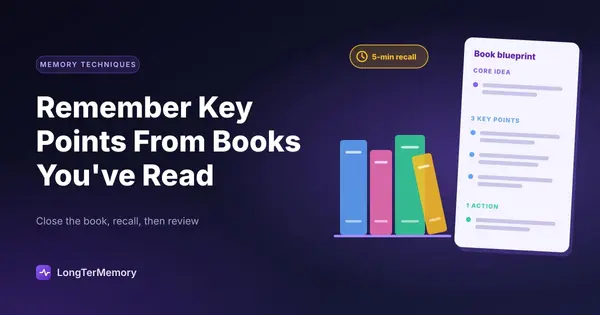
- The five-minute chapter recall
- The one-page book blueprint
- Use the "teach it" test
- Read with questions in mind
- Building a Personal Library of Book Summaries for Future Review
- Decide on a home
- Use a repeatable template
- Schedule reviews, not just storage
- Turn key ideas into flashcards
- Using Quote Capture and Annotation Tools to Retain Book Content
- Annotate with purpose
- The "one quote per chapter" rule
- Digital highlights and review tools
- Link ideas across books
- A Simple Weekly System
- Special Cases
- Textbooks and exam study
- Fiction
- Reading fast
- Common Mistakes
- The Bottom Line
You finish a great book, close the cover with a satisfied sigh, and tell a friend how much you loved it. Then they ask, “So what was the main idea?” and you hear yourself say, “Well… it was about… you know… a lot of things.”
If that sounds familiar, you’re in good company. Almost every reader forgets most of what they read. The good news is that this is a technique problem, not a memory problem, and it can be fixed.
Here’s the direct answer. To remember the key points of a book, you need to do three things: recall the core ideas right after you read, capture them in your own words in a searchable personal library, and revisit them on a spaced schedule. Reading alone doesn’t build memory. Retrieval and review do.
Why You Forget Most of What You Read
The core idea: forgetting is the default, and passive reading does almost nothing to stop it.
In the 1880s, Hermann Ebbinghaus mapped out the forgetting curve, showing that memory for newly learned material drops quickly in the first hours and days unless it’s reinforced. Modern studies have broadly confirmed the shape of that curve, though the exact speed depends on how meaningful the material is and how it was learned.
On top of that, reading creates a comfortable illusion. As you read, the words feel familiar, and familiarity feels like understanding. Psychologists call it the fluency illusion. In a well-known line of research, Karpicke and Roediger found that students who practiced retrieving information remembered far more a week later than those who simply re-read it. A major 2013 review by Dunlosky and colleagues likewise ranked practice testing and distributed practice as high-utility techniques and put highlighting and re-reading near the bottom.
Translation: the yellow highlighter on your favorite chapters is mostly decoration.
| Habit | Feels like | Actually does |
|---|---|---|
| Highlighting | Learning | Marks text, little memory effect |
| Re-reading | Reinforcing | Builds familiarity, not recall |
| Closing the book and recalling | Hard work | Strengthens memory |
| Reviewing summaries on a schedule | Light | Fights the forgetting curve |
If you want to go deeper on why this happens, see why re-reading doesn’t work and our broader guide on how to remember what you read.
The Post-Reading Recall Method for Capturing a Book’s Core Ideas
The core idea: right after each reading session and right after finishing the book, close it and write down what you remember, before you look anything up. This simple act is the single highest-impact habit you can add.
The five-minute chapter recall
After each chapter (or each reading session), do this:
- Close the book. No peeking.
- Set a timer for five minutes.
- Write or speak the main points you can remember, in your own words.
- Open the book and compare. Add anything you missed in a different color.
- Rate yourself from 1 to 5 on how much you recalled.
The gaps you find are not failures. They’re the exact spots where your memory needed a boost, and the struggle to recall is what strengthens the memory trace. Cognitive scientists call this a desirable difficulty.
The one-page book blueprint
When you finish the entire book, create a single page that answers these questions. Write quickly, from memory first.
| Prompt | Your answer |
|---|---|
| What’s the book’s central thesis in one sentence? | |
| What are the 3 to 5 key ideas that support it? | |
| What’s one story or example for each idea? | |
| What do I disagree with or question? | |
| What will I do differently because of this book? |
That last question matters. Connecting a book to a concrete action or decision makes it meaningful, and meaningful information is far easier to remember. It also turns your reading into results, whether the book is nonfiction for work or a textbook for a course.
Use the “teach it” test
Try explaining the book to a friend, a colleague, or an imaginary beginner in two minutes. If you stumble, you’ve found where your understanding is thin. The Feynman technique works beautifully here: explain it in plain language, find the gaps, then go back to the text. You can read more in our guide to active recall techniques.
Read with questions in mind
Before you start a chapter, skim the headings and write two or three questions you expect it to answer. This approach, similar to the SQ3R method, primes your brain to look for answers and gives you built-in recall prompts afterward. See our guide on the SQ3R method for dense textbooks.
Building a Personal Library of Book Summaries for Future Review
The core idea: a book you can’t search or revisit is a book you will forget. Build a simple personal library where every book gets a short summary in your own words.
Decide on a home
Choose one place and stick with it. Any of these work:
| Tool type | Good for | Watch out for |
|---|---|---|
| Notes app (Notion, Obsidian, Apple Notes, etc.) | Searchable, linkable summaries | Can become a dumping ground without a template |
| Spreadsheet | Simple tracking and tagging | Less pleasant for long text |
| Paper notebook | Focus and handwriting benefits | Not searchable |
| Flashcard system | Long-term retention of specific ideas | Needs good question writing |
The best tool is the one you will actually use. For more options, see our comparison of Apple Notes vs Evernote for studying and our guide to effective summary notes.
Use a repeatable template
A consistent format makes reviewing easy. Here’s a template for each book entry:
- Title, author, date finished
- One-sentence thesis
- 3 to 5 key ideas (one or two sentences each, in your own words)
- Best quote or two, with page numbers
- My reaction: agree, disagree, questions
- Action items: what I’ll try or change
- Tags: for example, “habits,” “leadership,” “biology”
Keep it to about a page. Summaries that are too long won’t get reviewed. If you want to practice compressing information, our guide on compressing notes into a one-page summary can help.
Schedule reviews, not just storage
Writing the summary is step one. Reviewing it is what makes it stick. Use spaced intervals:
- Same day: write the blueprint.
- 1 to 2 days later: reread it and try to recall the key ideas first.
- About 1 week later: quick review.
- About 1 month later: another review.
- A few months later: one more.
This spacing is the same principle behind spaced repetition software. You can read more in the science of spaced repetition.
Turn key ideas into flashcards
For ideas you really want to keep, such as frameworks, definitions, models, and facts, convert them into question-and-answer cards. Examples:
- “What are the four stages of the model described in chapter 3?”
- “What’s the author’s argument against X?”
- “What example did the author use to illustrate Y?”
If writing cards by hand feels like a chore, LongTerMemory can speed it up. You can upload a PDF or notes from your book, and it generates Q&A flashcards automatically and schedules them with spaced repetition so the ideas come back right before you’d forget them. Review the cards afterward to make sure they match what you consider truly important. You can try LongTerMemory for free.
Using Quote Capture and Annotation Tools to Retain Book Content
The core idea: annotating and capturing quotes turns reading into an active process, as long as you capture selectively and then actually revisit what you’ve captured.
Annotate with purpose
Mindless highlighting is the problem. Purposeful annotation looks different:
- Write short margin notes in your own words: “Same as the idea in chapter 2,” “Counterexample: remote teams.”
- Mark only the key sentence, not whole paragraphs.
- Use symbols: a star for key idea, a question mark for confusion, an exclamation mark for surprise, an arrow for “connects to something I know.”
- Use sticky tabs or page flags for the 5 to 10 pages you’ll want to revisit.
Our guide on annotating textbooks for better memory retention goes into more detail.
The “one quote per chapter” rule
You don’t need to capture everything. Pick one best quote or passage per chapter, the one that most clearly captures the idea, and copy it into your library with a short note on why it matters. This limit forces you to decide what’s important, which is itself a form of processing.
Digital highlights and review tools
If you read on an e-reader or use digital books, highlights can flow into other apps. Review tools like Readwise send your saved highlights back to you on a schedule, which turns passive highlights into spaced review. Features and pricing change, so check each tool’s current offering. We cover one approach in using Readwise to review highlights for study.
A caution: highlights are only useful if you review them. A thousand saved highlights you never reopen are just a digital pile of unread text. Delete low-value ones and keep the best.
Link ideas across books
As your library grows, connect related ideas. If two books discuss habit formation, add a note in each entry linking to the other. These links build a network of knowledge, which is easier to remember than isolated facts. Over time, you’ll notice patterns and develop your own views.
A Simple Weekly System
Here’s a lightweight routine you can start with this week:
| When | What | Time |
|---|---|---|
| After each reading session | Five-minute closed-book recall | 5 minutes |
| After finishing a book | One-page blueprint and quotes | 20 to 30 minutes |
| Next day | Quick recall check | 5 minutes |
| Weekly | Review 2 to 3 older book entries | 10 to 15 minutes |
| Monthly | Review flashcards and prune your library | 20 minutes |
That’s about 30 to 45 minutes a week. In return, you’ll keep a large share of what you read, and you’ll have a personal knowledge base that grows over time.
Special Cases
Textbooks and exam study
For course material, add practice questions and past papers. Combine the recall method with the strategies in our guides on remembering what you read for exams and memorizing a textbook chapter.
Fiction
For novels, focus on plot structure, character motivations, and themes. A short recall after each reading session, plus a few lines on “what I felt and why,” is enough for most readers.
Reading fast
If you read quickly, your retention may drop unless you add recall. See reading faster while remembering more for how to balance speed with retention.
Common Mistakes
- Reading more books instead of processing the ones you read. Quality of processing beats quantity.
- Highlighting heavily and never going back. Use fewer highlights and review them.
- Copying passages word for word. Rephrase in your own words whenever possible.
- Skipping the recall step because it feels hard. The difficulty is the point.
- Building an over-complicated system. Start simple and refine it.
- Never reviewing. A summary you don’t revisit is just a nice archive.
The Bottom Line
Remembering a book isn’t about having a better brain. It’s about giving the book a second and third chance to stick. Recall the key ideas right after reading, write a short summary in your own words, build a personal library you can search, and review it on a spaced schedule. Add selective quote capture and a few well-written flashcards for the ideas you truly want to keep.
Try it with the next book you finish. Close the cover, set a five-minute timer, and write down everything you remember. You’ll be surprised how much you hold onto, and even more surprised how much that small habit changes the way you read.