How to Study When You're Overwhelmed by the Volume of Material
Too much to study and too little time? Use triage, prioritization frameworks, and a sustainable plan to focus on what matters and stop the overwhelm.
Table of Contents
- Why Trying to Cover Everything Leads to Covering Nothing Well
- Working memory has hard limits
- Stress narrows your thinking
- Passive coverage feels productive but isn't
- Prioritization Frameworks for Narrowing Your Study Focus
- 1. The weight-times-weakness grid
- 2. The Pareto approach (80/20)
- 3. The Eisenhower-style sort
- 4. The MoSCoW triage
- Gather the real data first
- Build a Psychologically Sustainable Study Plan When You're Behind
- Step 1: Count your real hours
- Step 2: Chunk it small
- Step 3: Use techniques with the best return on time
- Step 4: Compress the content with flashcards
- Step 5: Protect the basics
- Step 6: Build in a buffer
- A Sample 7-Day Triage Plan
- Handle the Emotional Side of Overwhelm
- Common Mistakes When You're Overloaded
- The Bottom Line
You open the syllabus, and your stomach drops. Twelve chapters. Four hundred slides. A stack of readings you haven’t touched, and an exam that’s closer than it should be. You sit there, unsure where to begin, and so you end up doing nothing, or doing something comfortable like reorganizing your notes for the third time.
If that’s you right now, here is the most important thing I can tell you. Feeling overwhelmed by the volume of material is not a sign that you’re bad at studying. It’s a sign you’re facing a triage problem, not an effort problem. The solution is to stop trying to cover everything, decide what matters most, and build a plan you can actually stick to.
Let’s walk through how.
Why Trying to Cover Everything Leads to Covering Nothing Well
The core idea: when you spread your time evenly across all the material, you end up with shallow, short-lived knowledge of all of it, which is the worst possible result for most exams.
There are a few things going on in your brain when you’re overloaded.
Working memory has hard limits
Cognitive load research, associated with John Sweller and others, shows that working memory can hold only a few pieces of new information at a time. When you try to absorb too much, too fast, you hit overload and new information doesn’t get encoded properly. It feels like studying, but little of it sticks.
Stress narrows your thinking
When panic kicks in, your brain shifts toward threat response. That makes it harder to plan, prioritize, and think clearly. It also fuels avoidance: the bigger the pile feels, the more tempting it is to scroll your phone instead.
Passive coverage feels productive but isn’t
Skimming every chapter once creates the illusion of competence. You recognize the words, so you assume you know them. But recognition is not recall. A large 2013 review by Dunlosky and colleagues found that re-reading and highlighting were among the least effective techniques, while practice testing and spaced practice were among the best. Covering ten chapters passively is far worse than mastering six chapters actively.
Here’s the trade-off in plain terms:
| Approach | What you get |
|---|---|
| Skim everything once | Familiarity with all topics, ability to recall almost none under pressure |
| Master the highest-value 60 to 70% | Reliable recall on the most tested material |
| Master the highest-value 60 to 70% plus a light pass on the rest | Strong core plus partial credit and recognition on the leftovers |
The last row is usually the winner. Depth on priorities, plus breadth where time permits.
Prioritization Frameworks for Narrowing Your Study Focus
The core idea: use a simple, explicit framework to decide what to study first, instead of relying on how each topic makes you feel. Feelings are a terrible guide. You’ll avoid the scary topics and overstudy the comfortable ones.
Here are four frameworks that work well. Pick one and apply it today.
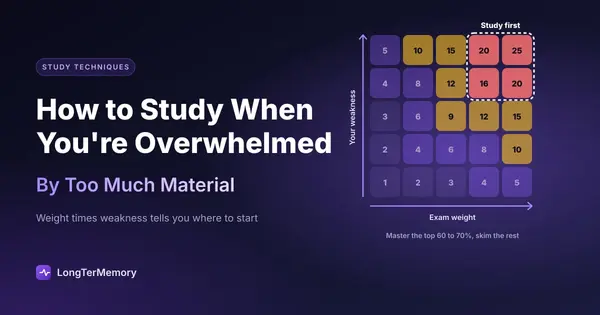
1. The weight-times-weakness grid
For each topic, score two things from 1 to 5: how much it counts toward your grade or exam, and how weak you currently are. Multiply the two.
| Topic | Weight (1-5) | Weakness (1-5) | Priority |
|---|---|---|---|
| Topic A | 5 | 4 | 20 |
| Topic B | 4 | 2 | 8 |
| Topic C | 2 | 5 | 10 |
| Topic D | 1 | 1 | 1 |
Start with the highest scores. Topic D, low weight and already known, barely needs attention. Topic A is where your time pays off the most.
Where do you find weights? Use the exam blueprint, the syllabus, the professor’s emphasis, past papers, or the number of lecture hours spent on each topic. If you can’t find any of those, ask your instructor or a student who took the class.
2. The Pareto approach (80/20)
The Pareto principle suggests that a small share of inputs produces a large share of results. In studying, a limited number of topics often generate most of the exam points. The exact ratio varies, but the lesson holds: find the vital few. Scan past exams and flag the topics that appear again and again. Those are your vital few.
3. The Eisenhower-style sort
Sort your study tasks into four boxes:
| Urgent | Not urgent | |
|---|---|---|
| Important | Do first: exam-weighted topics due soon | Schedule: deeper review, practice tests |
| Not important | Quick wins only: small tasks that are cheap | Drop: perfect notes, decorating, extra readings |
This helps you spot the busywork that’s disguising itself as studying.
4. The MoSCoW triage
Label every topic as Must, Should, Could, or Won’t (for now).
- Must: high weight, will definitely be tested. Master these.
- Should: likely tested or moderately weighted. Study after the musts.
- Could: low weight or lower odds. Light review only if time remains.
- Won’t: very unlikely to be tested. Consciously skip.
The “Won’t” box is where the relief lives. Giving yourself permission to skip things is not laziness. It’s strategy. Doctors in emergency rooms do triage because they can’t save everyone first, and a smart student does the same with time.
Gather the real data first
Before you apply any framework, spend 30 to 45 minutes collecting evidence:
- Find the exam format and blueprint (topics, weighting, question types).
- Grab past exams or sample questions.
- Note what your instructor emphasized in class.
- List every topic in a single document, so the whole picture is on one page.
Seeing the whole mountain on one page, even if it’s big, is calming. The unknown feels bigger than the known.
Build a Psychologically Sustainable Study Plan When You’re Behind
The core idea: a plan that you actually follow beats a perfect plan that collapses on day three. When you’re behind, the temptation is to schedule 12-hour days. That never survives contact with reality.
Step 1: Count your real hours
Work backward from the exam date. Subtract classes, work, meals, sleep, and commitments, and see how many truly free study hours remain.
| Item | Example |
|---|---|
| Days until exam | 14 |
| Realistic study hours per day | 3 |
| Total study hours | 42 |
| Hours reserved for final review and mock tests | 8 |
| Hours for new learning and practice | 34 |
Now you know your actual budget. Allocate the 34 hours across your Must and Should topics in proportion to their priority scores. Our guide on backward-planning from your exam date walks through this step in more detail.
Step 2: Chunk it small
A task like “study chapter 7” is vague and scary. Break it into pieces you can finish in 25 to 45 minutes:
- Skim the headings and write three questions you expect to be asked.
- Read the first half and answer your questions from memory.
- Do 10 practice problems or write 10 flashcards.
- Teach the concept out loud to an imaginary student.
Small, concrete tasks reduce the activation energy of getting started. For more on this, read procrastination and study momentum.
Step 3: Use techniques with the best return on time
When time is tight, efficiency matters. Favor:
- Active recall: close the book and retrieve. See active recall techniques.
- Spaced repetition: revisit key facts over several days instead of one marathon session. See the science of spaced repetition.
- Past paper practice: it shows what’s tested and trains retrieval at the same time.
- Interleaving: mix topics in one session, which improves your ability to pick the right approach. See interleaved practice.
If you’re really pressed, our guides on exam preparation in two weeks and cramming effectively without burning out are made for this situation.
Step 4: Compress the content with flashcards
Large volumes of text become manageable when you convert them into questions. The catch is the time it takes to write them. A tool like LongTerMemory can help here: upload your lecture slides, PDFs or notes, and it generates question-and-answer flashcards automatically, then schedules them with spaced repetition so cards return at the right moments. That means you spend your scarce hours on reviewing rather than typing. You still want to remove low-value cards so they match your priority list. You can try LongTerMemory for free.
Step 5: Protect the basics
Overwhelm makes people sacrifice sleep, food, and movement. That backfires. Memory consolidation happens during sleep, and exhaustion makes everything take longer. Read why in sleep and memory consolidation.
A minimum viable routine looks like this:
- 7 hours of sleep most nights.
- Real meals and water.
- A short walk or stretch between sessions.
- One proper break each week.
Step 6: Build in a buffer
Things go wrong: you get sick, a shift changes, a family issue pops up. Plan only 80 to 85% of your available hours, and leave the rest as a buffer. When something slips, you’ll adapt instead of giving up.
A Sample 7-Day Triage Plan
Say you have one week and an enormous syllabus. Here’s what a triage week could look like:
| Day | Focus | Output |
|---|---|---|
| 1 | Gather information, build the topic list, score priorities | One-page priority map |
| 2 | Must topics, part 1 | Notes turned into questions, 20 practice items |
| 3 | Must topics, part 2 | Flashcards plus practice items |
| 4 | Should topics | Targeted active recall and practice |
| 5 | Mixed practice test | Timed paper, error log |
| 6 | Fix weak spots, light pass on Could topics | Updated flashcards |
| 7 | Final review, rest, sleep | Flashcard reviews and calm preparation |
Adjust this for your own timeline. The principle stays the same: map, prioritize, practice, review, rest.
Handle the Emotional Side of Overwhelm
Strategy matters, but so does the feeling in your chest. A few habits help:
- Write everything down. A brain dump of every task relieves the mental weight of juggling it.
- Do a 5-minute start. Commit to just five minutes. Starting is the hardest step, and momentum often carries you.
- Track small wins. Check off completed sessions so you can see progress.
- Talk to someone. Classmates, instructors, or advisors may have tips or extensions available.
- Reframe the goal. You don’t need perfection. You need to pass, or reach a target score. Define it clearly.
If anxiety gets heavy, see our guides on managing exam stress and exam anxiety with CBT techniques. And if the overwhelm feels persistent or beyond ordinary stress, consider reaching out to your school’s counseling or support services.
Common Mistakes When You’re Overloaded
- Starting at chapter one by default. The first chapter isn’t automatically the most important.
- Re-reading instead of testing. It feels safe, but it’s inefficient.
- Making beautiful notes. Pretty notes aren’t the same as remembered notes.
- Switching plans every day. Choose a plan and give it a fair trial.
- Studying only what you enjoy. Your weakest high-weight topics deserve the most attention.
- All-nighters. They erode memory and next-day performance.
The Bottom Line
When there’s too much to study, the solution isn’t to work harder on everything. It’s to choose. Gather real information about what’s tested, rank topics with a simple framework like weight-times-weakness or MoSCoW, plan around the hours you truly have, and use the techniques that give the best return: active recall, spaced repetition, and practice papers.
You can’t learn everything, but you can learn the right things well. Open a blank page, list your topics, and score the first five. Ten minutes from now, the mountain will look like a map.